A few days ago, if someone had told us that there is a nation called Cape Verde playing in the 2026 FIFA World Cup, none of us would have believed it. In fact we would have to look up at the map to figure out where this country is and what we found would have surprised us. It is a country of around half a million people, virtually unknown, yet soccer is played there with a passion like no other. That truly is the scope and reach of soccer as a sport. If you can call any game truly international, soccer has to be in the top three spots, if not the first. The same cannot be said of cricket or American football or some of the other team sports, That is why the FIFA World Cup, which occurs once every four years, is such a global event like the Olympics. Whoever holds that beautiful golden cup aloft in mid-July is richly deserving of that cup because you have to be really the best, the most tenacious along with a liberal dose of chance and luck in your favor to win it.
Writing about any sport is never easy. You can write about dance. You can write about music. You can write about literature. But writing about sports requires the art of capturing raw physicality of the body and its trained instincts. That is why you have very few great sport writers in history. Soccer makes it even more difficult to write about. There is so much happening on the field, almost chaotic to a untrained eye, but to the connoisseurs to the game - there are billions of them across the globe - there is great beauty and plan in each kick, nudge and goal. It is a sport where every goal becomes a moment for a lifelong celebration, an inner explosion of joy that leaves us elated and drained at the same time, a thing of beauty, something extraordinary that defies logic. It is a game filled with unbridled joy, deep loss, and unspeakable ecstasy all rolled into one and erupting and pulsating in one voice within the stadium and couches across the globe. In no other sport does scoring a goal bring about so much catharsis, so much joy, so much anger and disappointment as it does in soccer, and for the very reason, unless a writer can let go of literary posturing and join the flow of the game, it is impossible to capture the essence of soccer.
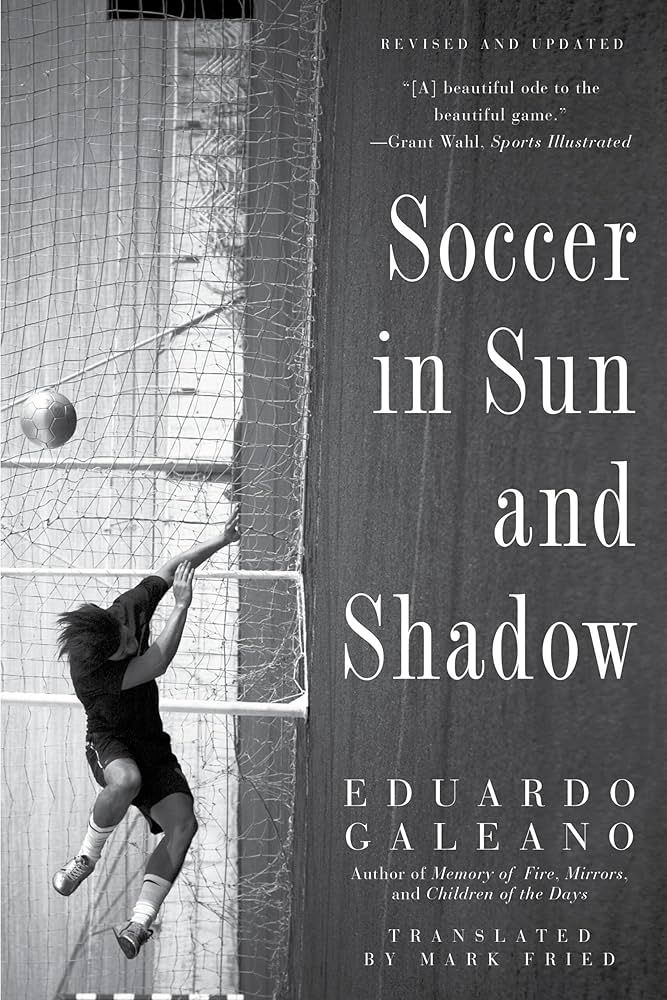
As FIFA 2026 got underway, I pulled out my copy of Eduardo Galeano’s “Soccer in Sun and Shadow“. Galeano (1940–2015) was a Uruguayan journalist, essayist, and novelist who became one of the most influential literary voices of the Latin American left. Primarily a novelist, but Guiliano had a lifelong passion for the game. In fact one of his childhood ambitions was to become a soccer player, which he couldn't. That is why he turned into a fan, a writer about the game. What a treat for us when a literary man with a great capacity to craft beautiful sentences gets to write about this mysterious game with a ball. Reading Galeano’s is like reading someone intoxicated with the game and writes from the state of intoxication, fully charged, with each sentence bristling with imagery, metaphors and superlatives.
The book covers a lot of ground from the early origins of the sport till the present, written as short nuggets. Scattered across the pages are soccer tales spanning countries, decades, players, goals, grudges, superstitions, and jokes, yet, somehow in and through this fascinating collection of facts and tales, Galeano’s manages to weave a beautiful tapestry of the game of soccer and write about players who made the game look so magical. If you love soccer, then you must read Soccer in Sun and shadow. To me, this is how a book of sports should be written. Each sentence lyrically beautiful and each slice of history so loving described.
In the first few pages, Galeano talks about Friedenreich, a Brazilian player, I never knew - a player so great that there is claim among soccer aficionados that he was better than Pelé. Unfortunately, he played during the era before television. Uruguay, not surprisingly, occupies a special place in Galeano’s history. The country won in 1924 and again in 1928, and those victories helped announce South American soccer to the world. In 1924, Uruguay’s style dazzled Europe. José Leandro Andrade, Black, South American, and poor, became one of the first international idols of the game. An archetye that continues to repeat itself in the world of soccer.
The thing I like about Galeano’s way of seeing soccer is that he anchors his history of the game on players tracing their rise and fall from streets, ports and poor neighborhoods all over the world. Through his lens soccer quintessentially still remains a common man’s game and how players from the South America invented the game in all its artistry. For instance, he writes lovingly about Ramón Unzaga from Chile as the inventor of the bicycle kick, that backward shot made with a sudden scissor-like snap of the legs. Later David Arellano performed it in Spanish stadiums and helped carry the move into legend. The bicycle kick is beautiful because it looks impossible. It is athletic, yes, but also theatrical. It is a player briefly refusing to obey gravity. That is how Galeano describes the move.
Soccer is often full of moments when the game seem to belong to arts rather than sports. There are passes that roll over defenses, back-and-forth exchanges that make the ball travel like a secret between players, there are goals from positions that sounds spatially impossible to score, yet players manage to thread the needle. For instance, there is the Argentinian Nolo Ferreira’s 1929 goal that “penetrated the wall.” Then there is Zizinho’s strange and wonderful “double goal” in 1950. The referee disallowed the first version, so Zizinho simply repeated it, step by step, entering the box from the same spot, dribbling past the same defender with the same delicacy, slipping left, and driving the ball into the net at the same angle to the same spot in the net. This time, the referee had no choice. When a genuine goal scored the first time had been erased by the referee, Zizinho wrote it again exactly the same way. I was so fascinated when I read this nugget and imagined the scene in my mind.
Galeano is equally adept as showcasing ridiculous in the best possible way. In the 1938 World Cup, Meazza was about to take a kick when his shorts dropped. The crowd was stunned, but he did not stop. He held his shorts with one hand and scored with the other - the kind of confidence only a great player can possess. The episode may look comical, but it also speaks to the madness of the game which has always made room for embarrassments, improvisations, and geniuses in the same breath.
Galeano describes some players almost like creatures from another world. Brazilian Leônidas da Silva’s goals were so pretty, he writes, that even goalkeepers supposedly got up to congratulate him. He had the dimensions, speed, and cunning of a mosquito. That is such a Galeano kind of image: funny, precise, and affectionate. A mosquito, we all know, is annoying, quick, impossible to catch, and always where you do not want it to be. What better animal for a forward player? I let the book hang in the fingers for a few minutes to allow this metaphor to sink in. I dont think there is a better way to describe a forward in soccer than this. If there is, I would like to know.
Soccer fans don’t forget that easily. Galeano’s writes about the 1950 World Cup when Brazil lost to Uruguay, one of the poignant defeats and wounds in soccer memory. Barbosa, one of the finest Brazilian goalkeepers, was blamed for the goal that allowed the Uruguayan attacker Ghiggia to score. That moment when Barbosa allowed the ball to slip through his fingers swallowed his entire career. Forty years later, Barbosa was still being treated as guilty for that lapse. That is one of the darkest sides of fandom in sports. Defeats are remembered with the accuracy often denied to victories.
But Brazil responded to that wound by changing its image. In the 1954 World Cup in Switzerland, Brazil unveiled the now famous yellow shirt with the green collar, replacing the white uniform associated with the bad luck of 1950 world cup. The new color of their shirts became a symbol of rebirth. By 1958, they had Pelé. He emerged as a player with prodigious genius in the sixth world cup at Sweden; a legend was born. This was also the first FIFA cup to be televised, even though the live broadcast was limited. Pelé’s consecration into soccer consciousness and visual spectacle began with images transmitted over satellite. From then on, greatness would no longer depend only on stories told and myths remembered. It could be replayed, sold, remembered, and worshipped on screen. The era of commercial soccer had began.
But for me, the greatest image of Brazilian soccer in the book is still the1970 world cup final goal against Italy. The ball traveled through all of Brazil, meaning all eleven players in the team touched it. Finally Pelé, without even looking, fedtly laid the ball out for Carlos Alberto, who came in like a tornado and finished the move. It is hard to conceive of a better argument for soccer as collective art. The goal was not just the final kick. It was the whole journey: movement, patience, rhythm, trust, and then the kill. That Brazilian team played a kind of soccer that feels almost lost now. Today many teams have become so defensive that a goal can feel nearly impossible. Games can go 120 minutes without a single goal and then end in penalties. By contrast, Brazil in 1970 played with four strikers: Jairzinho, Tostão, Pelé, and Rivellino, while Gérson and Carlos Alberto could also come forward from the back. That sounds like a team committed not merely to winning but to abundance of goals. They did not treat attack as a risk to be minimized. They treated it as the point of the game. Modern soccer may have lost that spirit, but still watching Messi and few others, I feel, all is not lost. The game has a way of sprouting geniuses who keep the flame alive.
Galeano also writes about the irrational side of soccer. That the sport is full of superstitions. Carlos Bilardo, coach of Argentina in the World Cups of 1986 and 1990, did not want his players to eat chicken; he believed it brought bad luck, while beef was somehow better. Silvio Berlusconi, owner of Milan, believed that singing the national anthem brought bad luck and created his own. These details are funny to read, but they also reveal something serious. A lot is at stake in soccer, and players and team live under unbearable uncertainty. After a period of intense play and the team is close to scoring a goal the ball could hit the post and could miss it by a fraction of an inch, or hit the post and miraculously slide in. Or a referee sees something, or does not (like what happened to Maradona’s famous Hand of God goal in 1986). Or a goalkeeper guesses right, or wrong. Under that kind of ambiguity and pressure, superstition becomes acceptable and it is ok to pretend that chaos has rules that will bend to your rituals. All of us have superstitions and rituals we follow before any undertaking. In soccer, such acts are elevated to a whole new level because the damn outcome is so consequential.
Albert Camus, understood this pressure and chaos really well. Before he became the famous and influential French existential philosopher and author of “Rebel” and “The plague”, he was a goalkeeper for his university team in Algiers. Camus’s position on lthe purpose of life to find meaning within uncertainty may have had roots in his goal-keeping days. A goal keeper learns quickly that the ball never arrives where you expect it to. Though he has less to do with the ball than the rest of the team, what he does or does not do defines the outcome of the game. His last minute adjustments, the stillness in the midst of moving bodies and the swirling ball could mean the difference between saving a goal and granting it. Camus also said, “Everything I know about manners I owe to soccer.” Coming from a goalkeeper, that makes sense. A goalkeeper must learn to live with solitude, blame, sudden danger, and the need to stand up again. Camus’s life is a testament to this attitude.
Soccer is anchored in the current of history adjusting to the time like flotsam and jetsam in a river. I was surprised to learn, and I am sure not many know that the United States played in the 1930 tournament in Uruguay ( by no stretch is the USA new to the game as many of the friends in the US assume), and in 1950 the U.S. defeated Britain with a goal by Larry Gaetjens, a black center-forward from Haiti. That’s interesting, isn't it? Germany did not play that year because of the war, and the British entered the world cup tournament for the first time only to suffer that shock defeat. Soccer began, like many other sports, in Britain. Soccer history is full of reversals; it humiliates certainty. The politically and economically powerful are not always powerful once the whistle blows on the field and the game begins.
Football is a game of intense fanaticism, polarization and obsession. Fans are wedded to their clubs and national teams. Nothing can sway their loyalty. Galeano’s beautifully observes that for Soccer fan, pleasure comes not from your own club’s victory but from the other’s defeat. It is a painfully accurate statement. Real fandom in this game often has two hearts: one that loves and one that hates. Flamengo versus Fluminense in Brazil, River Plate and its rivals in Argentina, national grudges, old defeats, old ghosts — soccer gives people identities, but it also gives them enemies. Sometimes the enemy matters almost more than the team. Blood has been shed and murders have been committed in the name of soccer. Sometime a simple game turns into a crusade.
And then there is Maradona, my favorite player. Galeano recounts a scene from his youth playing for Argentinos Juniors against River Plate in Buenos Aires. Young maradona gets the ball and takes off. Players try to stop him, but he lifts it over one, puts it between the legs of another, fools a third with a back heel, and keeps going until the net is waiting. He leaves crushed boys behind him and keeps moving with that habit of sticking out his tongue when he attacks and nudges the ball into the net. Maradona was a phenomenon. Nature doesnt produce another like him. Messi, a fellow Argentinian comes close, but for me, as it was Sherlock holmes’s Irene Adler: “Maradona is the footballer” . He mad dribbling feel like rebellion and did not simply beat defenders; he embarrassed them with his legs and movements. I can never forget the 1986 World cup. I can still conjure in my mind’s eye the stocky man, with curly luxuriant hair bouncing off his shoulders and forehead with the ball virtually sticking to his heels as he ran across the field evading man after man until a subtle pass or flick would open the goals like gates of heaven.
Soccer began as art and turned into an institutions like everything else In 1974, João Havelange became FIFA’s president and changed the scale of world soccer. Under his rule, the number of countries competing in the World Cup expanded, eventually reaching thirty-two by 1998. That expansion surely helped globalize the tournament, but it also standardized the game. Players became less aggressive, less appetite for risk and art. Behind the goals are officials, television, money, power, and politics. Galeano charts out the development of soccer that belongs both to children in dusty fields and to executives in suits.
Still, the deepest truth of the soccer may be that it belongs wherever people make room for it. There are towns and villages in Brazil that may have no church, but not one lacks a soccer field. Soccer is a form of worship for many teams and nations. It gives people ritual, belonging, saints, sinners, miracles, and curses. It gives them their Sunday hope.
The 1994 World Cup was held in America, and Brazil stood as the only country to have qualified for every World Cup, the only country to have won it four times, and the country with the most matches won and goals scored. These numbers matter, but they are not the soul of the game. The soul of soccer is the magic that happens when great players take the field. That is Eduardo Galeano’s book Soccer in Sun and Shadow feels so alive. he presents the game in all its messiness, beauty and commercialism. Soccer, in Galeano’s telling, is full of tiny moments that somehow decide everything. A ball moves a few inches and a country mourns for forty years. A player caresses the ball instead of kicking it, and suddenly a stadium believes in grace.
Soccer is absurd. It is cruel on the body and mind. It is beautiful. And maybe it is this incompatible blend of sensations that makes the game feels so much like life and addictive. I recommend Galeano’s book admirably translated by Mark Fried, a long time translator of Galeano’s works. I promise that you cannot put it down, if you love the game.