“The characteristic act of men at war is not dying, it is killing.” This is the opening sentence of Joanna Bourke’s 1999 book, An Intimate History of Killing. When I read this sentence a few days ago, I paused and took a long breath. How true! Wars are remembered, written down and recounted in the number of dead: roughly twenty million in the First World War, sixty million or more in the Second, and several million in Vietnam, about fifty-eight thousand of them American. The number of dead define the scale of our wars. We find it convenient to gather our thoughts around those killed and turn a blind eye to the other side of the coin, the killers.
Modern warfare, especially since the First World War, depends heavily on mobilizing men and women from civil society at a scale unknown in history. They are rigorously trained to fight and, when the time comes, to kill the enemies the state identifies for them. When a country goes to war, whatever the pretext, the objective is to kill, to destroy. Death is a consequence of acts of aggression. Bourke’s book was written from the diaries, memoirs and accounts of soldiers who fought in the two world wars and Vietnam. These are accounts of civilians who were recruited and trained to kill. They had to be molded to a different way of looking at life and death. The letters that young soldiers, having had their first taste of war, wrote from the trenches poignantly trace the moral transformation of young men and women. Their letters note the elation of having made the first kill, or the boredom of waiting for “real action” (which is to kill), or jokes about the dead, who were objectified as the “other” who deserved to die.
War is about training people to kill without compunction, without the moral restraint that prevents us from taking another’s life. Bourke’s unsettling finding is that, during war, decent people are trained to become enthusiastic killers without being brutalized by the act itself. The art and science of military training is to achieve this delicate and intense balance. No matter how abstract war has become and how rarely soldiers face each other face to face these days, those who find themselves in the thick of action rarely come out unscathed. Every soldier sent to the field of war bears a scar. Some cope with it, some do not. The term PTSD became part of the official lexicon in the early eighties, after the Vietnam War, when soldiers returned home and couldn’t settle down or fit back into society.
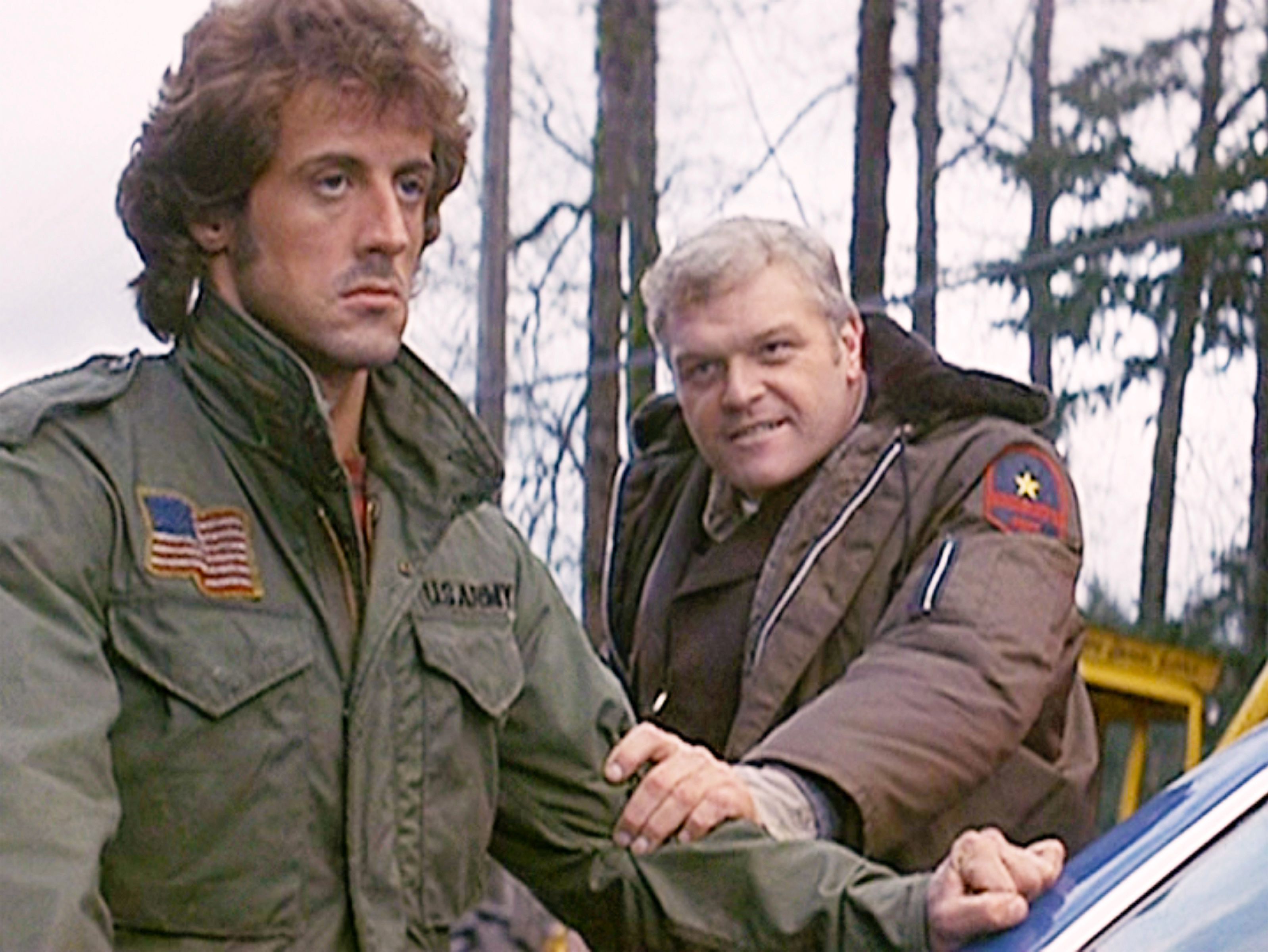
The 1982 movie First Blood is about such soldiers in the form of John Rambo. When I watched this film in the eighties, I enjoyed it only for its gritty Stallone action. The deeper layers of the movie weren’t apparent to me as a teenager. I happened to watch it again this week, coincidentally, on Veteran's day on Tubi (a free streaming channel and, in my opinion, one of the best if you can stand some advertisements during the movie). This time, it hit me with great force that this film is less about explosive action and more about the deep psychological scars that killing and survival leave on a human being.
The background of First Blood is the ignominious Vietnam War, which ended in defeat in 1975. US troops came home beaten and bruised and confused about the purpose of the war that had occupied them for years. It is one of those strange ironies of history that when soldiers return from a successful war, they are often hailed as heroes, but when they return home defeated, having sustained huge losses of life, the reception is quite different. They get to bear the brunt of the blame, though they personally have nothing to do with it. They obey orders, that’s all.
Rambo, played by Sylvester Stallone, is an elite soldier, a Green Beret with extraordinary fighting skills. After the war, he travels to Washington state to meet an old friend from his unit. He learns that the friend is dead, killed by cancer from the Agent Orange he was exposed to in the Vietnam jungles. Rambo walks into the nearby town of Hope looking for something to eat. The town’s sheriff, Will Teasle, does not want him there. Instead of letting him eat, the sheriff drives him to the edge of town and tells him not to return. Rambo disregards the sheriff’s words, turns around and walks back into town. On seeing him again, the sheriff arrests him for vagrancy and for carrying a concealed knife.
In the police station, the deputies taunt Rambo for his appearance and body smell, and have no respect for his service. They don’t realize that they are dealing with a man whose mind and body are hardened to the rigors of combat and survival against all odds. They treat him as they would a street criminal. Rambo holds himself back even when horrible war memories surge through his mind. At one point, when the deputies attempt to clean him up and bring a shaving blade close to his face, Rambo’s restraint breaks. He breaks free and goes on a rampage. He escapes into the mountains, jumps cliffs, burrows through caves, eats what is at hand, carves out lethal weapons and hurts anyone who tries to get close to him. He is a fighting machine. Yet for all this fury, he kills no one on purpose. He wounds and disables, and keeps warning them to stay away. The only man who dies in the entire film falls from a helicopter while shooting at Rambo. Throughout the manhunt, Rambo keeps his actions to what is necessary for his survival. He knows he is not at war, and these are not his enemies. But what can he do when they treat him as one?
David Morrell’s 1972 novel, on which this movie is based, ends differently. In the book, Rambo kills many of his pursuers, and in the end Trautman, his old commander, shoots him dead. The filmmakers changed that before release, and I think they were right. A Rambo who kills his way through a town and dies for it would have been a man undone by his own rage, and we would have had little reason to feel for him. A Rambo who hurts no one on purpose, and who survives to break down in front of the one man he trusts, is someone we can grieve for. Letting him live also serves the film’s point. The war does not end for these soldiers, and the story could not end for Rambo either.
The film climaxes when Rambo is brought under control by Trautman, to whom he vents his frustration. He wails incoherently: “Nothing is over! Nothing!” This outburst is the essence of the movie, that for soldiers wars never end, especially when society refuses to acknowledge (as in the case of the war in Vietnam) that they have nothing to do with the decision of war or peace. The great Irish poet William Butler Yeats captured it beautifully in his poem “An Irish Airman Foresees His Death,” in which the airman says he does not hate those he fights and does not love those he guards. They are trained to risk their lives for a cause that they often don’t know or don’t understand.
Rambo agitatedly recounts how, on coming home, he was met by protesters at the airport who spat at him and called him a baby killer; how in the war he was responsible for equipment worth millions, and how at home he can’t even get a job parking cars. And he talks of his friend Danforth, who wanted only to come home and drive his ’58 Chevy, and who was blown up in Vietnam by a shoeshine box wired to explode that a child carried up to them. Bourke writes that soldiers often told stories of combat as a way of coping with the tension at the heart of war. Rambo attempts to stitch together a story for the only man who perhaps understands what he has been through. He screams, at himself, at society, at his country, at the war for what it has made of him, a killing machine with no family, friends or society left to return to. He doesn’t know who he is anymore or what he should be doing. The war had given him purpose, but now, back in civil society, there is nothing for him to do, and worse still, he is ostracized. All he has left is the one skill the war gave him.
One of the main reasons this film has not dated is that every generation since has gone to its own war and come home with similar scars. The names of the wars change, but the purpose of war hasn’t: to kill and survive being killed.
First blood captures that essence well. This time around, it was not the action I enjoyed but the underlying motives, reasons and circumstances that lead to action. Good art often reveals different meanings at different stages of life. The meaning and dimension that eluded me a teenager stood out this time.