Epics are usually about two things: about war and about trying to get home. Most epics have a good share of both episodes. Homer’s Iliad, for instance, is full of the adrenaline of combat, the tragedy of destruction, and the fury of revenge. On the other hand, the Odyssey, (though has its fair share of violence and bloodshed) touches something quieter, something far more intimate in us. Its hero, Odysseus, is a man of multitudes. He is a husband, a father, a carpenter, a liar, a leader, a beggar, and a king of a small, rocky island who wants to go back to his family and his people after a long and tiresome war that has left him and his soldiers craving for home. The central essence of Odyssey is this idea of nostos—the ancient Greek concept of a heroic return. You will recognize this as the root of English word nostalgia: that sharp, aching remembrance of a time and place left behind. In a way, whether literally or metaphorically, there is an Odysseus in each one of us trying to navigate our own way home - whatever home means to us. That's the power of an epic. It speaks to human nature, which hasn’t improved or diminished across ages. We vibrate to the same emotions, moods, and morals that our ancestors did in much humbler and harder circumstances. There is nothing new under the sun.
This ache for the long road back home isn't unique to the story of Odyssey either. Across world literature you find the same pulse. Valmiki’s Ramayana and Vyasa’s Mahabharata and many other Nordic stories depict prolonged periods of displacement (Rama’s fourteen years in the forest or the Pandavas' thirteen years hiding in exile) and then finding their way back to society is a recurring theme. Alongside Nostos, there is one more important cultural quality in ancient Greek society that one must know, without which it is impossible to understand the trajectory of the Odyssey. That is xenia—the sacred law of hospitality said to be protected by Mighty Zeus himself. In the Hindu tradition we profess “Athithi devo Bhava” which means that a guest, even if he or she is a stranger, is the lord himself and must be fed first before any further interaction can happen. Xenia, in Greek tradition, means exactly that. The host and guest are bound by divine duty: a host must shelter, feed, and honor a stranger before even asking his name, and. equally, guests must respect the integrity of the home. Breaking this unwritten code is a violation of the natural order. The ancient Greeks were passionate about preserving Xenia. In Homer’s poem, this idea of Xenia is present in almost each canto as Odysseus and Telemachus visit different places and palaces. And it is the violation of sacred code of "xenia" that justifies the violence Odysseus unleashes towards the end on the parasitic suitors who crowded in his palace vying for Penelope’s hand and unlawfully feasting on his wealth in violation of Xenia. That was simply not acceptable in the Greek universe. You cannot take advantage of your hospitality, It is against the law of nature.
Homeric poetry has seeped so deeply into our cultural bloodstream that it has given the English language countless foundational words, idioms, and metaphors. When we speak of a "Trojan horse" - which means an unknown thing; or an "odyssey," to describe an arduous undertaking or describe someone as a "Mentor," as someone who guides - we are speaking the Homerian language. Perhaps most hauntingly, when Odysseus steers his wooden ship through the narrow strait between the six-headed monster Scylla and the roaring whirlpool Charybdis ( an unforgettable scene Homer’s poem and Nolan’s adaptation), it gave the language its idiom for impossible human choices: choosing between Scylla and Charybdis, means being caught between a rock and a hard place. We are so full of Homer whether we like it or not.
The Odyssey is not about Odysseus alone; the epic is fundamentally a story of a fractured family fighting simultaneous battles across three distinct fronts. The twelve-thousand line poem doesn't even begin with Odysseus , but begins in Ithaca, the kingdom of Odysseus, where a young Telemachus is restless and suffocating under the weight of his father's absence. He is desperate to discover whether his father is alive or dead, and equally anxious over whether his mother, Penelope, will finally break under pressure and marry one of the parasitic suitors overrunning their home. Odysseus left to fight the Trojan war when his son was a baby, and now he is a grown up man. There is a sharp, psychological tension in the young prince: he longs deeply for his father to return and unite their broken family, yet as a young man coming of age, he also feels the weight of his own ambition and duty to claim his rightful inheritance and step out from the long shadow of a legend. Penelope, Odysseus' wife meanwhile, wages her own quiet war of attrition at home, spooling her shroud by day and unspooling it by night to stall the suitors. The entire family is bound by a shared crisis, each fighting their own siege while waiting for the center to hold and in breathless anticipation of knowing the fate of Odysseus for sure.
It is an interesting coincidence that this need for homecoming, the central theme in the Odyssey, often peaks in the middle of a person's life. Centuries after Homer, Dante Alighieri , the Italian poet, began his Divine Comedy with the line, "Midway upon the journey of our life, I found myself within a dark forest, for the straightforward pathway had been lost". Dante was thirty-five—literally at life's physical midpoint. Odysseus was in his early forties after ten years in the dirt at Troy and another ten battling the sea. When we are young, we are driven by ambition, and then at a certain stage, we begin to become nostalgic, we wish to return to an Eden that we willingly forsook. Modern psychology often mischaracterizes this pivotal threshold as a superficial "mid-life crisis". But in reality, it is not an aimless panic or a desperate reach for youth; it is a profound, instinctual desire to strip away illusions and return to firmer ground. By the middle road of life, our youthful hunger for raw glory ( in Greek they called this kleos) has burned away, replaced by a deep fatigue and a desperate need to reclaim one's true center. Homecoming is acutely felt when you realize you have traveled far enough through the chaos to know what actually matters. It is a state of deep realization about what are one’s priorities in life.
My own love for Homer began with Robert Fitzgerald’s 1961 translation - a copy I picked in a second hand book store a decade ago. Since then I have bought and read all four translations, including Emily Wilson's 2018 ( which is Nolan’s basis for the adaptation) and Daniel Mendelsohn's latest one. Among the four, my favorite still remains Fitzgerald’s. His translation is poetic and there is a wonderful cadence to his language and choice of meter. In an ancient, illiterate society, when stories weren't committed to paper; they were most likely performed live, strung together on the spot before a gathered crowd. There are recurring epithets about dawn, evenings, wind, storm, sea which is inevitable in an oral tradition. The arrival of dawn is mentioned twenty times across its twenty-four books of the poem. Every single time, the phrasing is similar: "up when the young dawn's fingertips of rose opened in the east". What a beautiful image! Repeating a line like this in an oral culture served a vital, practical purpose. Since the bards of the time didn't have the luxury of revision or the written word in front of them, once an utterance left the storyteller's lips, it was out there, and it is through the help of these formulaic phrases they kept the cadence steady and held the audience together in spellbound attention. Modern English translators have had the onerous job of preserving these phrases and tying them together like beads in a necklace, and all four translators have done it brilliantly. If you have the time, I strongly recommend reading a translation before watching the Nolan movie or at least start on one. It is worth the effort and time.
I watched the 3:00 a.m show of “The Odyssey” last Sunday sitting in a sold-out IMAX theater in Atlanta. What a cinematic experience it was! Nolan’s decision to shoot the entire 3 hr movie in native 70mm IMAX is the perfect meeting of text and vision. Nolan is a thinking director and one of the best in his craft. To pick a venerated poem 12000 lines long and script in a manner that brings out the vitality and timelessness of this classic while leaving huge chunks out, is a master act. Nolan’s evocation of the Bronze Age through stark, barren lands, endlessly churning seas, mellow sundraped colors, and primal stone castles creates an astonishing, elemental mood—a visual texture in each frame that feels raw, unadorned, and deeply ancient -- which is how the Bronze age must have looked like. The Odyssey goes back and forth in time. Nolan’s non-linear editing and kaleidoscopic handling of time beautifully translates the mood and cadence of the Homeric epic to the big screen.
One of the greatest challenges film makers face when they bring an epic to life is language and dialogue. Do they stick to classical dialect or should they reflect modern speech patterns? This is a critical question that could make or break the cinematic experience. Instead of hiding behind artificially archaic English, he grounds the film in the direct register of Emily Wilson’s landmark 2018 translation. Wilson’s translation had stripped away centuries of stiff Victorian pomposity, giving us the flavor of the epic in swift, plain-spoken English. Nolan follows her lead. His characters speak normally. They don't sound like men and women living three thousand years ago. While the stage is in the bronze age, their language makes the story modern. Right at the beginning of the film, Nolan establishes this tone when Odysseus looks out at the endless siege of Troy and asks the raw, profane question on every exhausted soldier's mind: "What the fuck are we doing here for ten years?". It’s a kind of english that stuns a listener, and immediately dismantles any heroic romanticism. Oops, here is a man very much like me - is what you instantly feel.
Beyond the dialogue, Nolan also makes a significant departure in his handling of the divine elements in the tale. In Homer's poem, the gods are constant, meddlesome interveners, but here they are notably absent in the movie except Goddess Athena, who appears a few times more as a human adviser than as a God. This choice of excluding the Gods from his Narrative, Nolan refocuses the drama entirely on human choice and the brutal, existential weight of Odysseus’ journey and reflects the exhaustion, angst and hope Odysseus and his crew go through. Nolan's Odysseus doesn’t come across as a sanitized Hollywood superhero. He is a man who contains multitudes. He is humanized, and that is possible only because the characters speak in a language that we understand and it resonates deeply within us. Nolan has come under some criticism in some quarters for toning down the richness of Homeric poetry and particularly for using Emily Wilson's translation as his base. I think that this criticism is both unjustified and unwarranted. We can endlessly nitpick on what is right and wrong, but that doesn't take way a scintilla of brilliance from the movie or Wilson's translation.
Nolan’s magic with his camera ( a specially made IMAX camera) is endless. The use of recurring visual motifs—sunlight cutting across open water, the rhythmic dip of oars, flashes of memory— imitate the poetic equivalents in reiterating themes and anchoring his viewers in the middle of the action. The non-linear editing of the story doesn't scramble the plot, but it would definitely take some time for audiences unfamiliar with the Trojan backstory to get to grips with. Once you understand the arc of the story, it becomes easier to follow the flow. The overall effect of the massive scale of the movie is that it creates a world that feels vast and ancient, and a human story that feels completely immediate, visceral, and alive. That is an unparalleled achievement when it comes to bringing epics to screen.
This movie adaptation remind us that great stories don't age; they only change their skin and that they can be recast without diluting the essence. Will Durant, the great historian once wrote “ After thousands of years of civilization, man still remains the trousered ape”. What he meant was that human nature hasn't changed in ages. Watching the Odyssey roll on screen vindicates Durant's insight. The same emotions, desires, wants, and aspirations course through our veins as they did in our ancient ancestors. . The movie offers a new entry point to this timeless story for a contemporary audience. It forces us to look past myth and see the exhaustion, the hope, and the humanity beneath the characters. Even God's cry in Nolan's world.
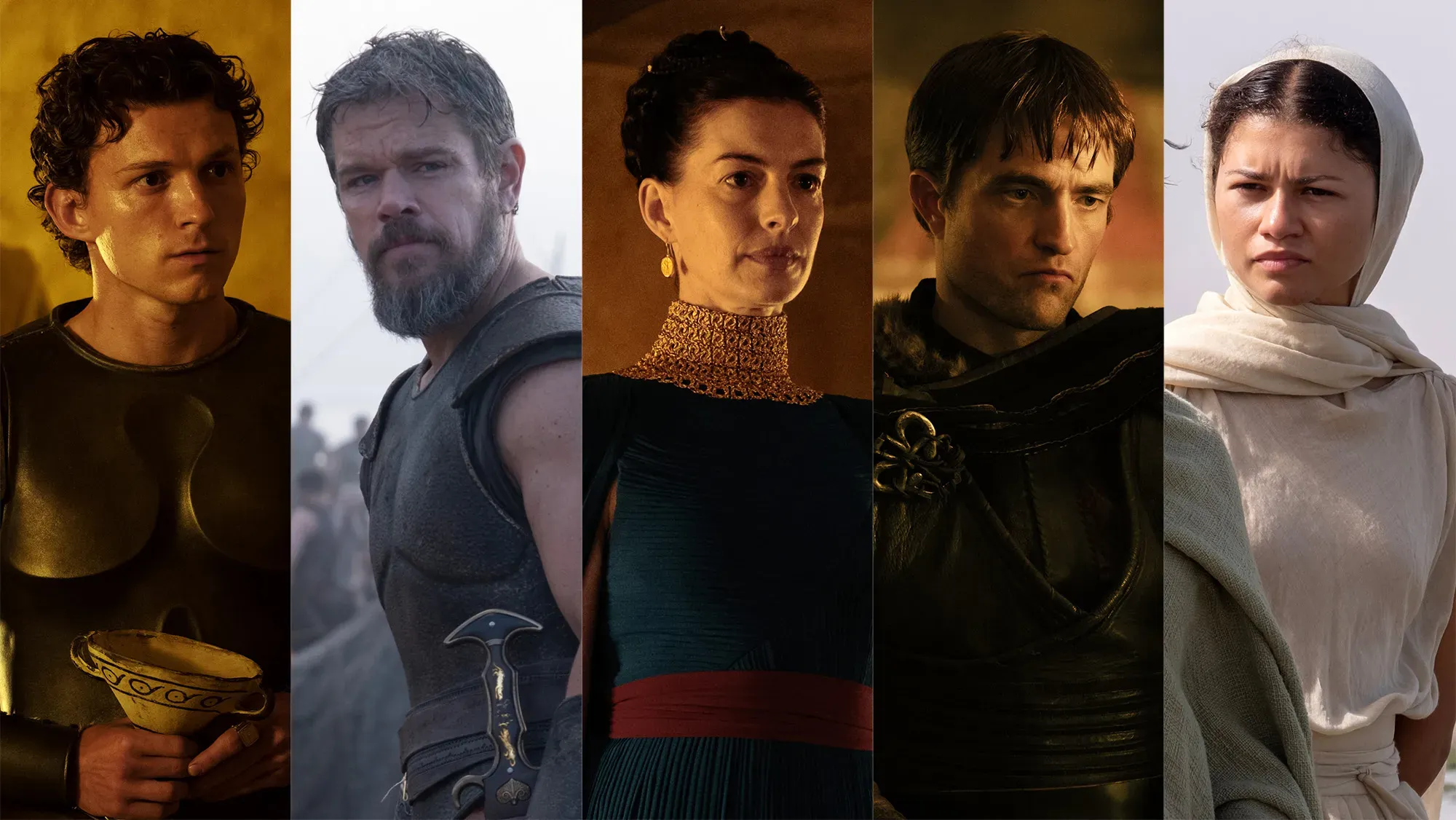
A word on the stellar cast that brings a gritty, humanizing depth to these legendary figures. Nolan likes to work to a select group of actors in all his movies. Therefore he understands them well, there is a good working relationships among the actors, and Nolan knows how to get the best out of them. Making cinema is communal art, and like drama, it pays to work with the same cast. Matt Damon’s portrayal leans into the character's profound existential exhaustion and weary determination. Great performance, perhaps an Oscar winning one. Opposite him, Anne Hathaway, as always, brilliantly captures the fierce, quiet resilience of Penelope, turning her domestic waiting into a powerful siege of its own. Those close-up shots with her son will go down as some of the finest sequences in cinematic history. Meanwhile, young Tom Holland provides a compelling counterpoint as a restless Telemachus, embodying the tension of a young man caught between the yearning for his father’s return and the pressure of carving out his own legacy. Through their performances, the film elevates these ancient archetypes into deeply relatable, flesh-and-blood humans.
In the end, Nolan remains true to the Homeric tradition. What he unfolds on the screen for us is a modern rendering of a wonderful story that at once awes, satisfies, questions and makes us think deeply. What more can we ask of a work of cinema? Pls watch it on the big screen, and once done, try and read the poem.