Imagine you are an Italian music lover in the eighteenth century, arriving at the opera house early enough to catch what happens before the curtain rises. Seated behind the small enclosure at the front of the stage, the orchestra is already playing. They are weaving together a shared melodic pattern warming the audience for what is to come. You are not particularly bothered whether the opera starts on time, because this music, this ensemble of sounds, is weaving a magic of its own, and you want more of it. But then, abruptly, the preamble stops. It is time for the opera to begin. You wish this wave of wordless music continues for some time, but then you are there for the opera and not this. But secretly you wish that this musical form that enthralled you becomes mainstream and you can hear more of it. This idea is the birth of the formal symphonic form of music. These instrumental preludes before the Opera are known as overtures. The Overtures were in a very real sense, the mother of the western symphony.
If you browse Spotify for western classical music, you will find a wealth of overtures. They are beautiful, light, melodic and self-contained pieces that typically run for seven or eight minutes. In fact, if you are new to western classical music, overtures are the perfect place to begin. Listen to Rossini's overture to The Barber of Seville, with its famous crescendo that builds from a whisper to a roar, or his overture to William Tell Opera, whose galloping finale has outlived the opera it was meant to introduce. Or try Mozart's overture to The Marriage of Figaro, a sparkling burst of energizing harmony that sets the comic tone of the Opera that follows, or Beethoven's Egmont Overture, which is almost a symphony in miniature – dramatic, brooding, and triumphant at the same time. Listening to overtures will sensitize your ear, train your musical attention to listen deeply, and prepare your musical sensibility for the grander architecture of the classical western symphony.
The symphony, however, did not arrive fully formed. It grew organically out of overtures. When astute composers writing operas noticed that the instrumental preludes before the opera assumed a life of their own, they started experimenting with that form. Audiences increasingly enjoyed these overture experiments as much as the operas themselves, and listeners came early to savor these short, energizing pieces of harmonic music. Gradually an overture developed a form and structure: a fast opening, a slow middle, and a fast close. This structure, over time, loosened and expanded as composers began use this structure as a vehicle for presenting abstract musical ideas and themes. Court composers Giovanni Battista Sammartini in Italy and Johann Stamitz at the famous Mannheim court in Germany pioneered this movement. They began writing full-fledged purely instrumental works without an operatic structure and started calling them symphonia (Greek for “Sounding together”). As the symphony matured, its message was built into its structure and innovative use of instruments and scale; more significantly, in the way the four movements unfolded, and what feelings each one of them evoked in the listener's heart.
Joseph Haydn established symphony as the predominant form of music. Haydn was extraordinarily prolific. He wrote more than a hundred symphonies during his lifetime, added a fourth movement to the existing symphony structure, and he laid down some unwritten conventions for composing symphonies that still govern the form today. His prodigious compositions transformed the art of symphony into a self-sufficient, architecturally ambitious form, with clean transitions, a persistent underlying melodic thread weaving an expressive range of instrumental harmonies encompassing the full breadth of human feeling. After him came Mozart, the golden child prodigy of western music, who introduced a breathtaking lightness and beauty into symphonies remains unparalleled even today. Who can listen to his 41st (Jupiter Symphony) without a thrill coursing through one’s spine. Then came Beethoven, Brahms, Bruckner, and Schubert, each master of this genre, and with their body of work the symphony stood elevated, stretched, and deepened into the supreme form of western musical expression it remains today.
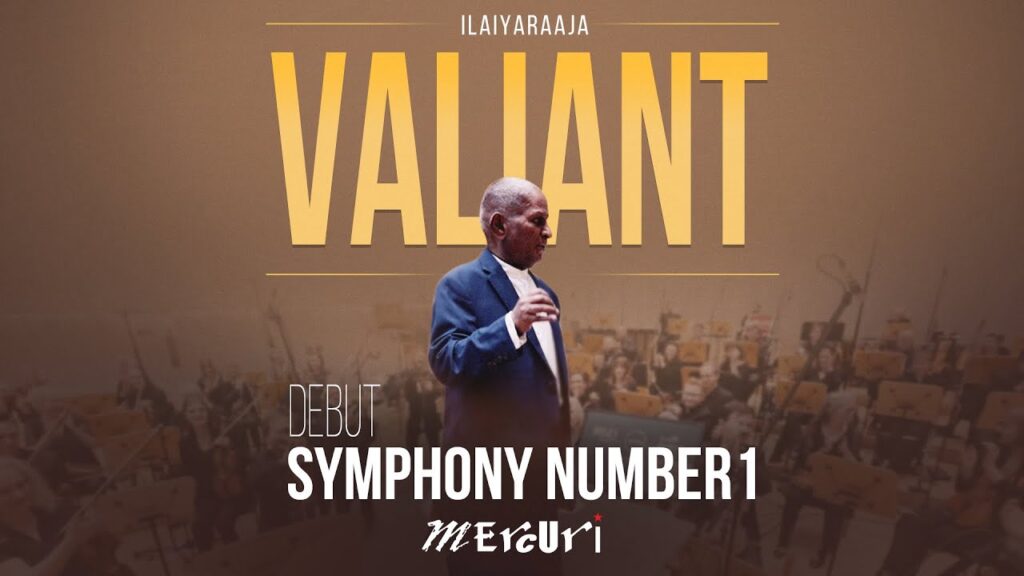
Ilaiyaraaja's Valiant symphony is now available on streaming platforms. A wait of nearly thirty-two years comes to an end. My first impression, upon listening to all four movements in one sitting is that it is beautifully composed. The symphony opens with a movement called The Journey - a piece that sets the tone for what is to follow, before settling down into the second movement (Solace), a slower and more contemplative movement. Then comes Frontier, a rhythmic and boisterous piece of orchestration that conjures in our mind’s eye images of unexplored horizons and unrealized dreams. The fourth and final movement named Triumph ends in pure musical joy. Across all the four movements, there is organic unity and the development of a single musical theme that ebbs, flows, and punctuated throughout with moments of transcendental beauty.
What is breathtaking about this symphony is that a man steeped in Indian film music for fifty years and eighty-one years old when he finished writing it, could produce something of this order. But then, you quickly realize that Raaja's music has always been symphonic. His film songs have endured for decades not merely because of mesmerizing tunes, but also for the musical richness packed into interludes and the overall symphonic scaffolding of his songs. In Raaja’s film songs the music that happens in the background, foreground and in the interludes create the magic. It is impossible to separate the orchestration from the song. No two interludes are ever the same; subtle variations and nuances run through his compositions. That is the main reason why his songs can be heard over and over again; the musical possibilities emerging from them are endless. I often feel, and I know other music lovers who share the share sentiment, that Raaja's musical experiments and orchestral arrangements were often wasted on casual listeners and movies that really didn’t deserve that quality of music. That is a fair comment, but the fact, Raaja used movies as a medium to express his musical range. Whether the song found the right place in the movie was never his concern. He knew that people would listen to his music regardless of the movie and how the songs were picturized.
Thanks to a few dedicated YouTubers in recent years who have worked hard to educate listeners on some of Raaja's iconic compositions, some of his songs are beginning to be appreciated for its real depth and quality. Along with his songs one cannot forget the quality of Raaja's incomparable symphonic background scores. Most of them are masterclasses in music. Just the other day, I was watching Mani Ratnam’s Mouna Ragam, and the whole time I was only listening to the magnificent background score that transformed every scene into something exquisitely memorable. If you take away Raaja's music from Mouna ragam, it loses its life. That is the case with countless other films too.
Will the legions of Raaja’s fans appreciate the symphony. Honestly, I don’t know. Listening to a symphony is not easy. It is a cultivated musical taste just like Carnatic or Hindustani music. It is not critical that one should know the musical grammar of symphony to appreciate it (it helps if you do), but it requires undivided attention and deep listening - which are traits that are uncommon these days. Raaja’s first public performance of Valiant happened in Chennai a couple of weeks ago. I saw snippets of the performance on YouTube. And if that is anything to go by, I don’t think the audience assembled were there to listen to the symphony, they were there more in awe of the man, and all other stars who had found time to grace the occasion and occupying privileged, white-clothed-draped-seats. The camera rarely pointed to the orchestra; it was busy capturing the lost expressions of the VIPs.
One of the critical aspects in performing a symphony is the acoustical environment in which a symphony is performed. There should be a balance between a well-engineered concert hall and pitch-perfect coordination among all the musicians on stage. Silence is paramount during a symphony. There should be pin-drop silence. If the acoustic atmosphere during the performance isn’t engineered well and respected by the audience, the finer moments of a symphony will be lost. It is important to remember that not every instrument is in play throughout a symphonic movement. Sections of the orchestra pause when other sections are executing their part. For instance, in between a vibrant violin section, a cello may chime in for just a few seconds, and during that brief, incandescent moment the soul of that symphony could be revealed. These are the finer nuances to listen for in a symphony. Around the world, music aficionados prefer live symphony performances over recorded versions. I hope, Valiant will have many more runs in better acoustic setting than the one in Chennai.
What about Valiant’s acceptance in the Western canon of classical music? I am not sure if western audiences will embrace it readily. Perhaps they will, in time, after Raaja has written a few more symphonies and established a body of work. Just as we would not go out of our way to embrace a westerner singing Indian classical music(we might appreciate the attempt) but would carry some lingering subconscious reservations; so too the music patrons in the west will pay respectful tribute to Valiant without quite admitting it into their regular canon. Symphonies often take time to find their audience. Perhaps someday a leading orchestra will take up Valiant and perform it before seasoned listeners, and who knows, at that time, a major critic will find something special about this symphony and herald it to the world as a phenomenal work. And when that happens, a work that now seems like a curiosity to the west may be rediscovered as a gem that went unrecognized for too long. It has happened before in music and other art forms. It could happen again.
For now, the maestro is going strong. We hear that he is composing his second symphony and there are many more to come. That is good news. Over the years, Raaja’s film music has lost its edge. His musical interludes have given way to electronic shortcuts. But I take that as a good sign. It gives him a lot more time to focus on things that he has always wanted to do. His film music may have lost some of its orchestral flair, his interludes electronically generated; even so, there is something magical about his compositions that still possess the capacity to haunt and mesmerize. His symphonies may find the same fate as his previous albums: “How to name it” and “Nothing but wind”. They are respected and liked by a section of his listeners, but most of his ardent fans, who do not live in the metro cities or have time or leisure to enjoy other forms of music, Raaja’s beautiful films songs will remain the solace and happiness of their lives.
If you ask me, that should be enough for a lifetime.