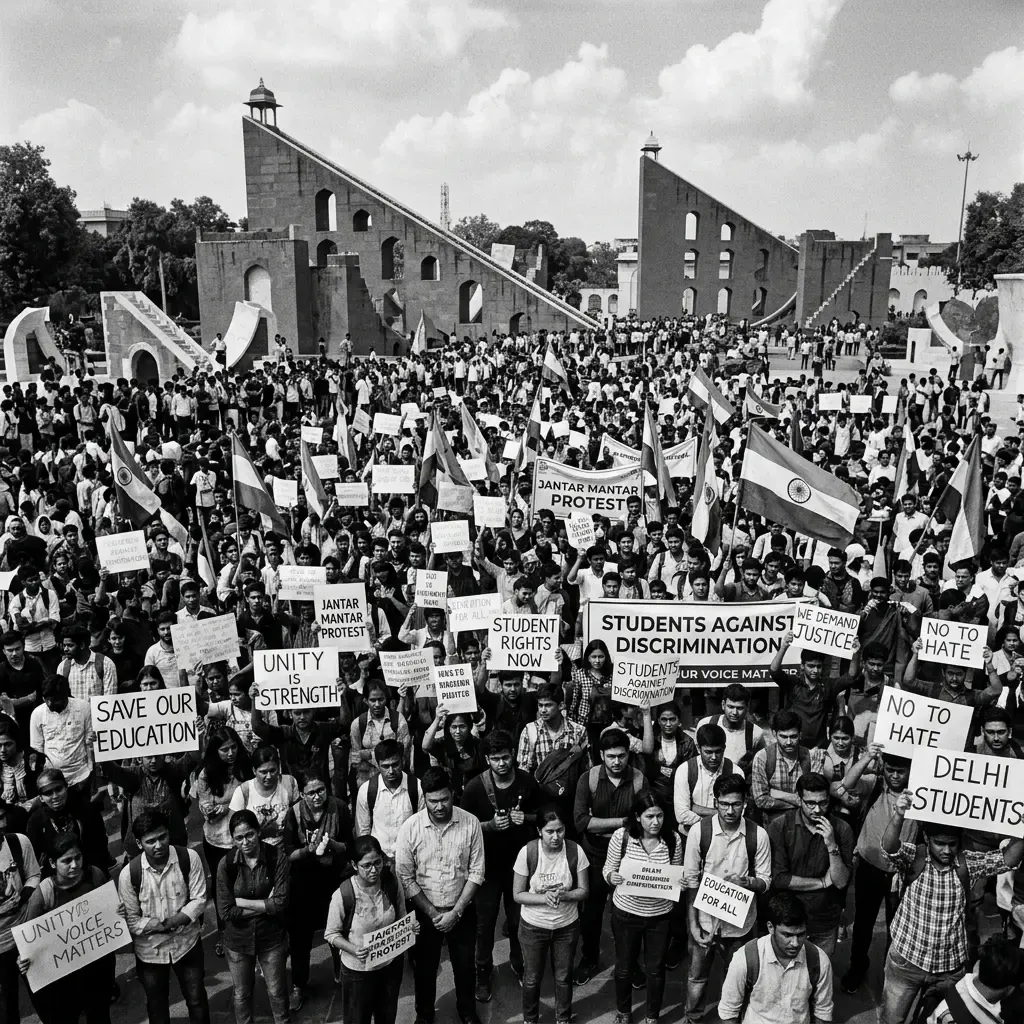
Every uprising begins with a trigger, a voice, a picture, a deed, a tipping point. In India this summer the trigger was a single sentence. On the fifteenth of May, hearing a matter that had nothing to do with the young or the jobless, the Chief Justice of India, Surya Kant, reached for a metaphor to explain himself. There are youngsters like cockroaches, he said, who find no employment and no place in a profession, and who then turn into activists of one variety or another and begin attacking the system. He would later say he had been misquoted. That did not matter. The word was already loose.
And a day later a thirty-year-old named Abhijeet Dipke, a political communications man then studying in Boston, put up a post inviting all such "cockroaches" of the country to assemble under one banner. He called it the Cockroach Janta Party. It was obviously meant as a satire, a joke. However, within days and weeks the page had crossed millions of followers. The satire had become a political census of a generation of Indians.
When I read about that Instagram post and its resonance with the youth of India, I was reminded of the Tahrir uprising in Egypt. The trigger for that event was different, and brutal, but it is similar to how the CJP's Jantar Mantar protests played out. In June of 2010 a young man in Alexandria named Khaled Said was dragged out of a cybercafé and beaten to death by policemen. Not an uncommon occurrence in that regime, but in this case it was captured on camera, and the brother of the deceased shared the picture of his sibling's broken face. When Wael Ghonim, a marketing executive at Google, an Egyptian living in Dubai saw the picture, something stirred within him (just as Abhijeet, living in Boston, was enraged). He was revolted by the injustice, and his reaction was to build a Facebook page named "We Are All Khaled Said." First he posted the dramatic image of Khaled's mutilated face on the page to pull people in, followed by more posts urging people to join him in his protest. Young Egyptians, long used to staying within the boundaries defined by the regime in power, responded to the call on social media. Thousands joined the page and started contributing, and soon a movement had started, which would find its apogee at Tahrir Square, urging for a change in the leadership of Egypt.
For eighteen days of agitation that summer, it looked as though Ghonim's indignation had found its voice that would change the face of Egypt completely. Tahrir Square filled with people who had never met and whose only connection was the call on Facebook to join the protest. New relationships were forged in the relentless heat of the Egyptian summer, and on the eleventh of February, Hosni Mubarak, who had ruled for three decades, resigned. For that brief window of time, Egypt had come as close as it ever would to realizing its own version of a utopia. Ghonim himself couldn't participate in the protests; he was held in custody and later released. When he learned about Mubarak's resignation, he wept openly on television. President Obama commented that this young man could become the next head of state. It looked as though the world had witnessed something important. But that euphoria was short-lived.
Within a few months, reality hit them. The Muslim Brotherhood, a strong and rooted organization within the country, reaped the benefits of Tahrir Square and won the next election. Two years later the army deposed the elected government. By the summer of 2013 the whole luminous thing the world had witnessed on Tahrir Square had fizzled out, flattened, and Egypt had merely exchanged one strongman for another with a detour in the form of protests in between. Tahrir Square had achieved nothing, except opening up a way of protesting using social media. It was a brief, incandescent flame that promised a lot, but burnt out quickly.
Coming back to the CJP. Dipke's post had, no doubt, touched a raw nerve at exactly the right time. The Indian examination system was in a mess. Question paper leaks — nothing new — had long been a source of deep emotional stress for students, and suicides linked to exam failure, always a quiet concern in India, were becoming both more common and more visible. Around the same time the Cockroach movement was gathering momentum, one more leak, a major one, touched the lives of millions. The National Eligibility cum Entrance Test, the country's medical school gateway, was found to have been compromised and was cancelled outright, forcing a retest. It triggered a wave of suicides. The discontent over the government's managing of this national exam mingled with the dissent raised by the CJP. And then events quickly precipitated to the clash at Jantar Mantar.
What happened at Jantar Mantar: angry students asking for an Education Minister's resignation in one voice, the violent clashes that ensued, the presence of political hooligans who exacerbated the matter, the fast unto death by Sonam Wangchuk which elevated the event to a new dimension — all of it happened in a hurry. It was all heady and intoxicating. There was a sense of urgency for change. New student leaders with a swagger emerged from these groups and were invited to hold talks with seasoned political leaders. I remembered the aftermath of the Mandal Commission reports in the late eighties and the massive student protests it triggered across the country. I was in college. I remember how empowering it was to find oneself in the limelight making speeches from podiums, exhorting people to change course. Like the Jantar Mantar protests, there was this feeling then that the system had to change, but how and in what direction wasn't clearly thought out. The Jantar Mantar protests were at best a visceral reaction to something that was visibly wrong and broken; that's the first step, of course, but the next step, on what to do about it, is equally, if not more, important than the first.
Earlier this year, I read Gal Beckerman's (a staff writer for The Atlantic) The Quiet Before. A brilliant book on how it is important for any movement, be it political, social, or scientific, to have an incubatory period of reflection, plan, and strategy before it erupts into public consciousness. To start something is easy, but to sustain it and take it to the next level of meaningful change needs discussion, debate, and clear thinking before the event. Before the social media era, there was a possibility for such dialogue and reflection, but now, such silent spaces to think through something individually or in a focused group are becoming increasingly difficult. Facebook, Instagram, and Twitter can provide that immediate impetus and traction, they can gather a huge number of likes and followers, but, until now, they haven't proved themselves capable of sustained deliberation and reflection. Their essence lies in being ephemeral, piling one image on another in succession, each one taking on a novelty that the last one lacks.
Which brings the question back to Jantar Mantar itself. Where, in the six weeks between the Chief Justice's remark and the crowd at the barricades, was the cockroaches' own quiet before? Was there enough reflection, deliberation on what needed to change, why, and how? The demands from students arrived less like the fruit of an argued-over position than like a crowdsourced list. Social-media-triggered conversations end up like that: they whip up emotions without giving time for studied opinions. Pradhan's resignation may seem like a real victory at first, but it is the kind of victory available to any crowd that never had to agree on more than its anger — remove one man, and the crowd's job is done, because the crowd was never asked to answer the harder question of what should replace him, or what structural change would keep the next leak from happening. Real change can only happen after the event. Gandhi's Dandi March to pick up salt, in the age of social media, would have been a clear PR stunt, but Gandhi's move to defy the British on their salt laws was a clearly thought-out strategy. He knew what would happen; he was prepared for the repercussions, and at the same time, he also understood what should happen next. Gandhi never undertook any action without having thought through his plan as well as he could. Even he couldn't stop the carnage when it mattered most.
The essence of the Jantar Mantar protests was to take the examination leaks seriously and correct a corrupt system. A legitimate demand, and sorely needed. No one with common sense would deny that. But whether the protestors have a plan in place is the key question. Once the minister resigned, the ruling party stepped in, took charge, and appointed a high-powered committee to reform the system. The Prime Minister directly addressed the younger generation, patronizingly, and patted them on the back for their anger, and at the same time, requested them to channel their enormous energies in creative ways. In short, the government took control. While it is true the student protests are erupting in many states over exam leaks, and in some cases, exams — wholesale — have been cancelled, this leaves deserving students in no better shape than before. Without a selection process, how do we select students for a limited number of seats? For better or for worse, exams have a role to play. And the sane approach is to scrutinize the system and make it robust, rigorous, and honest.
What makes the Jantar Mantar protests significant is that, for the first time, the central government under the BJP felt some pressure to yield to a demand. Some critics may construe this as a victory of sorts. Yes, for the first time, an opposition has managed to bring an important issue before the government for immediate action on their own terms. And the government yielded, not because they had to, but because it was the right thing to do given the situation. What should have been done within the walls of Parliament was done on the streets, orchestrated by students and aided by the opposition parties. For the Congress, the Jantar Mantar protests became a hook to hang their coat on, and to the extent the protest became politicized, to that extent, the movement lost its purpose and validity. Obscene language, and demands that had nothing to do with exam leaks, tarnished the image of the protests.
In the last month or so, I have been seeing Abhijeet Dipke interviewed on prime news channels. He seems to be getting used to the limelight. It is clear that what he started a few months back has suddenly assumed national importance, and Abhijeet himself is unsure how to process this rise to fame. And that is the problem of social media fame. It catapults anonymous people to instant celebrity status without the organic preparation to handle the transition. He states in his interviews that he has no desire to start a political party, but to remain as the voice of opposition. If you look at the CJP's webpage, it is quite well designed. I spent some time looking through the charter of the CJP. It is essentially a call to the young of the country to voice their opinions. Which is good, if the young can form their opinions based on deep thinking, discussion, and constructive debate. The power of digital platforms and social media is that it is easy to light the flame, but it takes a different mindset and perseverance to sustain that flame and steady it.
The image of a "cockroach" evokes different emotions in different people. For most people, it is a repulsive pest that they cannot stand if spotted anywhere in the vicinity. I belong to this tribe. The moment I spot a cockroach in my kitchen, I can't sleep until I have thrashed the hell out of it and disposed of the dead thing in the trash can. I know for sure that there is one more lurking somewhere I cannot see. It is a fact that cockroaches have been around for millions of years, and are one of the most resilient species. They survive; they can never be wiped out. And they can get on your nerves. I don't know what Chief Justice Surya Kant was thinking when he invoked the cockroach metaphor that day in the courtroom. He would never have imagined, in his wildest dreams, that his loose metaphor would give birth to a youth movement that, within a couple of months, would rock one of the strongest ruling parties in the world.
Like everybody else, I believe that in a democracy, one should have a strong and meaningful opposition. In India, for some time, we haven't had a quality opposition. But taking to the streets, disrupting lives, damaging and hurting oneself isn't the meaning of opposition. Fifteen years ago, AAP, the Aam Aadmi Party, rose to fame on exactly the same kind of promises the CJP is making today. We know what happened to AAP. At one point, several Indians I personally know were proud card-carrying members of AAP. Today, they wouldn't even wish to be reminded of that period.
The BJP is a strong, cohesive party with clear thought and strategy. They have built their ground for decades before assuming power, and therefore their foundations are very, very strong. This is precisely what Gal Beckerman talks about in his book The Quiet Before. Quietly and steadily, the RSS and the BJP have worked to build their plans and structure, and now that they are in power, they look unshakeable. They may be right-wing, authoritarian, and bullies also, sometimes. But — and this is important — they know what they are doing, and they have the right think-tank and people to forge their strategy. The Jantar Mantar protests will be viewed as a minor aberration in an otherwise smooth-running political machinery. If the CJP can get together, form their base, and present themselves as the collective conscience of a new generation of Indians, I welcome it.
Democracy needs those periodic injections to keep it vibrant.