It is a recurring theme in the history of technology that, during periods of crisis, some of our sharpest scientific and operational thinking takes shape. Wars compress time, concentrate attention and resources, and force people to solve problems that might otherwise remain theoretical for years. Ideas have to be tested in the real world even when they are not fully thought out, because the sheer advantage of being first can be of paramount importance.
The Second World War is perhaps the clearest example. Radar was not invented by the war, but the war pushed it into a far more capable and practical form. Penicillin had already been discovered, yet wartime need drove the work required to produce it at scale. The war also accelerated electronic computing and much of the early thinking about how hardware and software should be built. In Doris Kearns Goodwin's brilliant study of FDR's leadership, No Ordinary Time, she spends pages detailing how America literally reinvented itself during those years and how that explosion of invention gave it a strategic advantage. The war did not create every one of these ideas from nothing. What it did was move them from their nascent stage to mainstream use with extraordinary urgency.
When the Second World War ended, a new world order emerged, and with it, a different problem: the Cold War had begun. In this tense standoff, the Western powers realized that remaining preemptively close to the scene of action was key. Because of an increase in covert warfare in the 1950s, the United States and its allies had to deploy elite forces with technical capabilities and maintain intelligence assets nearer the places where trouble could potentially unfold. Being closer to the target meant understanding military developments earlier, seeing the situation better, and responding faster. This was the origin of the postwar military practice and vocabulary of "forward deployment" and "forward presence", strategically positioning resources closer to likely theaters of action so that crises could be managed before they became uncontrollable conflagrations.
This logic of forward deployment would later find a very different home in Silicon Valley within a software company: Palantir. The question is, why would a software company need a military-sounding idea in the first place? In the early 2000s, immediately following 9/11, there was immense urgency to identify suspicious activity within domestic borders and across geographies using the fragmented data points at the disposal of intelligence agencies. This included call logs, passport records, field reports, financial transactions, and many other pieces of information from diverse, unstructured sources. Today, an alert appears on our phones when a credit card is used in an unusual way, an experience that feels routine. Two decades ago, pattern matching across large amounts of messy, disconnected data was a far less mature operational capability. Intelligence agencies were chartered to find the proverbial needle in a haystack, and the haystack was messy. Collecting such data was only part of the problem. The bigger challenge was that the information was time-sensitive. If not acted upon within a tight window, its relevance evaporated. In intelligence operations, time is gold; information has value only while there is still time to act on it.
Analysts also worked under very different constraints. Their workflows were often classified and impossible to explain outside a secure environment. There was no way they could ship sensitive data to Silicon Valley and ask an engineering team to experiment with it. Nor could they turn their collective experience, intuition, and shifting procedures into a clean product specification. There was simply no time. Ultimately, there were two intertwined problems: messy, unstructured data, and a massive data-processing hurdle, both of which had to be tackled on the fly.
At the time, Palantir held software consulting contracts with defense agencies. What they presciently realized was that the problems faced by intelligence teams, given the urgency, precision, and high stakes involved, could not be understood or solved from a comfortable office. Engineers had to solve problems in real time, working alongside analysts in closed rooms or in the trenches. They had to be plugged directly into that environment to react quickly to changing situations in the field.
So, what was Palantir's answer? Put the engineer in the same room as the problem. Let the engineer see how analysts and operators actually work. Let them see where the data pipeline breaks down, and build right alongside the intelligence teams. Code was no longer treated merely as factory output, developed in an air-conditioned office and shipped once every six months. It became fieldwork.
In a sense, that isn't so strange. Chemical engineers know the manufacturing plant floor well; mechanical and electrical engineers understand the physical realities of their environments. Software, for a long time, behaved differently: code was written first and tried against the world later. Palantir recognized this gap. Its engineers were expected to write code in the middle of the customer's problem, test it against reality, and improve it while the consequences were still visible. The luxury of elaborate project plans and architecture diagrams, though important later in the development cycle, was not the immediate priority. The pressing task was to quickly fix what the user was struggling with. That was a radical way of thinking about software engineering, but one deeply aligned with the root purpose of engineering: solving real-world problems.
This does not mean quality no longer matters; it means the first useful solution does not have to be the final one. In a complex operational setting, that initial fix may be incomplete or narrowly tailored to one situation. It may not be elegant. But it must do the job that matters at that moment. A Forward Deployed Engineer (FDE) therefore needs more than technical competence. They have to be smart, quick on their feet, and comfortable with ambiguity. They must be able to work closely with people who show what they need through actions rather than formal specifications. Palantir's description of the role reflected this breadth: direct engagement with customer stakeholders, architectural decision-making, custom application development, and end-to-end ownership from idea to deployment.
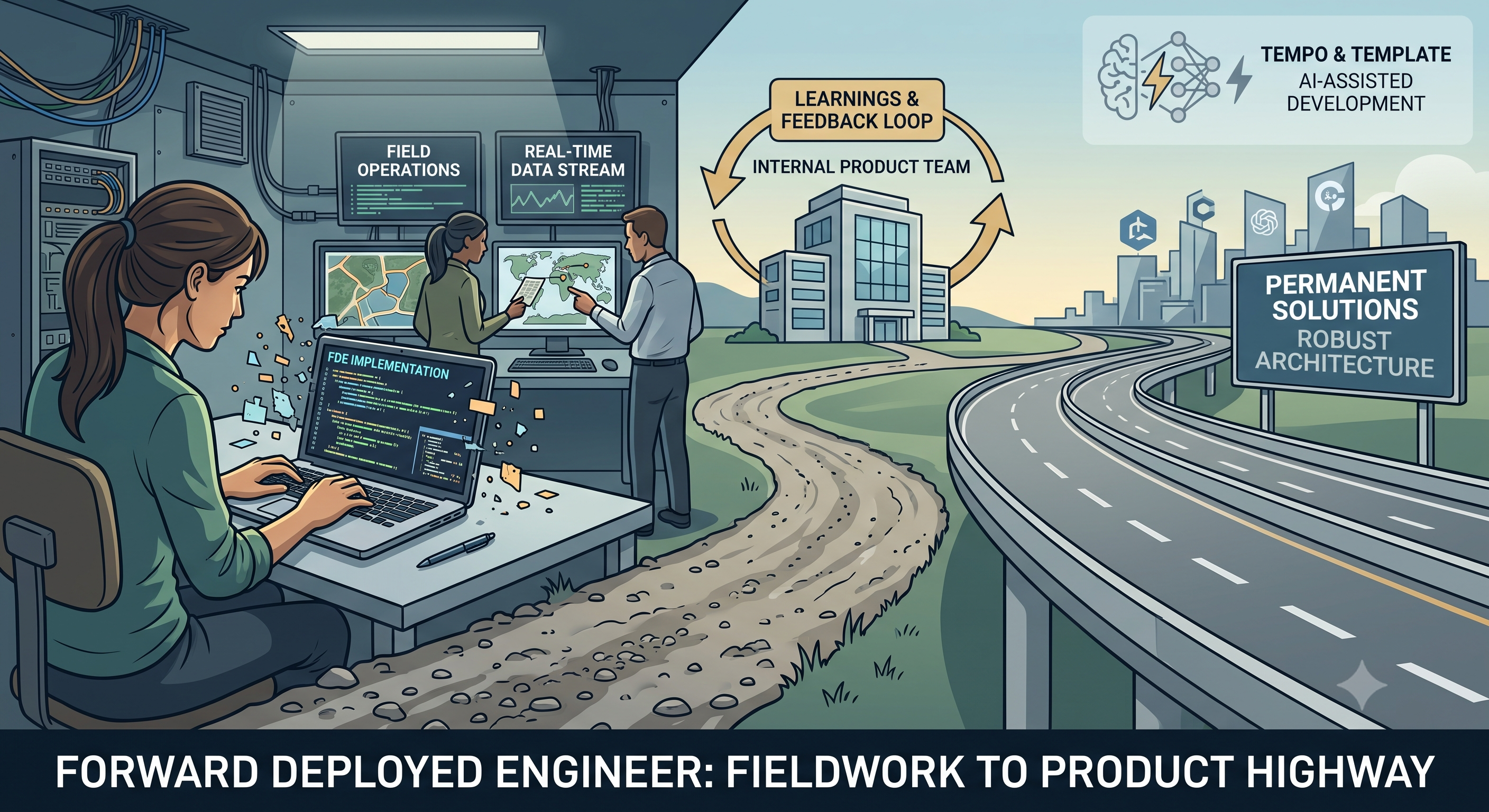
Palantir used a beautiful analogy to explain the product logic behind this approach: the shift from a "gravel road to a paved highway."
Imagine two places that need to be connected, but no road exists between them. The first task is not to design a perfect motorway complete with signs, barriers, and service stations. You put down gravel. You smooth the ground as best you can. People can now get from Point A to Point B without too much hardship, and you learn whether the route is worth developing further. This is forward deployed engineering. That instinct for quick, focused problem-solving against a live problem is the essence of the discipline.
Once the gravel road approach works, that learning flows back to headquarters. The core engineering team can see what was useful, smooth out the rough edges, and make the underlying architecture more reliable. A local fix transforms into a reusable product capability. The FDE in the field proves that a solution works in a real scenario; the product team then asks, "How do we build this out comprehensively?" This feedback loop between the FDEs and their product team is critical. Without it, companies end up doing endless, one-off custom work. With it, every difficult deployment helps the core product serve the next customer better.
This is also why an FDE is not simply a consultant with a dramatic title. The real distinction isn't whether the engineer travels or sits on-site; it's whether what they learn and do in the field fundamentally changes the core product or offering. If an engineer continuously patches customer-specific problems without returning anything to the core platform, the work may satisfy the customer temporarily, but it creates deep dependency and technical debt. In Palantir's terms, the gravel road never gets paved. A proper FDE model requires discipline: the team must solve the immediate problem, identify what is reusable, and systematically transition away from bespoke fixes toward permanent and robust solutions. Yet those first-cut solutions are exactly what open the way to a deeper engagement.
Today, this idea pioneered two decades ago feels newly vital, and many technology companies want to call their engineers FDEs. The reason extends beyond rebranding, though it is not quite the reason usually given. Generative AI, agentic workflows, and modern tooling have made the mechanics of writing code dramatically easier, and it is tempting to conclude that this democratizes the role, that forward deployment is no longer restricted to a small, elite cohort. That conclusion does not survive contact with what the job actually demands. Nearly everything difficult about forward deployment sits above the code: reading a workflow that nobody can articulate, deciding which of six visible problems is the one worth solving today, holding a room where the customer has neither a specification nor the time to write one. None of that gets easier because a model can write the function.
What has genuinely changed is tempo. In Palantir's early days, laying the gravel still took days or weeks of implementation work, which meant the engineer had to guess right the first time; a wrong guess cost a sprint. With AI-assisted development, the loop from problem to working prototype can close inside a single meeting. The engineer can now afford to be wrong, and being wrong cheaply is the whole method. A framing can be built, walked through with the customer, discarded, and rebuilt in an afternoon. That compresses the learning cycle that feeds the product team, and it lets an FDE test three interpretations of a problem in the time it once took to test one. The scarce ingredient is still judgment. AI has not widened the pool of people who possess it. It has raised the amount of ground a person who possesses it can cover.
It would also be dishonest to present this model as one without costs. Forward deployment pulls a software company toward services economics. Engineers embedded at a customer site are expensive, difficult to scale, and their output looks, in the near term, like bespoke work rather than product. The discipline that converts field work into reusable capability is real effort that no customer is paying for directly, and it is the first thing to erode when revenue pressure arrives. Palantir has spent years answering the charge that its software margins are really services margins wearing a better suit. Any company adopting this model inherits that same tension, and the honest way to hold it is to treat the conversion step as a funded obligation rather than as something the team gets to when it finds the time.
When forward deployed engineering is executed well, everyone wins. The customer gains immediate business value because an engineer solves a real problem rather than demonstrating a static feature. Trust deepens because the engineer took time to understand the customer's world from the inside out. Simultaneously, the product organization gains direct ground truth about where its software succeeds, where it falls short, and what needs to be built next.
That is the true philosophy behind the Forward Deployed Engineer. It is a practical recognition that some of the most critical problems reveal themselves only in the field, where they must be felt and understood in real time. The first solution does not need to be perfect, but it must work, and the FDE must show stakeholders why it is worth pursuing. Once that proof is established, the team can harness those learnings to build something truly enduring, turning a simple gravel road into a powerful, paved highway.