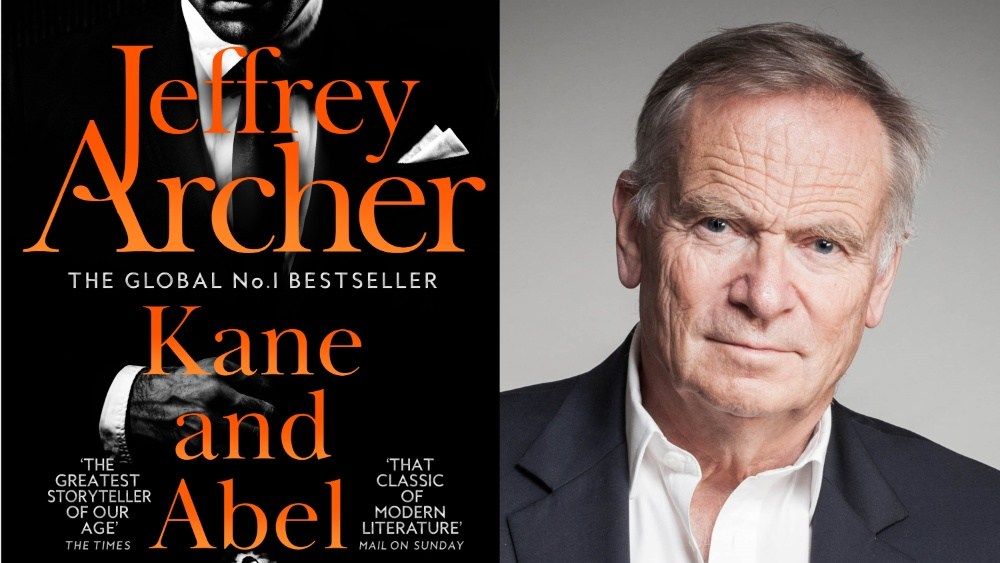
The last Jeffrey Archer I read was more than a decade ago, and that was a re-read of “Kane and Abel”. I had found a first-edition hard bound copy of the book in a thrift store. Reading Kane and Abel after twenty five years took me back to my younger days when I started reading adult books, and it was writers like Jeffrey Archer, Ken Follett, Frederick Forsyth, Sidney Sheldon and James Hadley Chase who fueled my love for books. I suspect most readers begin their journey with books with a great story, not so much for the language, but the gripping narrative and edge of the seat drama. Love for language and literature comes later.
In fact, before I read Kane and Abel for the first time as a teen, I had watched the 1985 CBS adaptation on video. Those were the days when video cassettes and lending libraries proliferated. We were in Hyderabad then, and my father was a member of one the finest video libraries in the city. It was called Top-Shop, located in patni junction, run by two Sindhi brothers. Fantastic businessmen, both. They had an instinctive feel for good movies and their recommendations more often than not were worth watching, at least once ( I owe my love for movies to those brothers) . My father was an ideal customer. They loved him because he liked to sample new titles without questions, and the brothers would willingly oblige by loading him with dozens of cassettes each time he visited the store. If the brothers wanted a review of freshly arrived titles,especially English ones, they would lend it to my father, who would sometimes come home with a carton full of movies (I am serious, he did) much to the irritation of mom. It was from one of those big loads, I got to watch Kane and Abel. If memory serves me right, there were six tapes. We watched the series over ten days or so.
Soon after, I read the book. It was one of my first full length novels that I was able to finish. Fresh from the teleseries, the book was a fantastic read - an archetypal story of two men, one born poor, and the other with a silver spoon and how these two boys, brought up in utterly different circumstances, make it out in the world and how their paths cross to reach a final confrontation. The novel is, what we call, a multi-generational novel. The opening line of the book is firmly etched in my mind: “ She only stopped screaming when she died. It was then that he started screaming”. This is how Abel Rosnovski’s - one of the protagonists - birth is announced. Almost Tolstoyian! And on the other side of the world, William Lowell Kane, is born in one of the best private hospitals in Boston. Once this contrast is framed, Archer takes us an unforgettable emotional ride full of twists and turns and drama. Kane and Abel is a thick book, around four hundred pages depending on the font and size of the edition. And written in breezy style that is typical Archer. It is the perfect introduction to someone who wants to get into the habit of reading. I have said this to many young readers that If you have the mental muscle to read and enjoy Kane and Abel, chances are high that you have the reading gene in you.
Archer’s literary output is phenomenal despite his active social and political lifestyle. Thirty full length novels, ninety-five short stories, three plays, three prison diaries ( yes, he was imprisoned because he lied under oath in a libel case against a Newspaper), a children’s book, and a gospel ( a controversial book about the life of Jesus from Judas’s perspective). I haven’t read them all. But I have read the popular ones: “As the crow flies”, “Not a penny more, not a penny less”, “first among equals”. They are in the same class as Kane and Abel, written fluently and compulsively readable. Many Archer fans consider “As the crow flies” his best work. Well, art is subjective, and in my opinion, structurally, Kane and Abel, is Archer’s most complete and fulfilling novel.
It is a testament to Archer’s reach among the reading public that his stories are known in many regional languages. In youtube you will find quite a few reels from readers presenting an Archer story in their own language. There are about three millions copies of his books in print, including translations.A staggering number, by any count, considering that the act of reading itself has diminished in recent years. Archer literally died writing. Just a day after his death, his final novel “Adam and Eve’ was released.
The question often debated is whether Archer’s works qualify as literature in the way Henry James or Anthony Trollope’s or Dicken’s works are read. That is a mute question, and a snobbish position to take. The difference between classical literature and popular writing is in the texture of language, and the focus of writing. All of them tell stories, one way or the other. In Henry James books, for instance, you will find deep psychological exploration, rich descriptions of people, places and inner dispositions of characters but very little story. You don’t read James for his breathtaking stories; you read him for rich inner worlds he deftly excavates and lays bare in honeyed prose. But in writers like Archer, story and narrative pace is everything. You just can’t read James in one sitting. It is not advisable, either. But Archer’s novels are unputdownable. Like Stephen King, Archer spun stories that immediately appealed to the heart. Though he wrote for the western audience, they resonated with others too. That is what fiction is for. To create an imagined world that others can enter, immerse and appreciate. Archer was a master at pulling at the right strings in the reader’s mind and heart.
Prolific writers usually live secluded lives, but Archer's life was a complicated one. Writing came easily to him. He could write anywhere, even in prison. His ambitions were not to be known just as an author, his horizons were wider. But the one thread that weaves through his life, no matter whatever else he did, was writing stories. That is a gift. To be able to wake up in the morning, put pen to paper, unlock one’s creative instincts, and allow words to flow across the page. Archer was vocal about his writing discipline and it is worth remembering his process. When he worked on a book, he wrote six hours a day in two-hour blocks, one in the morning and the other in the afternoon with two-hour breaks between them. He took a long walk in the afternoon, followed by two more hours of reviewing what he'd written that day. Importantly, he wrote his drafts in longhand, using a felt-tip pen. By his own admission, he wrote up to fourteen drafts of a book before he handed it to the editor and publishers. Archer could write so many books not just through talent - which he obviously had in plenty - but it was his personal uncompromising discipline that scaffolded his writing life. It is discipline like this that differentiates the successful man from the rest.
There are enough critics in the field who attempt to weigh his literary achievements against the improprieties and missteps of his personal life. I am not on that side. I look at Archer through the lens of his work and everything else is his personal business. Did Archer repeat a formulaic structure in his novels? Yes, he did. The subtle theme that ran through his novels is the battle between merit versus privilege. Whether it is Abel, the polish immigrant in Kane and Abel, or Clifton the dockworker’s son in “Only time will tell”, or Charlie, the barrow boy in “As the crow flies, Archer preferred the story of underdogs overcoming odds to win. His moral universe consistently leaned towards the underprivileged, though he himself belonged to the wealthy class. And no one could craft a climax as Archer. His narrative would reach its crescendo only to take an unexpected turn. In kane and Abel, towards the end Archer scripts a haunting scene when both men, aged, near the end of their lives, rival in every sense of the word, yet with deep respect for each other, doff their hats to each other. A rare and momentary acknowledgement of each other's social equals. It is endings like these that made reading Archer’s books a cathartic experience.
It has been a while since I read an Archer book. Still, I fondly remember him. He belonged to my formative reading years, as one whose grand tales of moral and ethical wars gently eased me into the world of fiction, preparing me for deeper and more literary experiences that followed. Before writing this essay this morning, I hunted for my hard bound copy of Kane and Abel. I found it on one of the bookshelves in my bedroom, its pages yellowed and a black and white photo of a young and debonair looking Archer on the backside of the dust cover. I read the first chapter just to get into the mood of writing this piece. I needed to relive that experience once more. I still felt the thrill of the opening scene, the tumbling sentences conjuring vivid images of a child born in the wilderness, and another in a gilded hospital room. The narrative flowed smoothly just doing enough to evolve the atmosphere and mood of the long story to follow. I closed the book and began writing this essay as my tribute to one of finest story tellers of our generation.
Jeffrey Archer will be read for a very long time. There should be no doubt about that.