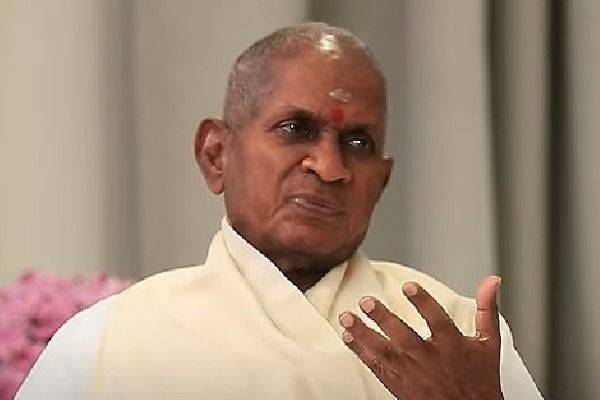
Fifty years is a long time in any field of endeavour, more so in a demanding art form like music, the most subtle and ephemeral of the arts. When those fifty years are filled with unbridled passion, supreme commitment to one’s calling and craft, undisputed mastery of technique, unswerving discipline and dedication, and, above all, a prodigious output that baffles the imagination, then such an artist is indeed worthy of celebration. There are just a handful of artists who have sustained their artistic excellence for half a century or more. Instantly, Picasso comes to mind: he produced on the order of 50,000 artworks over a career spanning more than seven decades. Tolstoy wrote towering novels, shorter fictions, essays, and religious–philosophical texts over about fifty years, running into tens of millions of words. And then there is Ilaiyaraaja, the musical maestro, a living legend—a phrase often casually bestowed on people but certainly appropriate for him—who has composed music for over 8,500 songs and provided scores and ensembles for more than fifty years.
May 14th, 2026, officially commemorates his fiftieth year in music, a period that marks only his public life; his musical journey began much earlier in the verdant fields of his village, Pannaipuram, nestled in the foothills of the Western Ghats, where, as a young boy, uneducated and free, music flowed through him—clear as a stream, untutored, yet strangely fresh and buoyant. Art often manifests early. Exactly fifty years ago, the Tamil film Annakili hit the screens, and for the first time Ilaiyaraaja’s name appeared as music director. In India, film music is an art form in its own right, a genre unto itself, and the surest way into the hearts of millions of music lovers is through the songs they hear in cinemas and on the airwaves. While the classical repertoire is still revered, the popularity and fame one can attain through film music is virtually unparalleled anywhere else in the world. They were penniless, when Ilaiyaraaja and his brothers landed in Chennai - the great southern metropolis, the counterpart to Mumbai in the north. The only aspiration young Raaja carried in his heart was to learn music and, one day, perhaps, if the gods prevailed to compose for films.
Then Annakilli came along in 1976 and catalyzed the break Ilaiyaraaja needed. The story often told of how he came to be its music composer is worth retelling. Producer Panchu Arunachalam happened to hear Raaja’s now iconic tune “Annakkili Unnai Theduthe” and was deeply moved by its strange musical idiom, its ache and ecstasy. He immediately decided that a script should be built around this song , and he drew upon a story by R. Selvaraj to commission the project. The universe does work in mysterious ways. The film itself, by modern aesthetic standards, was a modest village drama. It was the soundtrack filled with its fusion of folk idioms, classical motifs, and modern orchestration that lifted the narrative to a masterpiece, a musical trait would demonstrate over and over again throughout his musical journey: the ability to transform mediocre movies into enchating audio landscapes. In Annakilli, the young Raaja, whose natural talent and diligent study had prepared him for such a musical break, quietly announced his arrival with five songs and a haunting background score. The music was unlike what people had heard until then: the sound, the tone, the timbre, the interludes, the layered orchestration and the fragrant atmosphere it evoked—all of it deeply grounded in the tradition of the great masters before him and yet, in some strange way, sounding utterly new. Little did he or the listening public realize that a musical phenomenon had just been ushered in, an inflection point in Tamil film music had occurred, a turn that would transform the very texture of musical composition for films.
It would be wrong to assume that Ilaiyaraaja was unanimously welcomed after the success of Annakili. He had his detractors. Critics felt that his music was too lusty, too extravagant, and prone to musical excesses and experiments that did not quite fit the cinematic medium. The flow, cadence, and tempo of M. S. Viswanathan’s mellifluous compositions were still the gold standard; measured against them, Raaja’s music was difficult to place. It was symphonic - true; and yet, at the same time, earthy and rooted in the emotion each song wished to convey. No two interludes were the same. he played with instruments drawing sounds never heard before. His songs compelled listeners to hear the entire composition, not just hum the main tune (which they did anyway) or linger over the lyrics. One of the serious criticisms leveled against his work, right from the beginning, was that Raaja shifted the focus from lyrics to the musical arrangement of the song, thereby compromising the poetic beauty one had come to expect of film music. To some extent, this criticism holds true, but to dwell on it is to miss the point. Raaja’s focus was on musical harmony—on the delicate balance between the musical interpretation of emotion and the language that seeks to express it. In that duality, sometimes words sometimes lost their prominence, unless a Kannadasan, a Vairamuthu, a Vaali, or a few equally great poets found inspiration to write poems that matched the musical vision of the maestro.
For music lovers of my generation, there was never a time when Ilaiyaraaja’s music was not in the air. We grew up listening to him. The eighties and nineties were his golden years: the period in which the artist in him unravelled every possibility contained within a four‑and‑a‑half‑minute film song. From tragic to comic; from a mother’s love to the infatuation of youth and the romance of adolescence; from the passionate to the patriotic; from lullaby to lust; from birth to death; from marriage to funeral—there is scarcely a life event or emotion that his music has not given soul to or embellished with musical finesse. He composed for films at an astonishing rate as well. At his peak in the 1980s, he scored the songs and background music for more than forty films a year—an almost unimaginable output during that period. That is a phenomenal number of songs, and most, if not all, were musically brilliant. Unlike most film composers, Raaja, like the great Western classical composers, wrote his music out on paper, and more often than not he did not have to be present during recording, because every nuance, every note, each octave was clearly notated and anyone who could read and understand music could conduct and record. Music originates full and complete in his head before he brings it out on paper.
The beauty of Raaja’s music lies in its structure—in its harmonies, as musicians would say. Like a sonnet in literature, every song is a lyrical, musical poem with its own grammar, symbolism, and intent. Close your eyes and listen deeply to the sound and you are transported into a world created by a layered musical arrangement that reveals itself gradually over time. Even though his songs are usually made to order for films, Raaja’s genius lies in his ability to make the music transcend the temporal frame for which it is created. You do not have to know the film sequence to enjoy the song. Once it is composed, the song stands alone in its resplendent musical beauty, to be experienced and enjoyed from every angle. That, for me, is the key differentiator between Raaja and most other film composers: for him, the musicality—the very structure of the piece—must shine forth, and when it does, it automatically lifts whatever is happening on the screen. How else can we explain how a low‑budget Ramarajan‑starrer like Karagattakaran became a mega hit in the late eighties, or the innumerable films of that kind? It is the magic of Raaja’s music, nothing else.
There is scarcely an artist who has worked with him who has not attested to Raaja’s inner discipline, his punctuality, his perfectionism, and his almost ascetic approach to music. No singer or musician could get away with singing a false note or playing a phrase carelessly. That demand for excellence, in himself and in others, elevates him not merely as a man of genius but as someone who understands that genius without rigor and discipline is useless, even meaningless. Singers who have sung just one or two songs for him still cherish those musical sessions as the crescendos of their careers.
In the heat of our adulation for favorite artists, especially someone like Raaja, we forget that they are human too, susceptible to the same weaknesses we are prey to. Raaja is headstrong, likes to think of himself as beyond comparison, and is definitely not an easy person to interview. Part of the problem is that many of those who approach him to ask about his music do not quite know what to ask, and what they receive in response to their inane questions is a brusque rebuff or a curt dismissal from the maestro. One of the low points in Raaja’s otherwise indomitable stature in music was his failure to acknowledge A. R. Rahman’s Academy Award–winning work with an open heart. He simply could not accept that a younger composer ( who had worked under him) had garnered international acclaim while he, arguably the more accomplished of the two, had yet to receive any such recognition. That’s natural. It is our sense of how people we put on a pedestal should behave that causes the problem, not theirs.
Raaja is in his eighties now, still strong and vibrant musically. His long‑cherished dream of writing and recording a full‑length symphony has been realized, and we are told he is already at work on a second. He is as busy as ever. The sparkle in his eyes has not dimmed. Age may have made him physically frail, but his mind is still restlessly active. How many more years will he be able to go on? We do not know. For men like him, age is not a factor at all. Chronological time does not touch them. They measure time in a different dimension: so completely absorbed are they in their work that time loses its serrated edge—the edge that fragments and dissipates energy—and instead becomes a creative force propelling them to create more.
This is my my third or fourth essay on Raaja in the last few years, and each time I write, I am filled with great joy. I write as if this is the first time I am writing about him. He is such an integral part of my life and millions of others who listen to his music.
Fifty years in music, then, for the maestro. Here is wishing him many more years of creative life. Who knows what still lies hidden in Raaja’s musical repertoire, waiting to be heard? Every time he steps into his recording studio, the air seems to stand still, and when he picks up his pen and paper there is a breathless hush, everyone around him waiting to see what musical contours the master is about to draw in space and time. We, too, are in attendance, in spirit—wherever we are.