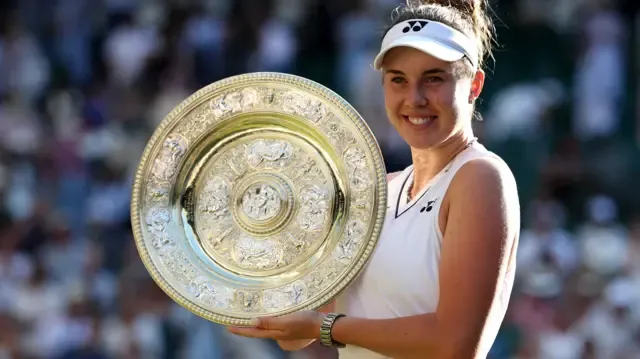
There is something to be said about royalty. Even if the title doesn’t mean very much anymore, and democracies have pushed royalty to the sidelines, it hasn’t disappeared. You see it most clearly during Wimbledon. I tuned in early for the finals not just for the commentary and the buildup towards the women's final, but to watch that moment when the Princess of Wales made her entry.
The first thing that hits you is the way she carries herself. Kate comes in wearing a simple, beautiful red dress. Nothing flashy, and at the same time stunningly attractive. She talks to the organizers, the staff, and a few kids. She stops a little longer by a child in a wheelchair. When the child doesn’t respond, Kate bends down to talk to her with the same intensity and easy grace. None of it looks forced. Then she crosses the bridge that connects the clubhouse and the court. Every eye is on her, but she seems completely untouched by that fact. That absence of self‑consciousness is its own kind of training. Or maybe its own kind of birthright, a strange gift of royalty: to be permanently watched and somehow remain untouched by the watching.
And then, inside all this ritual and ceremony, there is a very different story that was about to make history on the court today. On the eve of Wimbledon 2024, an 18‑year‑old girl named Linda Nosková lost her mother, Ivana, to cancer. Her working‑class parents, holding two or three jobs, quietly poured their money and time into tennis lessons for Linda. 2024 was her break‑out year, and Wimbledon her first major Grand Slam. Losing her mom was a great shock. Yet, twenty‑four hours later Linda was on a court playing Sara Errani, an Italian, on grass, and she won in straight sets. But that was only as far as she could go that year; she lost in the second round. But now, a couple of years later, that same girl stood on Centre Court with the Wimbledon trophy in her hands and tears and smiles on her face.
During her victory speech, she looked up for a moment and thanked her mother. She said she wouldn’t be there without her. Her father was in the stands, trying to hold himself together. It’s easy to forget, at moments like this, that not every champion arrives from a neat, privileged route into the sport. A lot of them come from homes where time and money have to be stretched thin, where one person’s ambition becomes everyone’s burden and everyone’s hope. When they win, the trophy is not just about talent. It is about those years that nobody saw and years that were spent chasing a dream.
Karolína Muchová played marvelous tennis today. It was a great game befitting a championship final. Neither one throws around a lot of emotion. In the first set, Nosková seemed settled. The serve was working, she was hitting the ball cleanly and the shots were landing where she wanted them to; there was a rhythm that looked unassailable. In the second set, she continued her roll and was up 5–2, ready to serve for the championship.
That is where everything changed. It always does at that point, doesn’t it? You can play freely right up to the moment you realize you are serving for Wimbledon championship, and then the racket suddenly feels heavier. Nosková likes to say during her interviews that she doesn’t bother about rankings or titles and just focuses on enjoying the game. But at 5–2, serving to win one of the biggest matches of her life, those words sounded hollow. She was tangibly nervous, and rightly so. She couldn’t close the game. Her first serves started missing the box. Forehands went spraying all over the place. Muchová, sensing the tension in her opponent, lifted her own game and took the second set 7–5, a great revival from the Czech. A match that looked almost finished suddenly opened up again.
To go from being a few points away to losing the set is brutal on anyone. It is not just the physical exhaustion of having lost something that was within one's grasp but the psychological paralysis it causes. It eats into your confidence. Not many players could have recovered from that dip, but not Nosková. That’s the surprising part. For a young girl, she displayed remarkable maturity and did not allow the loss of the second set to weigh on her. She started the third set by breaking Muchová and from there she held on to her own service games quite well.
When she finally won with a great service, she lay down on the ground, hands on her face, unable to believe that she had achieved something impossible. Then she got up, looked around at Centre Court, and you could see the tears, the smile, and the weight of the last two years all sitting together on her face. For once, the history, the crowd, the cameras, and even the Royal Box faded into the background. It was her moment, and she had earned every point that led to it.
It was great ending to women's championship. Martina Navratilova was there in the Royal box, watching both her proteges embrace the center court with passion and emotion. There were a tear or two in her own eyes as well. Whether Nostova will carry on this winning streak and emerge as a consistent champion, we don't know. We hope she will; but nothing can take away her name from the list of champions permanently engraved in the hallowed corridors of the All England tennis club.
That is the highest honor in this sport.