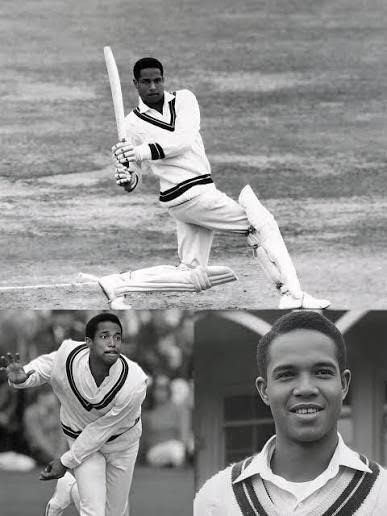
I have not seen Sir Garfield Sobers play. He retired before I started following cricket. In fact, very few of us have. When he was playing at his peak, televised cricket was nothing like what we have now. If you wanted to watch him, you had to be at the ground or wait for those rare tours when the West Indies came to your country, your city, your ground. But what an experience that must have been.
And yet it is almost impossible to have even a modest interest in cricket and not know of Sobers. India is a cricket‑loving country, and growing up in the 1970s, it was impossible not to have heard of him. His legend was overpowering. My parents, grandparents, elder cousins, uncles, friends—all of them incessantly talked about him, especially that improbable feat of six sixes in an over. It was the stuff of imagination. Sobers did it in 1968. Anyone who has ever held a cricket bat in his or her hand knows the difficulty of hitting one ball in an over over the boundary, let alone six. For a long time that act stood alone as an act of God, and Gary Sobers’ name was always taken with a breath of reverence and awe. He was the cricketer of our dreams, the high priest of bat and ball.
As I grew, learning and appreciating the game, what interested me more than that achievement was Sobers’ position as an all‑rounder.
In every sport there are specialist positions, and every sportsman likes to settle into specialist roles. Football has defenders and forwards, basketball has guards and centers, cricket has batsmen and bowlers. When you begin playing the game, you are never sure what you are good at; you dabble with everything. Then, gradually, you hear from others or feel within yourself that one part of the game comes more naturally to you. You are more of a batsman, or less of a bowler. The feedback loop, from others and from within, kicks in. You lean into that. The rest of your game doesn’t disappear, but it moves to the margins, and you end up becoming a specialist.
But there are those select few who don’t get caught in that stranglehold of specialization. They retain their joy and freedom to do everything the game offers. Cricket has always had a special place for the genuine all‑rounder, the player who can do more than one job properly and is trusted in all of them. Sobers was the clearest example of that. When we hear about the Bradmans, Gavaskars and others, they are remembered as master batsmen with matchless class, technique and style. Sobers is spoken of differently. Bradman himself called him a “five‑in‑one cricketer” and “the greatest all‑round cricketer” he had seen. Sobers could bat, bowl and field at the highest level, and he could bowl in different styles: left‑arm fast or medium, left‑arm spin and other variations, depending on the situation. He could do anything the game demanded, and usually did it well.
When I look back on the cricket of my younger days, it is the all‑rounders who come first to mind: Kapil Dev, Ian Botham, Richard Hadlee, Imran Khan and even Vivian Richards. They could change a match on their own. There was something magical about their presence. They had great personalities, and when they played, the atmosphere was electrifying and unpredictable. Single‑handedly, they could change the course of a match. Their brilliance had many dimensions, like a diamond; whichever side happened to catch the light on a given day shone with an iridescence that mesmerised the spectators. Sobers belongs to that elite group, but he was one of the first great, genuine all‑rounders of the game. He was a trailblazer. He showed, long before many others, what it means for one player to be trusted with the bat, the ball and the fielding—a complete cricketer, the like of which there are very few today.
There is another aspect to him that mattered to me as I understood sport better, and that is how he played the game and what kind of cricketer he was beyond the extraordinary statistics of his career. Much of what I know about his cricket and life comes from what I have read and heard, along with the occasional bit of footage on YouTube. In a world where we now have video evidence of almost every ball, there is something special about knowing a player mainly through language and recollection. It lets us imagine the man: his innings, his spells, his catches. Writing about Sobers reminds me of Attenborough’s remark about Gandhi, that future generations might scarcely believe that such a man walked the earth in flesh and blood. Yes, it does seem strange that such men as Sobers ever played the game of cricket, doesn’t it?
Under Sobers’ captaincy, the face of West Indian cricket was transformed. The West Indies team that grew under his tutelage turned out to be one of the greatest sides that cricket has ever known. The 1970s and 80s West Indian side had so much skill, talent, and joy for the game that even if they occasionally lost a match (which was rare), we still rooted for them. Sobers gave that dream team its initial shape and form, which the great Clive Lloyd then took over and refined. When I think of West Indies in their prime, I think of a way of playing that felt different at all levels. While other sides were often careful and methodical, the West Indians played with flair. There was swagger and rhythm in their batting and a kind of raw intensity in their fast bowling. Their talent seemed to carry something of the spirit of the place they came from, and of heroes like Sobers who led from the front.
After Sobers, West Indies produced a stream of players who carried that spirit forward: Lloyd, Viv Richards, Brian Lara, Malcolm Marshall, Curtly Ambrose, Joel Garner, Jeffrey Dujon, Larry Gomes and many others. The West Indian team today is a different story. It is easy to dwell on that gap between past and present, but that is not what I am trying to do here; that is a different story for a different time.
The spirit of Sir Gary Sobers will live on. For twenty blazing years between 1954 and 1974, he changed the course of cricket and set the standards of the game for a new era. Very few people possess the talent, dedication and effort to leave a mark on their professions; Sobers was one of them. Not just on the field, but off it. In his available interviews, he comes across as a great evangelist and ambassador of the game and, through the game, of life and how to lead it with dignity and grace. Many times, we lift a sportsman or woman to glory only to find out that, when they hit the ground, they are miserably ill‑equipped to handle daily life. Fame, riches and adulation don’t sit well on them. But Sobers was different. He quit the game close to his peak, and thereafter led a rich and fulfilling after‑cricket life.
Dying at eighty‑nine years, after such a rich life, is a blessing. The fact that I write this tribute to a man whom I have never seen play, but whose achievements have been the background against which I have known the game throughout my life, is itself a testament to Sobers’ legacy.