The secret is out: SAIT’s centennial birthday cake was a creation that tested both gravity and the skills of more than 70 volunteers.
Students, staff, faculty, alumni and notable members of the community were all on hand to witness the unveiling of the culinary wonder on Sunday, Oct. 16, during SAIT’s 100th birthday celebration.
What they did not see, however, were the 1,300 hours of planning and labour that went into creating the seven-foot tall, 14-tiered, edible work of art.
“It would be at 2,000 hours just from all the time I’ve spent thinking about it,” laughed Rose Warden, a graduate of, and now an instructor in SAIT’s baking and pastry arts program.
Back in October of 2015, Warden, an award-winning baker, was tasked by the SAIT 100 planning committee to lead a team of volunteers in creating what would likely be the biggest culinary creation of their careers.
By February, 2016, Warden sent out a SAIT-wide call for ideas for the cake, soliciting input from students, staff and faculty in all of the school’s departments.
As evidenced by the final product, a Heritage Hall theme was one of the most frequently suggested ideas, especially from SAIT’s staff and faculty.
Warden said that students didn’t submit a great deal of feedback for the cake, with most requesting that it just be “big or grand.” But a few funny and clever ideas caught the eye of the planning team.
“This is the best one,” said Warden, reading one of the submissions aloud. A student had requested “a superhero called ‘Learning Man,’ so we ended up doing the Learning Man and the Learning Woman.”
Indeed, Learning Man and Learning Woman are just two of more than 100 edible figurines on the cake, some of which are representational of students and those within the SAIT community.
Others, like Calgary Mayor Naheed Nenshi, were real people, whose likenesses, for a brief moment, were immortalized in gummy candy and fondant.
By the end of April of 2016, Warden had gathered enough feedback and was ready to start recruiting her team of volunteers, starting with staff and faculty in the baking and pastry arts program, and then expanding to include alumni, industry members and students.
There was no formal application process, and anyone who was willing to help out with the project was welcome, with one caveat: each volunteer had to sign a confidentiality agreement, and solemnly swear that every detail of this undertaking was kept top secret until the cake’s big unveiling.
“If anything, it wasn’t so much the volunteers we were worried about, it was myself,” said Warden, grinning.
As an online cake blogger, Warden said she frequently updates her followers on the progress of her creations over social media. But for this project, she had to resist the temptation.
There was a payoff, however, to the level of secrecy required from the team in order to make this project a success.
“I trust them more than I trust myself, and when you put that trust in students, they really perform,” said Warden.
“The honest truth of this all, which I would really love to emphasize, is that I probably only touched about five per cent of the cake,” said Warden.
“The majority of the work was done by students or alumni. That’s the part I’m most proud of.”
What’s more incredible is that all of this work was a volunteer effort.
It was experience, not extra credit they would be receiving, said Rebecca Conrad, a second-year baking and pastry arts student.
Amethyst Thompson, another second-year student in the program, agreed.
“There were even cooking students helping, so it was a really interesting dynamic being around all of these people. It was a once-in-a-lifetime experience because nowhere else are you going to be able to work with this variety of people.”
Warden said that while almost all of the baking and pastry arts staff contributed to the cake in some way, about 80 per cent of the work was done by students or graduates of the program.
However, every volunteer was valued, no matter what they brought to the table.
“I wanted to make it as collaborative as possible because I think SAIT is really moving towards a tone of friendliness,” said Warden. “It’s about being friendly, and open, diverse and inclusive.”
Warden found that creating tasks for volunteers based on the areas they had the most skill or expertise in was one way to effectively manage the workload.
“Linnea Neels graduated earlier this year, and she is very, very good at figures. So she probably made over half the figures,” said Warden.
“Rob and Kim Hambley are alumni, as well as industry members, they were part of my class. They came back to help with the cake. They are excellent at structure, so I had them doing anything related to structure, anything technical.”
The minutiae of the planning however, was left to Warden.
“Usually I plan backwards, so I try to think, what do we have to do, what do we have to get done,” said Warden.
“So we did the figures in June, and started sculpting dry decorations over the summer, anything that could hold basically, because I knew I had time to do that then.”
Warden also took on the role of draftsperson for the project, hand drawing each true-to-size structural and detail sketch.
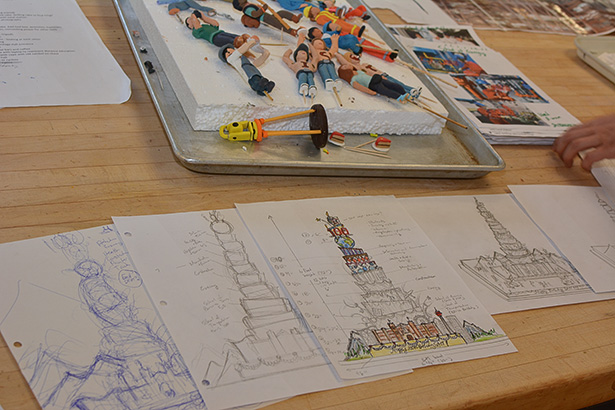
Size was one of the project’s largest logistical challenges, as each of the cake’s three sections would be built on top of an eight-foot, hollow-core door.
“One of the first things we did was measure the elevators, and measure the width of the doorways,” she said.
“Did you know you can fit eight-foot doors into a Toyota Corolla?” asked Warden jokingly.
Most of June, 2016 was spent creating the 100 figurines that would populate the cake.
“The thing about the figures, is that they took so long that one person often wouldn’t complete one from start to finish,” said Thompson.
“So it was a really interesting group collaboration where one person would do one half, another would do the other half, and I would end up doing the hair.”
Warden said the figures were one of the most painstaking details of the cake.
“Just one of those figures can take four hours to make. I did the figure of President Ross, and just the face took three hours. It was crazy.”
During the summer and early fall, the team created a miniature Rocky Mountain test cake for the SAIT 100 organizers to sample, and a 3D cardboard mock-up was built to determine the actual scale of the cake.
Windows in the chocolate and bakery labs were blacked out to keep the project top secret, and the team used the security tunnels that run under the campus for dry assembly runs from the labs to the Stan Grad Centre.
By the end of September, the volunteers started baking the cakes and freezing the completed tiers. Absolutely no detail was spared for the final decorations.
“Heritage Hall was quite the process,” said Warden.
“I told the students to look at the satellite view, and that’s where they were able to plot down all the pieces.”
It’s obvious that Warden is immensely proud of her team and their creation, but still awed by the sheer scale and detail that went into the project.
“A student even went out and they matched the colour of the concrete. Isn’t that crazy?”
Assembly on the cake began the night before the big unveiling, and the team was scrambling to finish on time.
“Six p.m. on Saturday was when we started putting the figures in. I was hoping to be at that point on Friday, but it didn’t work out that way,” said Warden.
“The heaviest day was probably Saturday, the day before. I was here until three a.m. working on the top three tiers. They stressed me out so much.”
Volunteers were back at 7 a.m. on Sunday morning, the big day, to start moving the cake piece by piece over to the Stan Grad Centre, and then begin the final assembly.
“I would say the cake was ready for display at 11 a.m., but we were still putting the final details on at about 10:30 a.m.”
The centre slab was moved over first, then the 14 tiers. A metal pipe, covered in Saran wrap, was used as a guide to keep each tier balanced on the cake.
Once the tiers were on, the outside two slabs were brought in, and additional figurines were placed on the cake, and finishing touches were made.
Warden was given the honour of cutting the first piece of cake at the unveiling ceremony, which she said is her second favourite part of the process.
Her favorite part was eating it, a fact that might surprise those who couldn’t bear the thought of digging into their own creation.
“ I think that’s the beauty of our industry,” said Thompson.
“We make temporary art. It’s very in the moment. It’s something that you experience, and then it goes away forever.
“Anybody who ate a piece of that cake can now say, 20 years down the line, that they ate a piece of the SAIT 100 cake, that was only ever going to be made once.”
Thompson said “making food magic” would be the best way to describe the experience.
“It’s really a dream-like feeling, working on something for months, seeing all of these different pieces and parts going together. Even when we were baking the cakes and making the tiers, everything didn’t seem real.”
I think that’s the beauty of our industry. We make temporary art. It’s very in the moment. It’s something that you experience, and then it goes away forever. – Amethyst Thompson
Warden agreed.
“There’s a lot of work that goes on behind the scenes, and sometimes people don’t believe it. It was a little bit much, it was excessive,” she said, laughing.
“It was complete chaos,” said Thompson.
“We pulled it off, but it was complete chaos to get to that point.”