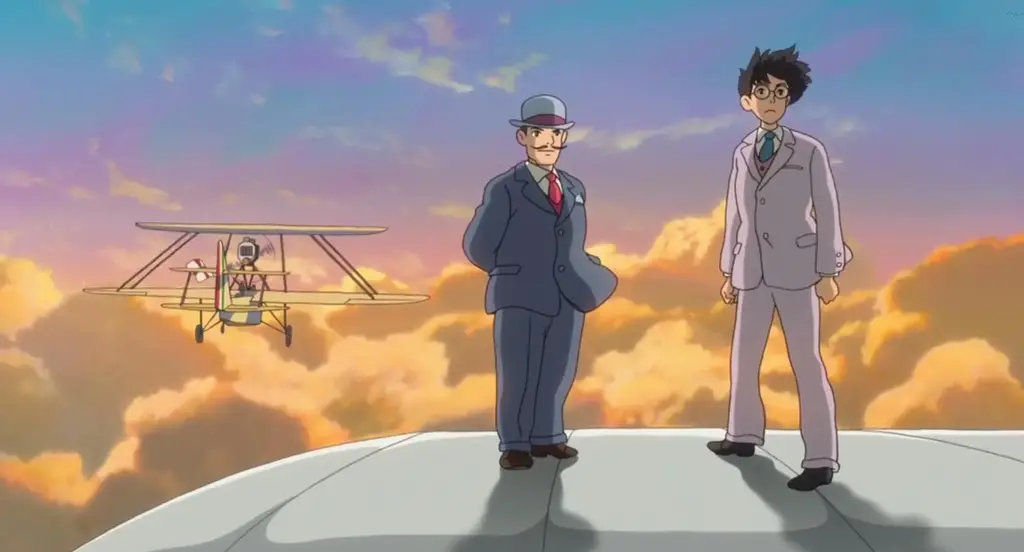
Advertised as Hayao Miyazaki’s last film before retirement (one of many with the title now!), The Wind Rises stands out as a humbly subtle, yet gorgeous installment to the animation savant’s filmography. Exploring joy, heartbreak, and a determination to create beauty during the hardship of WWII Japan, the nuanced film takes a less fantastical approach to storytelling than that of Miyazaki’s prior works. Though often overlooked in Miyazaki’s skilled repertoire, this masterpiece of a film holds a special place in my heart, symbolizing the contrast of immense joy and raw devastation through seasons of life.
A UNIQUE, HEARTBREAKING BEAUTY
In February 2014, I ventured to my local movie theater with a fellow high-school friend to watch the (seeming) final film of Hayao Miyazaki. Knowing only that the story involved WWII and planes, we were quickly blown away by the earnest film. Complete with some of Studio Ghibli’s most breathtaking visuals and a unique story that pulls at the heartstrings, the raw honesty and expression of passionate love within the story moved me to tragic sobbing. With a notably emotional soundtrack from Joe Hisaishi and paired with the miraculous dubbed performances of actors like Joseph Gordon-Levitt, Emily Blunt, John Krasinski, Martin Short, Warner Herzog, & Stanley Tucci (among many more), we were hopeless to the magic of the film. Sitting in silence through the credits, my friend and I didn’t speak a word until my mom picked us up, only then breaking into more sobs when she asked how the movie was! As a piece that has garnered the most emotional reaction from me as a viewer, The Wind Rises is one of my favorite films, still as precious and moving as the day I first saw it.
Based on Hayao Miyazaki’s manga of the same name, The Wind Rises is a fictionalized biography of Jiro Horikoshi, the designer of the Mitsubishi A5M and A6M Zero fighter planes used by Japan during World War II. The film tells the tale of Jiro’s life, following his dreams since childhood of flying (accompanied by his imaginary mentor, the Italian aircraft designer Giovanni Battista Caproni), his career as an engineer, and the lead-up to his marriage to Nahoko, a girl he met during the Great Kanto Earthquake of 1923. Through this tale of this life, the film also shows Japan’s historical, economic, and social contexts in the 1920s and 1930s, exploring themes of creativity, passion, love, and the ethics of war. Though Jiro encounters loss against the backdrop of a horrific war, he continues his fight to create something meaningful with his talents, stating, “All I wanted was to make something beautiful.”
“AIRPLANES ARE BEAUTIFUL CURSED DREAMS, WAITING FOR THE SKY TO SWALLOW THEM UP”
Departing from Studio Ghibli’s lively and whimsical, The Wind Rises is a tale of devastation – both in war and more personally in Jiro Horikoshi’s life. As a poorer and more technologically antiquated country before WWII, the Japan that Jiro grewgrew up in hinders his progress as an engineer, halting his ability to efficiently create the planes he dreams of. Through this and challenging events such as the Earthquake, failed plane tests, running from the German Gestapo, and the tragic death of his wife, Jiro still overcomes such trials to make a beautiful aircraft. Though his planes were ultimately used by the Japanese military to produce death (as well as converting his planes to kamikaze craft), he was still able to find and create beauty through his craft and marriage. Though the wind rose, he still made sure to live.
While the heartbreaking moments of the story may be easy to focus on, the disparity from sadness makes The Wind Rises’ moments of joy all the more incredible. From Jiro’s marriage to Nahoko despite her sickness, to his successful test flight despite being widowed, the film’s beauty compels viewers to mourn when he mourns, yet rejoice when he rejoices. To augment this joy, some of Studio Ghibli’s most stunning work perfectly accompanies the narrative beats, working to create an even more emotional experience. In this way, the life of Jiro Horikoshi is celebrated by Miyazaki through his incredible storytelling, dedicating the filmmakers’ last work (at the time) to the engineer.
CELEBRATING & CONTINUING A LEGACY
While seemingly bleak and dry compared to more popular, family-friendly, and fantastical films like Spirited Away or My Neighbor Totoro, The Wind Rises continues Hayao Miyazaki’s ardent activism against the atrocities of war. Echoing Howl’s Moving Castle and Princess Mononoke‘s implicit anti-war themes, Miyazaki finally explicitly applies his views through a more adult film, harkening to the blunt realities of Grave of The Fireflies. In this way and through similar visuals to his past works, Miyazaki used The Wind Rises to underscore his filmography’s messages, further exploring and celebrating them in a “final” bow to his fans.
Though very different and much less flashy than his other legendary films, The Wind Rises‘ tender and grounded nature brings a more mature and thoughtful tone to Studio Ghibli’s playful stereotype. In fact, by creating the film, Hayao Miyazaki not only honored his own artistic past, but paved the way for future Studio Ghibli releases in the same vein, such as Hiromasa Yonebayashi’s When Marnie Was There (released the following year). Though quite a different project than Miyazaki’s most recent “final” film, The Wind Rises serves as a perfect encapsulation and end to a marvelous legacy. Like Jiro Horikoshi, Miyazaki is truly a master at his craft, creating beauty amidst a warring world.
The Wind Rises is available to stream on Max. For our previous Miyazaki retrospective, check out Ryan Gaur’s thoughts on Ponyo here. Hayao Miyazaki’s latest film, The Boy and the Heron, releases in theatres in the US on December 8, and you can find our review for it here.