Davidson’s political contributions conflict with her words of support for
LGBTQ+ and immigrant communities
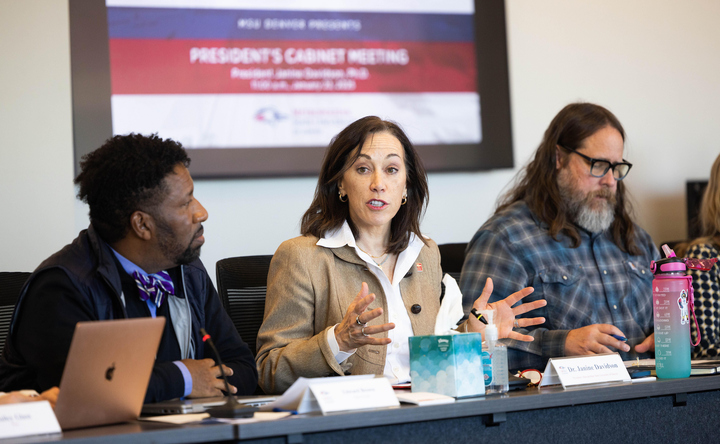
In the first week of classes for the spring 2025 semester, MSU Denver President Janine Davidson gave remarks to university leaders, focusing on “the University’s commitment to its core values.”
Early among those remarks, Davidson outlined her vision of the university’s purpose and mission.
“We’re here to educate. We’re here to create welcoming spaces of learning and critical thinking to foster open and fact-based dialogues, free speech,” she said.
Davidson also stressed that the university needs to be a resource and site of support for the student body.
“We’re here to help our students navigate history even as it’s unfolding around us.”
In the specific context of immigration and deportation risks, she added, “With respect to immigration and deportations, what are we doing? We are making sure our community understands what the law is and what their rights are. … It’s my personal opinion that this university is actually probably one of the most supportive places for that community and their families.”
Davidson’s remarks as university president seem to stand in contrast to her political donations.
Davidson’s contributions helped elect Democrat Sen. Elissa Slotkin of Michigan who voted for the Laken Riley act, supports increasing manufacturing capacity, supports Israel’s military actions, has voted for Republican-led anti-queer legislation, and has strong policy ties to national security circles, all of which has broad implications for the communities represented among the MSU Denver student body.
According to data from the Federal Election Commission (FEC), Davidson provided a combined maximum individual donation of $3,300 in donations to Slotkin’s Senate primary in 2024. Davidson supported Slotkin’s general election Senate race to the tune of another $1,038.
In the 2024 election cycle, Davidson only donated to one other candidate’s committee, having sent $200 to former Vice-President Harris’ general election fund for the presidential bid.
For the 2018, 2020, and 2022 election cycles, Davidson supported Slotkin’s bid for Congress, to a much smaller cumulative total of $1,172.54 for all three cycles.
The Metropolitan reached out to Davidson with questions about her support for Slotkin. Davidson replied, “As president I do not assign my personal political views to my role at MSU Denver, but I do exercise my rights to participate in our democratic process by voting and occasionally donating to causes. And I do so as a private citizen.”
She continued, “I generally do not donate to political campaigns, but I make a big exception for Elissa Slotkin who is not a Colorado politician (she is the Senator from Michigan). I have known her for about 20 years. We met in Iraq and she and I subsequently served in the Pentagon together.”
As a congressperson, former Rep. Slotkin was one of the two democrats who broke party rank and voted, in 2023, alongside Republicans to pass an amendment to the National Defense Authorization Act that banned pride flags and LGBTQ+ topics at military installations.
Janine Davidson strongly supported Slotkin’s Senate bid even after Slotkin voted for that ban and co-signed a letter accusing the International Court of Justice of “false and dangerous allegations” for attempting to hold Israel accountable for its actions in Gaza in January of 2024.
Another point of policy alignment between Davidson and Slotkin is evident in their national security ties and interest in promoting manufacturing capacity. On March 8, 2021, Davidson and Slotkin both spoke at a “Internal Women’s Day 2021: Women in National Security” conference. The event was broadcast live on the internet and sponsored by Lockheed Martin.
Lockheed Martin also sponsors MSU Denver, having provided an undisclosed endowment to MSU Denver to help build the Aerospace and Engineering Sciences building, the Advanced Manufacturing Sciences Institute, and create a pipeline for jobs and workforces to push MSU Denver students towards careers for Lockheed Martin in manufacturing and aerospace.
Additionally, on Jan. 25, 2023, when Slotkin was still a congressperson, she appeared on a podcast episode conducted by a non-profit called “Business Executives for National Security”. In that appearance, Slotkin discussed the importance of building manufacturing workforce development pipelines.
The most recent publicly accessible unclassified official minutes from the Department of Defense’s (DoD) Defense Policy Board, which Davidson still sits on as chair, are from June 2024.
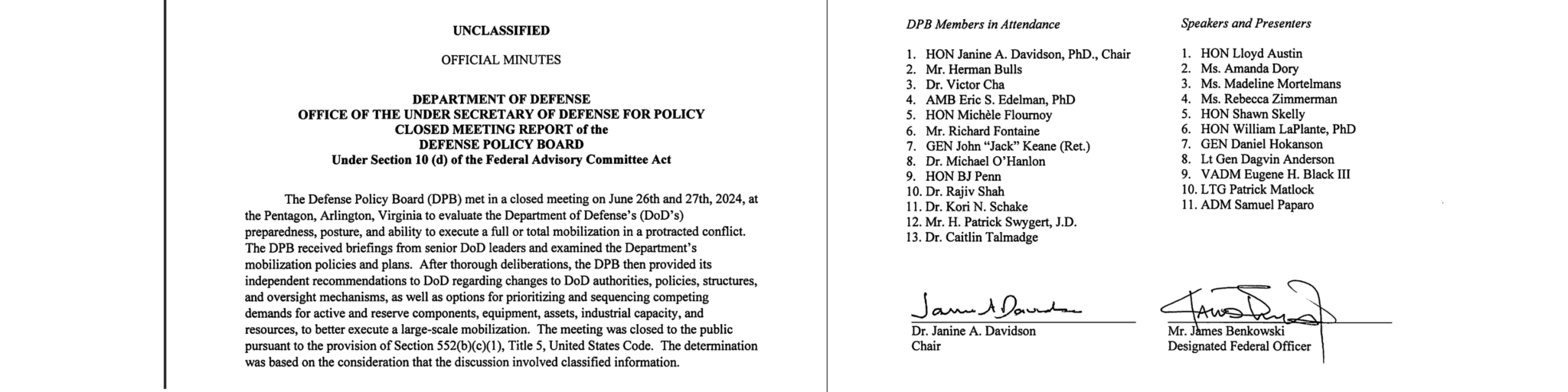
According to those minutes, Davidson and the rest of the Defense Policy Board (DPB), “provided its independent recommendations to DoD regarding changes to DoD authorities, policies, structures, and oversight mechanisms, as well as options for prioritizing and sequencing competing demands for active and reserve components, equipment, assets, industrial capacity, and resources to better execute a large-scale mobilization.”
In other words, the minutes, signed by Davidson in her capacity as DPB Chair, reveal that the DPB was working to help the DoD better access manufacturing and technical capacities to “better execute a large-scale mobilization” in the context of a “protracted conflict”.
As for manufacturing capacity, on Jan. 7, Slotkin joined Congresswoman Kristen McDonald Rivet (MI-08) and Senator Gary Peters (MI) in announcing a $325 million CHIPS Act award to Hemlock Semiconductors.
In the award’s official announcement, Slotkin stated, “America’s self-reliance means bringing our critical supply chains back home from places like China. And semiconductor chips are absolutely critical to Michigan’s economic security and America’s national security.”
Davidson was also involved in MSU protests against the occupation of Gaza.
The DPB meeting took place in June 2024, roughly 2 months after Auraria Campus leaders and Denver police collaborated to destroy the student encampment that was a protest in solidarity with Palestinians.
In between the police raid on April 26, 2024, that initially destroyed the encampment and Davidson’s meeting on June 26 – 27 in her official capacity as the DPB chair, 9News’ Kyle Clark and Melissa Solomon reported on May 7 that Davidson had made false claims about the student protestors, spreading misinformation in an all-campus email broadcast titled “Protestors escalate tactics.”
That misinformation was followed by the detention and ticketing of more than a dozen protesters a few days later.
According to FEC data, Davidson contributed in 2024’s election more than four times the number of total dollars to Slotkin compared to the dollars Davidson contributed to Slotkin in the three election cycles prior, an election that Slotkin ultimately won.
Davidson explained her increase in support, “I donated more money to her most recent campaign because it was a close race and it was for the Senate, where she will be a strong and moderate leader.”
One of the first pieces of legislation Sen. Slotkin voted in favor of as senator, as well as the only piece of legislation that has become a law so far this session (as of March 4), is the Laken Riley Act.
The Laken Riley Act is named after a teenager who was killed.
Pieces of the story of that murder became a xenophobic campaign talking point for Trump’s 2024 bid for presidency.
According to GovTrack, an open government transparency website, Slotkin’s vote in favor of the act was statistically anomalous.
The act empowers law enforcement officials, especially ICE, with a broader mandate.
A community explainer regarding the Laken Riley Act was published by the National Immigration Project, a group run by immigration lawyers, on Jan. 27.
In that document, the group explains the two major impacts of this new law.
“First, certain immigrants who are accused of certain crimes, like shoplifting and assaulting a law enforcement officer, will be detained by Immigration and Customs Enforcement (“ICE”) without an opportunity to ask for release in immigration court while their case is pending. Under the act, a person does not have to be convicted of any crimes to be forced into mandatory detention – even an arrest based on a false accusation or someone admitting that they committed a crime could be enough to detain them indefinitely until their immigration case is over.”
“Second, the Act gives states broad ability to sue the federal government over immigration decisions that the states do not like. For example, under the law, states can go to court to force immigration agencies to continue detaining someone or deport someone.”
The community explainer also provides context that those most directly impacted by this law will be those who are undocumented or temporarily without status.
Regarding her long support for Slotkin as a politician since her first contribution to Slotkin in 2017, Davidson said, “We have a shared world view, and are good friends. She is an amazing public servant and brilliant leader who, like me, has served in both republican and democratic administrations.”
