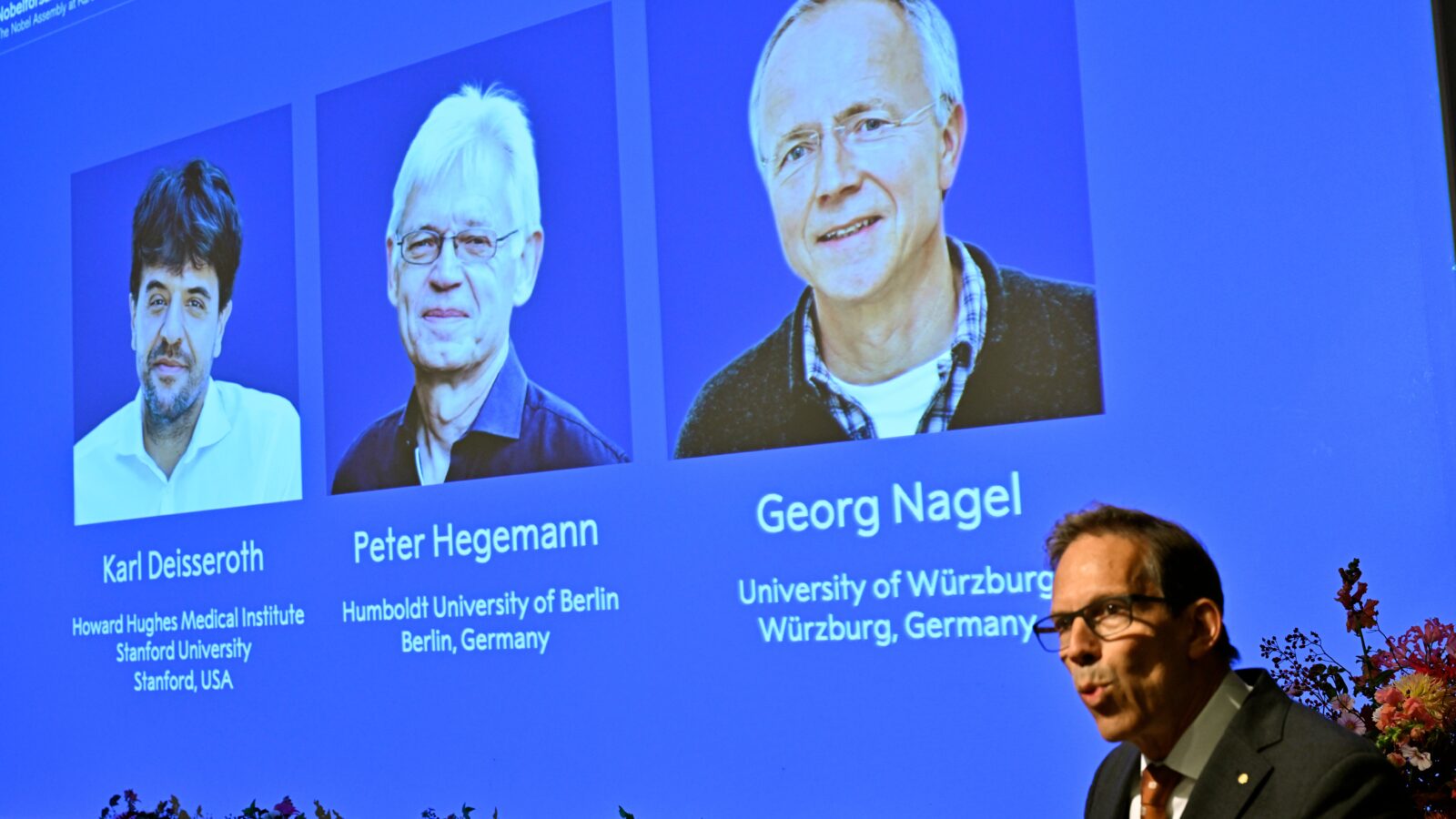
Karl Deisseroth, Peter Hegemann, and Georg Nagel found way to use light to turn neurons on and off with precision
Karl Deisseroth, Peter Hegemann, and Georg Nagel are the joint recipients of the 2026 Nobel Prize in Physiology or Medicine “for their discoveries concerning light-gated ion channels and optogenetics,” the Karolinska Institutet in Stockholm, Sweden announced on Monday.
Deisseroth, 55, a professor at the Howard Hughes Medical Institute and Stanford University; Hegemann, 72, a professor at Humboldt University in Berlin; and Nagel, 73, a professor at the University of Würzburg, Germany, developed a method that uses light, combined with genetic modifications of neurons, to switch on or off individual cells in a living brain. This makes it possible to show how nerve cells shape memories, feelings and behavior in the brain, and is being studied as a treatment for disease.
The work started in the early 1990s at the Max Planck Institute, when Hegemann wondered how a single-cell green alga called Chlamydomonas could swim toward light. Teaming up with Nagel, they discovered the answer: a protein called channelrhodopsin, a light-sensitive ion channel in the cell membrane that rapidly opened when exposed to light. They found that this protein worked in any cell they injected it in.