It’s a staggering figure — and it has nothing to do with the fear of drones and missiles.
In the early days and weeks of the war, the world was focused on the flight of millions of Ukrainians from their homes, and — ultimately, for many of them — out of their country. As we have chronicled in this space, that flow of Ukrainian refugees quickly became the largest-scale European migration since World War II.
But there has been a smaller-scale and politically more significant flow of humanity — this one involving an exodus from Russia. This week, the Washington Post puts a number to that migration: More than 500,000 people — perhaps as many as 1 million — have left Russia since the war began. As a proportion of the population, it’s a fraction of the Ukrainian exodus. But in this case, of course, the decision to leave has involved a very different calculus.
These migrants have fled for reasons that have nothing to do with the fear of missile or drone strikes; theirs have been choices — as best as we can understand them — driven by anger over Russian President Vladimir Putin’s war, fear of retribution for anti-Kremlin views or statements, or worries that Western sanctions might do lasting damage to the Russian economy. Whatever the case, it’s a huge number, and as Grid has reported, there have been two main waves in the Russian exodus: The first came in the immediate aftermath of the invasion; the second, several months later, when Putin announced a fresh mobilization of up to 300,000 troops for his war. That declaration drove a rush of fighting-age men to Russian borders.
This new diaspora has landed in many different places — influenced often by what has been possible in terms of travel and visas and so forth. Turkey, Armenia and Georgia have been popular destinations; the central Asian nations of Kazakhstan and Kyrgyzstan as well; others have gone to Finland, Israel and to the United Arab Emirates.
Given the state of the war in Ukraine, and the possibility of new mobilizations of troops, the Russian exodus may be far from over. For now, as the Post puts it, it’s “a tidal wave on scale with emigration following the 1917 Bolshevik Revolution and the Soviet Union’s collapse in 1991.”
We offer a comprehensive set of data points on the war in Ukraine below. Grid originally published this document on March 24, the one-month anniversary of the war. We update it every Thursday to provide a fuller picture of the conflict.
Civilians killed: at least 7,000 (probably thousands more)
On June 7, a Ukrainian official said at least 40,000 Ukrainian civilians had been killed or wounded since the war began. The official offered no breakdown of dead versus wounded civilians. The United Nations’ latest estimate of civilians killed is more than 7,000, but it consistently notes the figure is an underestimate, as is its estimate of total casualties — a combination of deaths and injuries — given as more than 18,000. (Updated Feb. 15; source, source, source.)
Ukrainian soldiers killed: at least 13,000
Mykhailo Podolyak, an adviser to Ukrainian President Volodymyr Zelenskyy, estimated in early December that as many as 13,000 Ukrainian soldiers had been killed since the war began. In early November, the chairman of the U.S. Joint Chiefs of Staff, Gen. Mark Milley, estimated that both sides had seen about 100,000 soldiers killed or injured. More recently, on Jan. 22, Norwegian Chief of Defense Eirik Kristoffersen also estimated the Ukrainian side to have over 100,000 personnel killed or injured. (Updated Jan. 25; source, source.)
Russian soldiers killed: between 5,937 and 139,000
From the early days of the war, casualty counts for Russian soldiers have varied widely — depending on the source. Ukraine raised its estimate of Russian soldiers killed in the conflict to more than 139,000 on Wednesday. These numbers have been updated frequently through the Facebook page for the country’s General Staff of the Armed Forces. In its first update on casualties since March, Russia claimed in late September that there had been 5,937 Russian military deaths. Kremlin spokesman Dmitry Peskov said in April that there had been “significant losses of troops, and it’s a huge tragedy for us.”
A report by Meduza, an independent Russian media outlet, and the Russian branch of the BBC confirmed at least 10,000 dead Russian soldiers as of Dec. 9.
Russia has also suffered a high rate of casualties among senior officers. Thirteen Russian generals have been killed, according to Ukrainian authorities; the U.S. Defense Intelligence Agency puts the figure at eight to 10. Grid’s Tom Nagorski and Joshua Keating previously reported on the possible explanations for this “inconceivable” toll: poor communications and command-and-control structures within the Russian military. (Updated Feb. 15; source.)
Total displaced Ukrainians: approximately 14 million
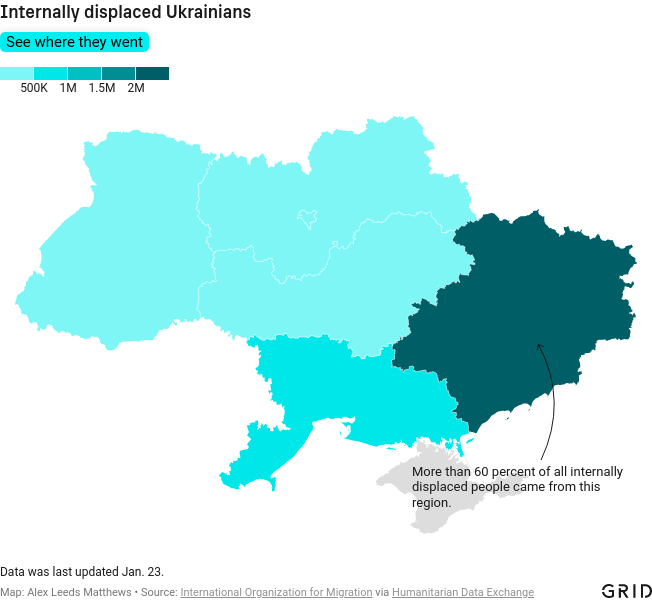
There are over 8 million Ukrainian refugees currently reported in other European countries. United Nations’ data indicates over 18 million Ukrainians have crossed the border since the start of the war, but millions have returned home, largely from Poland, as Nikhil Kumar and Kseniia Lisnycha reported. In late October, the International Organization for Migration’s latest survey of internally displaced Ukrainians found more Ukrainians returning home from within Ukraine, but 5.9 million remained displaced within their own country. (Updated Feb. 15; source; source.)
Internally displaced Ukrainians: approximately 5.9 million
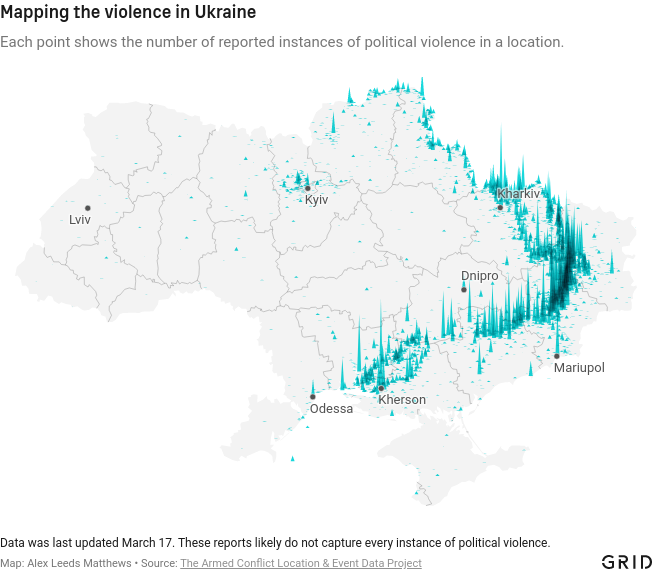
An overview of the violence
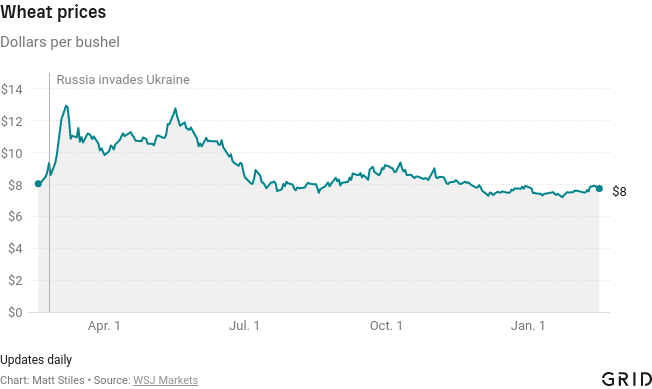
Global food markets: Wheat prices rose sharply after the invasion but have since fallen back to prewar levels.