Living in a low-income neighborhood or a state with a warm climate increases your risk.

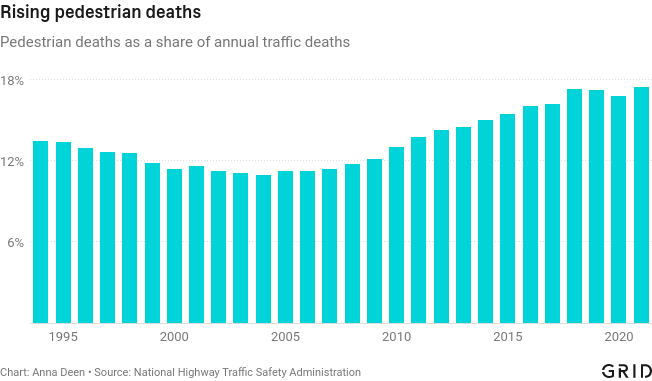
Walking is good for your health — as long as you don’t get hit by a car. But pedestrian deaths in the U.S. account for a growing share of all traffic-related fatalities.
There are several factors that affect your level of risk, including how urban your environment is and what your neighborhood’s income level is.
As a share of overall traffic-related deaths, pedestrian deaths have been increasing for years. And the most recent data shows that the trend is likely to continue.
“Sadly, pedestrian fatalities have been increasing at an alarming rate for more than a decade,” a recent report from the Governors Highway Safety Association said. “Worse yet, preliminary state data for the first six months of 2022 suggests pedestrian deaths are continuing to increase and will reach another historic high this year.”
In the first half of 2022, pedestrian deaths increased by 5 percent, or 168 lives lost, compared with the same period the year before, the report shows. The increase is even larger if you compare those 2022 numbers to the first half of 2019, which show an 18 percent increase, or 519 more lives lost.
Those numbers are even more alarming when you compare them to population growth. “Between the first halves of 2019 and 2022, pedestrian fatalities rose at a pace nine times higher than population growth,” the authors wrote.
Another recent report from the National Highway Traffic Safety Administration found similar trends for pedestrian fatalities across the first nine months of 2022 as well as an uptick in deaths among cyclists and motorcyclists. These increases come as overall traffic fatalities are leveling off, the administration found, after dramatic increases beginning with the covid pandemic in late 2020 and extending into last year.
The factors that put people at a higher risk of pedestrian death
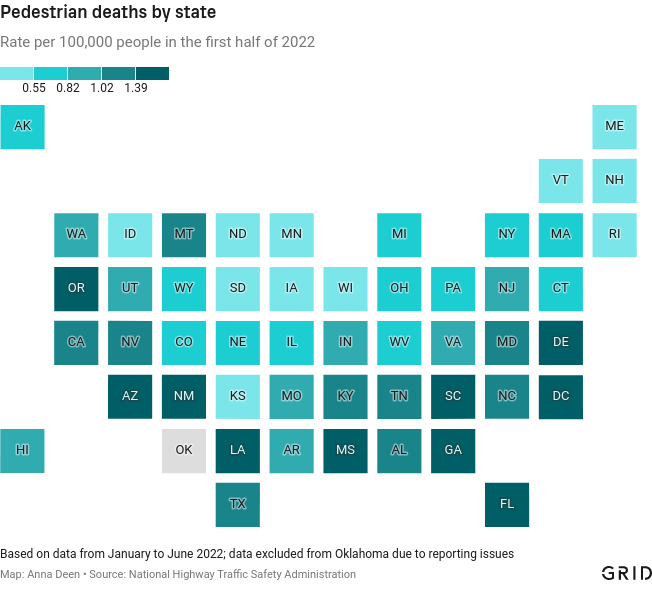
Warmer climates: One thing states with higher levels of pedestrian deaths have in common is warm weather, where people are more likely to travel by foot. Florida and New Mexico had the highest rates of pedestrian deaths in the first half of 2022, according to the association’s report.
According to research firm Westat’s analysis of the data, California, Florida and Texas accounted for 38 percent of pedestrian deaths despite accounting for 28 percent of the country’s population.
Living in a low-income neighborhood: One 2021 study published in the Journal of Transport and Land Use found that three-quarters of roads with the highest pedestrian fatalities are in low-income neighborhoods and share certain design features, like multilane roadways, that exacerbate this issue.
Urban settings with fast-moving vehicles: Many of the deaths tended to happen in urban settings involving high-speed roads (where speed limits exceeded 30 mph), high traffic volumes and multilane roadways.
According to the U.S. Department of Transportation, the odds of a pedestrian dying after getting hit by a vehicle moving at 30 mph is about 40 percent — and at 40 mph, the odds only increase to 80 percent.
Areas with no sidewalk: The vast majority of pedestrian deaths also happen when no sidewalk is present. “Notably, those stats don’t even account for whether the sidewalks that were present were actually usable at the time of the crash — particularly for people with disabilities, caregivers pushing strollers or anyone who struggles to navigate a narrow, broken or obstructed strip of pavement,” Streetsblog USA reported last year.
Because sidewalk maintenance is generally left up to adjacent property owners, Kea Wilson, the author of the article, wrote that many communities fail to comply even with basic ADA standards. Pedestrians may also be walking in the streets, increasing their likelihood of getting struck by a moving vehicle during inclement weather.
“Some advocates might add that requiring governments themselves to do basic maintenance — especially the kinds they already do in the driving lane, like snow clearance — should be an option on the table as well,” Wilson wrote.
The rise of SUVs: Researchers at the Urban Institute also suspect there’s another big factor at play: bigger and higher-up vehicles on the road. SUVs, for instance, have been gaining popularity over the last decade or so.
In 2020, passenger cars and light trucks (which include SUVs, pickup trucks and vans) were involved in a similar share of all pedestrian fatalities, at 39.2 and 39.5 percent, respectively, according to a Governors Highway Safety Association report. But SUVs have increasingly been involved in more accidents. “Deaths involving SUVs alone increased a shocking 76 percent over the last decade, while deaths involving smaller cars increased just 36 percent over the same period,” Streetsblog USA reported.
But the National Highway Traffic Safety Administration’s safety evaluations are limited to considering the safety of vehicle occupants and not pedestrians, the Urban Institute reported.
“As a result, SUVs can score well on safety rankings despite a 2015 NHTSA report … acknowledging that pedestrians are two to three times more likely to die when struck by an SUV or pickup truck than by a passenger car,” the Urban Institute said.
The European Union, which has seen a 23 percent drop-off in pedestrian deaths between 2010 and 2019, has regulations aimed at protecting people on the streets, according to the think tank. That includes testing how much of a threat vehicles are to pedestrians and cyclists and making sure new vehicles have certain safety features like automated braking systems that detect people outside of the vehicle.
The road ahead
The Urban Institute has also recommended measures that include reducing speed limits, creating nontraffic areas for pedestrians and promoting smaller vehicles.
In 2021, the U.S. Department of Transit adopted the National Roadway Safety Strategy, the first of its kind, to address and prevent traffic accidents. Some of its aims include creating environments that separate pedestrians and vehicles, for instance, or adding what are called “traffic calming measures,” like speed bumps or curb extensions.
“Of course, pedestrians and vehicles will continue to share space for the foreseeable future, but other countermeasures are available to incorporate facilities for safe pedestrian travel, reduce vehicle speed and increase visibility for all road users,” the Governors Highway Safety Association said.
It’s also important to acknowledge that the data we have might be incomplete, says the Urban Institute. The database reporting pedestrian fatalities only includes incidents in public trafficways and not parking lots or driveways, for instance. The data is also based on police data — and at least one study from the D.C. Policy Center showed if residents are mistrustful or fearful of law enforcement, they may be less likely to report an incident.
Thanks to Brett Zach for copy editing this article.