
Democratic and Republican congressional leaders have said that Social Security and Medicare will not be part of any fight over the debt ceiling, but a bipartisan group of senators and some conservative Republicans have toyed with changes to Social Security that could limit benefits.
The bipartisan group of senators has reportedly discussed a plan that could increase the full retirement age to 70. Other options for shoring up the program’s finances have been changing the formula for benefits that are paid out to retirees or increasing Social Security taxes, which are currently capped at applying to the first $160,200 of wage income.
This would not be the first time the retirement age for Social Security was increased in order to make the program’s finances pencil out. Life expectancy has risen since the system was established in the 1930s with a retirement age of 65. Reforms in the early 1980s started the process of slowly raising the retirement age to 67, as the life expectancy for those who reached 65 had risen a few years since the 1930s.
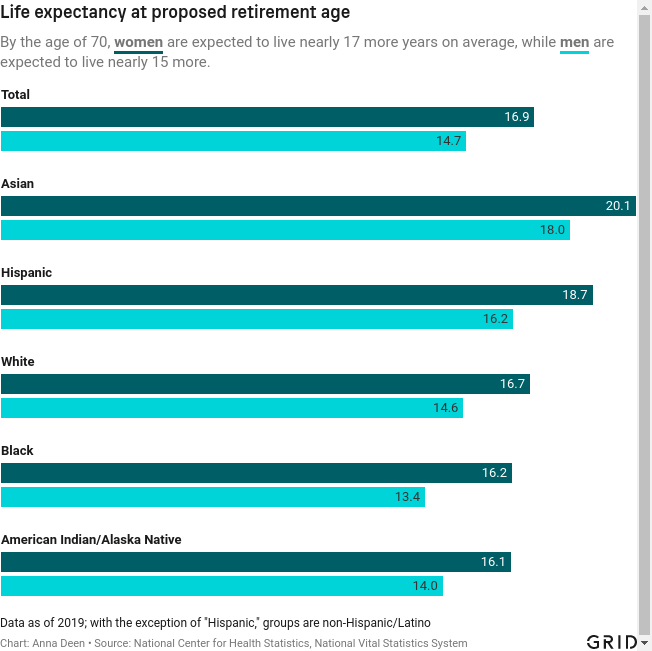
At age 70 today, American men can expect to live almost 15 more years, while women can expect another 17 years of life. But there are major disparities among racial and ethnic groups. Asian women can expect on their 70th birthday to celebrate a 90th birthday, while Black, white, and American Indian/Alaska Native men won’t expect to see 85. Black men have the lowest life expectancy at age 70 of any racial-gender group.
Life expectancy at birth is just over 76 years, according to the latest National Center for Health Statistics data, down from 77 years thanks to, among other causes, covid-19. But the relevant statistic when evaluating a change in the retirement age is life expectancy at retirement age. The life expectancy for people who have already reached 70 tells us how many years of benefits a retiree is likely to expect.
The data shows that increases in the retirement age to qualify for Social Security disproportionately hurt some demographic groups.
In recent years, there’s been an alarming downward trend in how long people live — falling with some demographics in the past few years when you break it down by race, gender and education.
The gender gap in life expectancy hasn’t been consistent over the years, with the difference in life expectancy at birth widening between 1900 and 1975 largely due to increased male mortality from cigarette-related heart disease and lung cancer, the National Center for Health Statistics wrote in a report. The difference narrowed between 1979 and 2010, before increasing again, by a fraction of a year, in 2019.
What do Republicans really want?
President Joe Biden has sought to force Republicans to be more specific about their desire to cut spending and to clarify their plans on the major mandatory spending programs that make up a big chunk of the federal budget: Medicare and Social Security.
While many elected Republicans have in the past supported budget plans that would cut or slow the growth of these programs, House Speaker Kevin McCarthy has said they’re off the table. Donald Trump has also opposed any cuts to the programs.
Many Republicans, however, at times have endorsed changes to Medicare and Social Security, including a budget produced by the Republican Study Committee, a conservative caucus to which most of the House Republicans belong. The RSC put forward a budget plan that, among other adjustments to Social Security, would increase the retirement age to 70 by 2040 and would cut expected benefits for many future Social Security recipients.
The federal government projects that sometime in the early or mid-2030s, the trust funds that pay out Social Security benefits will run out, at which point “incoming tax revenue would be sufficient to pay only about 80% of scheduled benefits,” according to the Congressional Research Service.
About a fifth of the federal budget, just over $1 trillion, goes to Social Security and just over $730 billion is for Medicare. These figures are set to grow as the Baby Boomer generation ages and retires. One proposal that’s been floated in various forms has been raising the retirement age for Social Security, which is currently 66 years for those born between 1943 and 1956 and will eventually rise to 67 for those born in 1960 or later. For those who wait until 70 to retire, the annual benefit is 8 percent larger for each year beyond the retirement age up to age 70.
Thanks to Dave Tepps for copy editing this story.