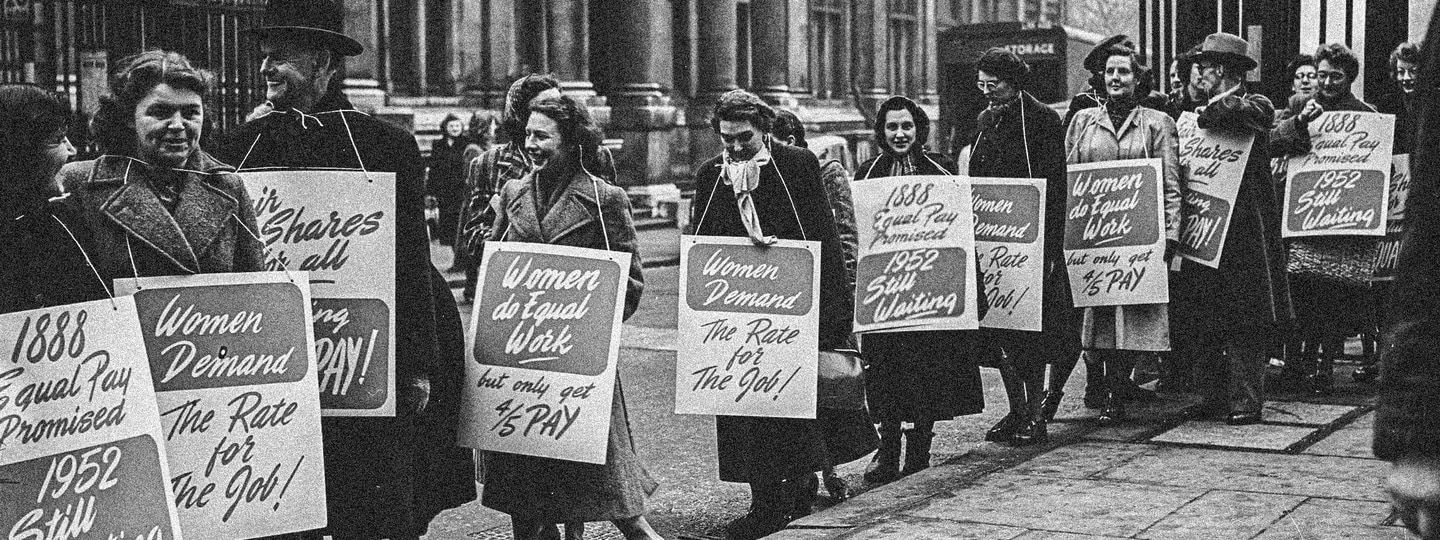
Progress in closing the gender pay gap has stagnated in recent decades, with sharp variation by race and age.

The gender pay gap may be closing, but it’s happening ever so slowly — and not at the same rate for everyone.
Equal Pay Day, which happens on a Tuesday in March every year, was created to raise awareness of the issue by the National Committee on Pay Equity in 1996.
“Because women earn less, on average, than men, they must work longer for the same amount of pay,” a Census Bureau news release said. “This date symbolizes how far into the year women must work to earn what men earned in the previous years.”
But instead of the day being a marker of how far we’ve come, it has turned into an annual reminder of how much time it is taking to fix the problem.
Currently, women earn 82 cents for every dollar that men earn, across full-time and part-time workers, according to recent Pew Research Center analysis. And yet, that figure has remained relatively stagnant when compared with two decades ago, when women made 80 cents on the dollar.
How long will it take to close the gap? At this rate, we’re looking at 2111 — that’s nearly 90 years on — according to a recent report by the American Association of University Women, a nonprofit that aims to advance equity for women and girls.
Who faces the largest wage gaps?
The greatest success in closing the gap has been made since the 1980s as more women attained higher levels of education, filled higher-paying jobs, gained more experience in the labor market and faced less overt gender discrimination. But while the wage gap has narrowed for all women, it has been the slowest to close for Black and Hispanic women, and fastest for white women, Pew analysis shows.
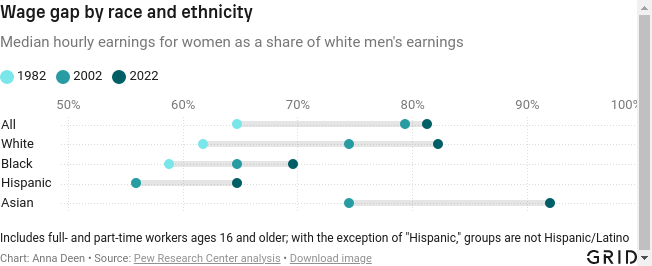
Structural inequities, which were only exacerbated by the covid pandemic, and differences in education, occupation and labor force experience, have contributed to more pronounced wage gaps for some demographic groups. Another factor has been hiring discrimination on the basis of race and ethnicity, sexual orientation or ability. “Discrimination in hiring may feed into differences in earnings by shutting out workers from opportunities,” Senior Researcher Rakesh Kochhar wrote in the Pew report.
Occupational hazard
Another reason the gap has been closing over the decades? More women are working in higher-paying occupations, such as business and finance, legal, or computer science and engineering fields, than in the past, Pew reported.
But the consequences of the pay gap don’t stop with the paycheck. Women, who hold two-thirds of outstanding student debt (as of 2019), will have a harder time paying off loans over the course of their lifetimes, which means their “debt burden compounds as time goes on,” the association wrote. Women also earn less from Social Security and pensions than men do. And this all contributes to a greater wealth gap, which is only more pronounced for women of color.
Also, Pew notes, women are still underrepresented in managerial and STEM roles — and overrepresented in lower-paying fields, such as education and healthcare. “The distribution of women and men across occupations remains one of the drivers of the gender pay gap,” Kochhar wrote.
Women are also more likely than men are to be working part-time. In 2021, 3 in 5 people in the part-time workforce were women, compared to 2 in 5 who were men, the association reported. About 28 percent of women ages 16 and older in the workforce were working part time, compared with just 17 percent of working men.
“While part-time workers by definition work fewer hours, they also tend to earn less per hour and face other less desirable outcomes,” the report said, such as earning less than the federal minimum wage.
The “fatherhood wage premium”
The pay gap generally increases with age, widening between the ages of 35 and 44, according to Pew. That’s largely related to parenthood. Women with children are less likely to be working, and when they do, they’re generally working shorter hours, the Pew analysis shows. With each child a household has, that disparity increases, according to a 2019 paper from the Center for Economic Studies.
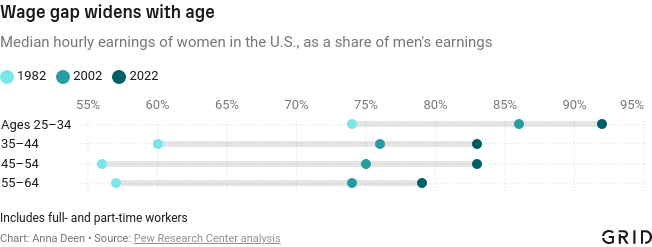
But here’s the thing. Women with and without children, who have the same levels of education, generally earn the same amount. Both groups earn less than men do, according to Pew.
Part of this phenomenon can be attributed to something called the “fatherhood wage premium.” Men with children at home are more likely to work — and work longer hours — than men without children, wrote Kochhar in the report.
“Thus, among the employed, the effect of parenthood on the gender pay gap does not seem to be driven by a decrease in mothers’ earnings relative to women without children at home,” Kochhar wrote. “The widening of the pay gap with parenthood appears to be driven more by an increase in the earnings of fathers.”
Why has the narrowing pay gap stalled? And what’s ahead?
A recent working paper from the National Bureau of Economic Research suggests that unintended consequences of paid family leave policies, introduced in the ’90s, have largely accounted for why narrowing the wage gap has stalled.
Another factor may be lingering gender discrimination and stereotypes. “Gender stereotypes and discrimination, though difficult to quantify, also appear to be among the ‘last-mile’ hurdles impeding further progress,” Kochhar wrote.
“It is important to note that women’s choices regarding work are not made in a vacuum,” wrote the National Organization for Women. Some pressures might be workplace discrimination, whether experienced or anticipated, or societal expectations for men and women when it comes to familial responsibilities, for instance.
The Biden administration has announced support of policies that could reduce the wage gap for federal workers and contractors and that provide workplace accommodations for pregnant and nursing people. The administration has also voiced support of the Paycheck Fairness Act, which aims to increase salary transparency.
Thanks to Lillian Barkley for copy editing this article.