The human toll of the fight for Bakhmut is staggering. The amount of territory taken, and its strategic value, are minimal.
Russian leaders claimed Wednesday that their forces now control eastern Bakhmut, the small city in eastern Ukraine that has been the site of the war’s longest and most brutal battle. Yevgeny Prigozhin, head of the Russian mercenary group Wagner, said his fighters had captured eastern Bakhmut, according to the Associated Press.
Last week, Grid posted a collection of photos from inside the horrific and close-quarters fight for Bakhmut; in January, Grid Global Security Reporter Joshua Keating reported on the fundamental questions of Bakhmut’s strategic value (limited) and its symbolic importance to both sides in the war (significant). Now, we use our weekly “War in Data” segment to examine this battle from the standpoint of numbers and metrics.
- The battle for Bakhmut has raged for more than seven months.
- Between 20,000 and 30,000 Russian soldiers are believed to have been killed in the battle for the city.
- Russian Defense Minister Sergei Shoigu claimed Tuesday that Ukraine had lost more than 11,000 soldiers in February, most of those in and around Bakhmut.
- Bakhmut’s prewar population: More than 70,000 people.
- Bakhmut’s population today (not counting fighting forces): Fewer than 5,000.
- Russia is estimated to have gained some 60 square kilometers around Bakhmut and the nearby town of Soledar since the fighting began.
- Ukrainian officials claim that nearly 30,000 of the Wagner Group’s 50,000 troops have deserted or been killed or wounded, the vast majority in and around Bakhmut.
- This week, a Ukrainian commander fighting in the battle, Sr. Lt. Petro Horbatenko, told the Wall Street Journal there have been days when as many as 18 “human waves of Wagner troops” have attacked a single trench over a 24-hour period.
Nearly all of these figures come with the caveat — especially necessary in the fog of the Bakhmut campaign — that it is hard to know the precise figures. But they are derived from among the best available sources. Meanwhile, as Keating reported, one metric is clear: The strategic value of this bloody battle is close to negligible. Experts at the Institute for the Study of War think tank noted this week that Bakhmut is not “intrinsically significant operationally or strategically.” They added that both sides are fighting largely for symbolic gain and to lessen the other side’s ability to devote forces to other fronts.
We offer a comprehensive set of data points on the war in Ukraine below. Grid originally published this document on March 24, the one-month anniversary of the war. We update it every Thursday to provide a fuller picture of the conflict.
Civilians killed: at least 8,100 (probably thousands more)
On June 7, a Ukrainian official said at least 40,000 Ukrainian civilians had been killed or wounded since the war began. The official offered no breakdown of dead versus wounded civilians. The United Nations’ latest estimate of civilians killed is more than 8,100, but it consistently notes the figure is an underestimate, as is its estimate of total casualties — a combination of deaths and injuries — given as more than 21,000. (Updated March 8; source, source, source.)
Ukrainian soldiers killed: at least 13,000
Mykhailo Podolyak, an adviser to Ukrainian President Volodymyr Zelenskyy, estimated in early December that as many as 13,000 Ukrainian soldiers had been killed since the war began. In early November, the chairman of the U.S. Joint Chiefs of Staff, Gen. Mark Milley, estimated that each side had seen about 100,000 soldiers killed or injured. More recently, on Jan. 22, Norwegian Chief of Defense Eirik Kristoffersen also estimated the Ukrainian side to have over 100,000 personnel killed or injured. (Updated Jan. 25; source, source.)
Russian soldiers killed: between 5,937 and 155,000
From the early days of the war, casualty counts for Russian soldiers have varied widely — depending on the source. Ukraine raised its estimate of Russian soldiers killed in the conflict to more than 155,000 on Wednesday. These numbers have been updated frequently through the Facebook page for the country’s General Staff of the Armed Forces. In its first update on casualties since March, Russia claimed in late September that there had been 5,937 Russian military deaths. Kremlin spokesman Dmitry Peskov said in April that there had been “significant losses of troops, and it’s a huge tragedy for us.”
A report by Meduza, an independent Russian media outlet, and the Russian branch of the BBC confirmed at least 10,000 dead Russian soldiers as of Dec. 9, 2022. More recently, a study by the Center for Strategic and International Studies estimated that between 60,000 and 70,000 Russian troops were killed between February 2022 and February 2023.
Russia has also suffered a high rate of casualties among senior officers. Thirteen Russian generals have been killed, according to Ukrainian authorities; the U.S. Defense Intelligence Agency puts the figure at eight to 10. Grid’s Tom Nagorski and Keating previously reported on the possible explanations for this “inconceivable” toll: poor communications and command-and-control structures within the Russian military. (Updated March 8; source.)
Total displaced Ukrainians: approximately 14 million
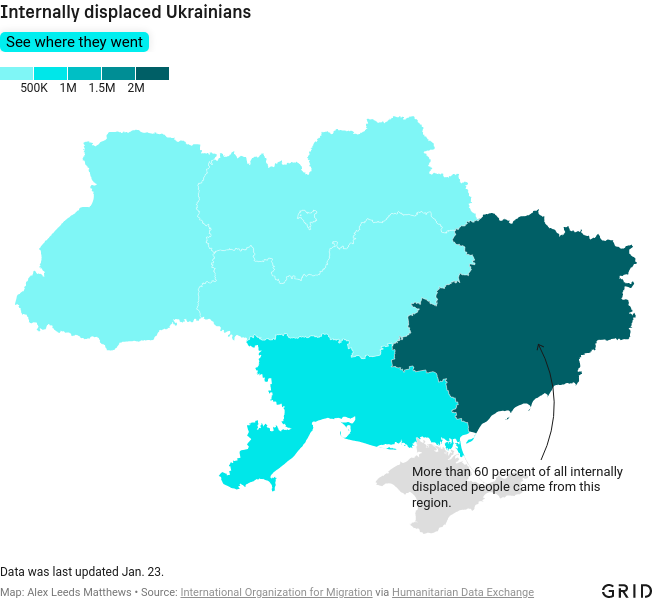
There are over 8 million Ukrainian refugees currently reported in other European countries. United Nations data indicates over 19 million Ukrainians have crossed the border since the start of the war, but millions have returned home, largely from Poland, as Nikhil Kumar and Kseniia Lisnycha reported. In late October last year, the International Organization for Migration’s latest survey of internally displaced Ukrainians found more Ukrainians returning home from within Ukraine, but an estimated 5.4 million remained displaced within their own country. (Updated March 8; source; source.)
Internally displaced Ukrainians: estimated 5.4 million
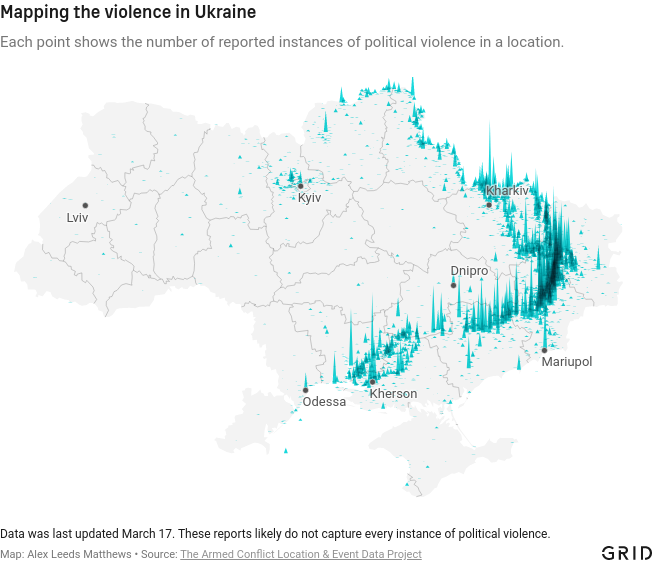
An overview of the violence