Bree Linville;Joseph Prezioso/ Erik McGregor/ Getty Images
There are currently 300 bills that would limit transgender rights being considered in states for this year alone.
State legislators are ramping up battles against the transgender community with a wave of bills aimed at restricting transgender freedoms, like limiting access to healthcare, preventing people from playing on sports teams as the gender they identify with and banning drag shows.
As of this week, there were more than 300 bills being considered in statehouses in 2023 specifically targeting transgender rights, according to LegiScan and Trans Track Legislation data.
Transgender freedoms have been under attack for the past several years as a relatively new conservative talking point.
But the sheer number of bills related to transgender rights appearing in statehouses this year compared to previous years demonstrate how this issue is at the top of minds for conservative lawmakers.
Just last week, Michael Knowles of the Daily Wire told an audience at the Conservative Political Action Conference that “transgenderism must be eradicated from public life entirely.” The statement received applause from the crowd.
“This represents an effort to purge transgender rights from the law and transgender people from public life. This is an extremely dangerous assault on some of our most fundamental freedoms,” said Gillian Branstetter, communication strategist for the ACLU’s Women’s Rights Project and the LGBTQ and HIV Project.
“Our ability just to be in public is under threat,” she told Grid.
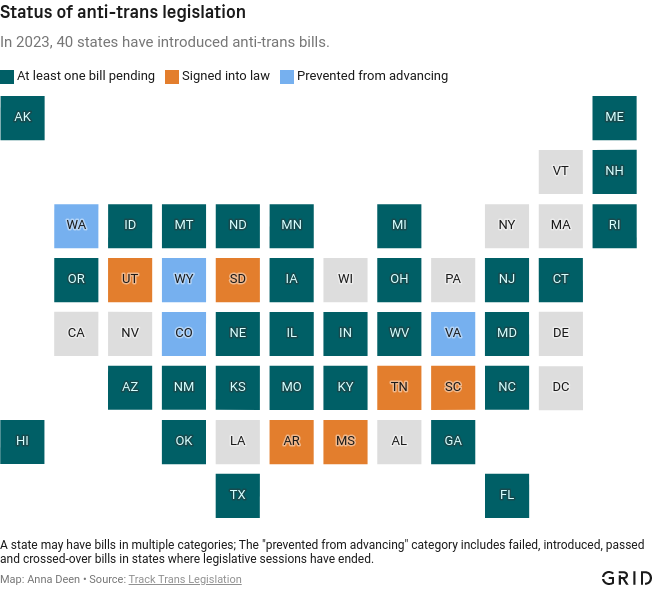
In the first few months of this year, Tennessee, Utah, South Dakota and Mississippi all banned gender-affirming care for minors — and multiple other states are considering similar proposals. Republicans such as Mississippi Gov. Tate Reeves called it a “dangerous movement spreading across America” after signing the legislation into law.
This is despite the fact that the American Academy of Pediatrics warned that was a mistake. It and other major U.S. medical societies endorse gender-affirming care as the appropriate model of treatment. A vast body of research shows transgender youths are at a higher risk for mental health problems and suicidal ideation, and gender-affirming care can substantially decrease that mental-health burden. A 2020 study of 21,000 trans people revealed the risk of suicide decreased by roughly 70 percent when transgender youths took medication to help align their gender identity and body.
A strategy of quantity
In some states, instead of limiting trans rights in one area or via one bill, multiple bills have been introduced covering a variety of restrictions. In Texas, 46 bills related to restricting transgender rights were being considered in this legislative session. In Missouri, 39 bills were being considered.
Not all bills pass, even in red states — Mississippi has seen 19 bills introduced, and only one has made it through — but just the discussion of these bills can cause a rise in anti-trans sentiment, say critics.
“When lawmakers discuss bills banning transgender and nonbinary youth from accessing medical care, playing school sports or using restrooms, it sends a message that even from an early age, transgender and nonbinary people are different and unwelcome,” said Jay Brown, a senior vice president at HRC.
According to the Human Rights Campaign, 315 “discriminatory anti-LGBTQ+ bills” were introduced across the country last year, and 29 were signed into law — roughly 10 percent.
Last year, “at least 34 transgender and gender nonconforming people” were killed, according to Human Rights Campaign, which tracks violence against the transgender community.
“We see how hateful rhetoric and misinformation about who we are and what we stand for ultimately can translate into real-world violence, real-world harm for our people,” said HRC President Kelley Robinson in a statement last month.
Anti-trans legislation comes in different forms
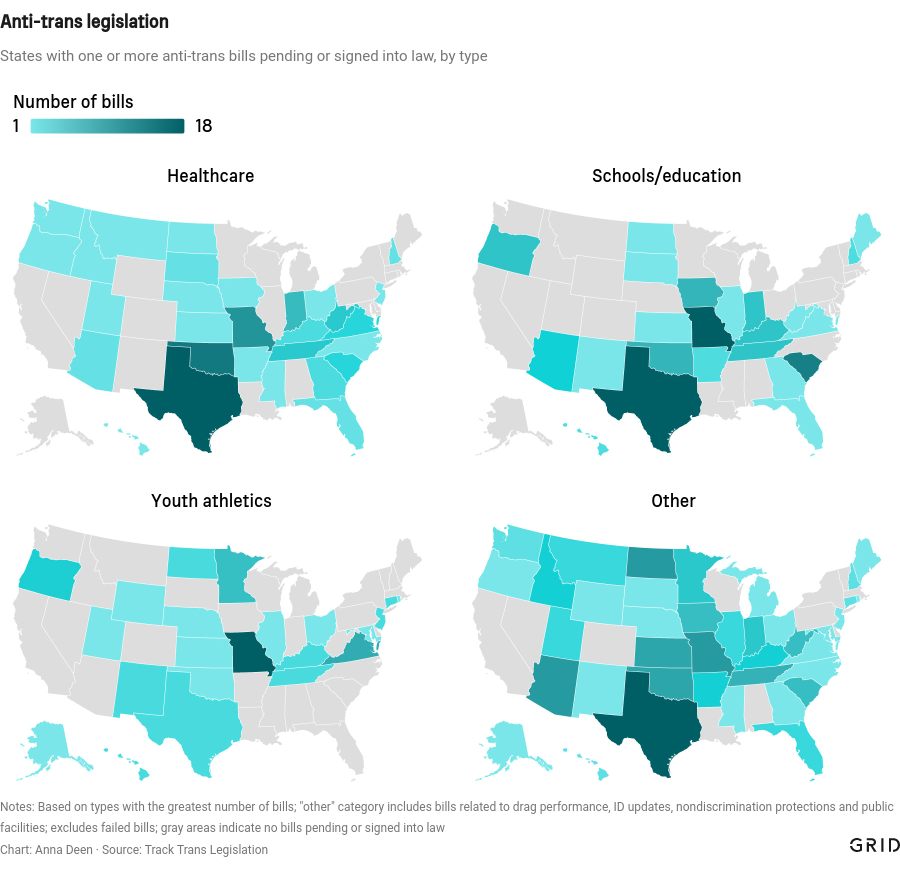
There are four main legislative categories state legislators are using to restrict transgender rights.
HEALTHCARE: Some states, like Oklahoma and Arizona, have proposed legislation that would stop transgender youth from being able to receive gender-affirming care, which can include things like supporting individuals who adopt different pronouns from the gender they were assigned at birth, puberty blockers, hormone therapy and surgeries.
SCHOOLS: In terms of what’s taught in the classroom, schools have been the target for legislation targeting transgender people in 25 states, legislating what and how schools can teach students about gender identity and sexual orientation. In Texas, for example, the legislation would prohibit schools from teaching students about gender identity or sexual orientation until ninth grade.
ATHLETICS: One of the areas that have received the most attention is youth athletics, which has been targeted in 23 states and has become a political talking point for Republican primaries in deep-red states and districts. Supporters of these bills argue that transgender athletes should not be allowed to compete on teams with the gender they identify with and therefore hope to ban schools from allowing it. And it’s not just limited to young children: Also in Texas, lawmakers are working on expanding restrictions on transgender student athletes at the college level.
OTHER AREAS: In addition to those three main categories, there’s a variety of other areas that legislatures have targeted: Lawmakers in Illinois introduced a bill allowing school districts to regulate and restrict access to public restrooms, locker rooms and dressing rooms on the “basis of biological sex.” Providing gender-neutral alternatives is optional. Other states like Kentucky and Arizona have proposed legislation that requires official identification, like birth certificates, to only have either male or female designations. And the debate over which restrooms transgender people can access — an issue that’s been in the news for years — continues today. In Arkansas, the legislature advanced a bill that criminalizes transgender people using a public restroom that matches their gender identity if a minor “of the opposite sex” is present.
Drag queens caught in the anti-trans legislation push
In addition to legislation specifically targeting transgender rights, lawmakers are also taking aim at drag shows.
While drag queens are not necessarily part of the trans community, many drag queens come from the LGBTQ+ community — drag is a type of performance art as opposed to a gender — but many conservatives argue it is not appropriate for children.
“It is this, this all-consuming war on gender nonconformity,” Branstetter told Grid. “It is an effort to suggest that if you are defying your gender assignment, no matter how you’re doing so, that is a danger. … And drag queens make an art out of defying their gender assignment.”
Branstetter added that not only is drag an art form but also “it’s celebratory” and “joyful.”
“It’s just about control,” she said, adding that drag is seen as a threat to a “broader project of enforcing these gender norms.”
Thanks to Brett Zach for copy editing this article.