
The cost of buying a house is driving some to move in with relatives and delay having children.

Last year, homeownership was further out of reach than it has been in modern recorded history. And that’s going back to and including the housing bubble of the early aughts, said Jeff Tucker, a senior economist at Zillow.
And that’s affecting how Americans are living their lives. Some people who would have their own place right now are renting, moving in with mom and dad, and delaying having kids.
While home prices and mortgage rates may be falling, making the market at least a little more accessible, they’re doing so from historic highs.
“The big picture is that prices rose at an extraordinary rate from mid-2020 until mid-2022,” said Tucker. “The vast majority of that cumulative growth is baked into the price level.” And mortgage rates doubled too during that time — it was a one-two punch, added Tucker.
So yes, returning to homeownership levels for young people, which peaked in the early 2000s, will take a while, to say the least. And people are making other plans in the meantime.
A level of exorbitance not seen since the housing bubble crisis
In October of 2022, the median homeowner spent 46 percent of their income on annual home payments. Houses are more affordable now than, say, last year, but the housing market had priced so many people out that the ones who can afford to buy have higher incomes and stellar credit scores, according to the Federal Reserve Bank of Atlanta’s Home Ownership Affordability Monitor.
For housing to be considered affordable under Housing and Urban Development Department guidelines, annual payments shouldn’t exceed 30 percent of the median salary. October’s figure not only exceeded that threshold but, for the first time in measurable history, surpassed the previous record of 42 percent of median income set in July 2006.
What happened? With the onset of the pandemic, there was a spike in housing demand that far exceeded supply, said Domonic Purviance, a subject matter expert in residential real estate at the Federal Reserve Bank of Atlanta. A lot of people saw an opportunity to buy houses because interest rates were low.
Many people with pent-up equity in their homes in high-cost markets (like New York, New Jersey or California) were able to sell their homes, pull their equity out and buy in lower-cost ones (like Atlanta, Nashville, Charlotte or Boise), Purviance said. “It was sort of this instance for people to get out of dense areas like New York,” he said, in response to the pandemic.
That led to a significant increase of roughly 40 percent in home prices, which peaked in June 2022.
Around the same time, the Fed’s response to inflation was to raise interest rates. This combination of rising mortgage rates and soaring prices last year led to extreme levels of unaffordability, Purviance said.
Since last fall, there has been some relief. The market is cooling down a bit, with median home prices falling since last summer’s peak.
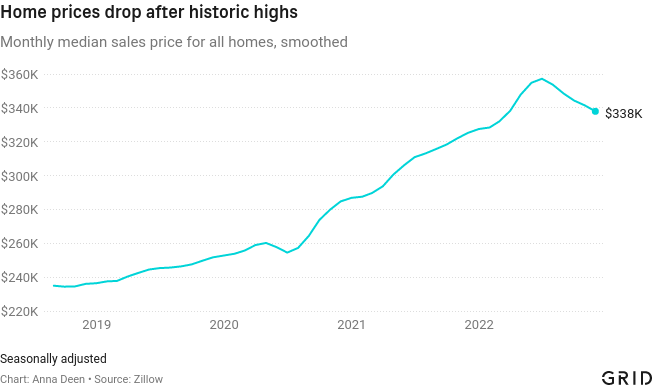
Even by November, annual payments dropped to 44 percent of the median income, Purviance said.
But it’s a long way to go before housing is largely considered affordable.
Mortgage rates are also falling, though it’s unclear for how long that will be the case, Purviance said.
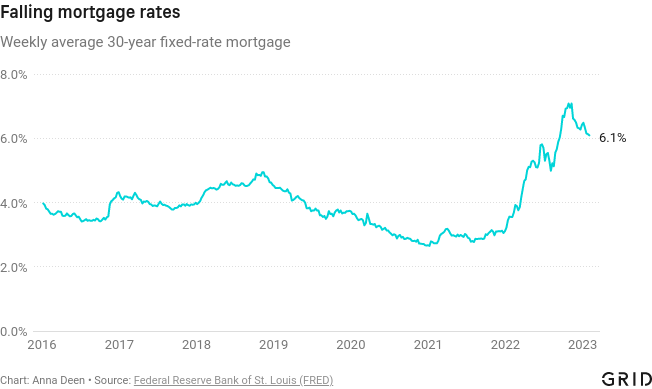
And even though lower mortgage rates sound good, it actually can be a double-edged sword. Lower rates will make homeownership more attainable for some but could also trigger more activity in the housing market, the New York Times reported. That means the cooling market may not last for long. More prospective buyers scrambling to purchase a home because of lower rates could mean higher prices — and ultimately fewer affordable options.
Predicting the housing market future is a bit of a guessing game
And that’s where there’s some debate among economists. Will home prices continue dropping? And if so, for how long? By how much?
“The sort-of bad news for interested first-time buyers that I’m seeing at the moment is that the cool-down process might be nearly wrapping up,” said Tucker. “It may have run its course, which is surprising to me, considering how unaffordable housing still is.”
Of course, it’s possible, Tucker said, that we’ll see regional dispersion, where the unaffordable markets — like those out West — keep cooling down. But, at the moment, it’s a little too early to tell.
It’s especially hard, he said, to predict the future, even with seasonally adjusted data, in the winter months because the housing market activity grinds to a halt.
Another factor is the “tug of war between supply and demand,” said Purviance. Housing supply is measured by how many months it would take to sell a given month’s inventory of houses at the current sales pace. If it takes more than six months to sell, the market is undersupplied (and vice versa).
Last year, existing homes dropped below a two-month supply, which meant there was an undersupply of houses. “We were at a critical low,” said Purviance. “We just didn’t have enough.” That meant people putting in multiple offers and bidding wars and paying above the asking price, he added.
Homeowners who locked in low interest rates, such as back in 2021, on their current homes were also reluctant to sell.
Right now, housing supply is very slowly recovering, said Purviance. But currently, many builders are putting up homes that people can no longer afford for various reasons, like inflation making budgets tighter.
Going into this year, housing affordability really depends on how comfortable consumers are going back to the market, said Purviance.
Who’s buying houses, overall? Millennials with higher incomes.
Part of the reason housing became so unaffordable was because of millennials entering the housing market (sorry, just another thing to add to the blame list) en masse.
“Their movement into homeownership over the last few years played a big role in causing the price increases,” Tucker explained. “They were a lot of those people crowding into open houses and competing in bidding wars to get their first home.”
Who can afford a house mostly comes down to income and credit score, said Purviance. “The people who are buying, the people that have strong credit, higher income — better positioned to be able to buy a house,” he said.
Many of those loan originations are going toward buyers with credit scores of 720 and higher. “That’s observably different from previous cycles,” he said.
Why? “There also aren’t many homes at an affordable price point for many entry-level buyers,” Purviance said. Many investors are coming in and scooping up affordable houses in major markets.
As a result, many younger millennials are getting priced out, aren’t accumulating wealth and are facing barriers (inflation, crushing student debt and the other usual suspects) to placing a down payment at the ideal 20 percent.
“A lot of them have been priced out of the market and then renting,” Purviance said. Because of this, the median buyer skews a little more affluent. The annual median income for 43 percent of people buying houses is $100,000 or more, according to Zillow’s spring 2022 Consumer Housing Trends Report.
Millennials (who are now in their late 20s to early 40s) represent the largest share of homebuyers. The median first-time buyer is also in their 30s, the report shows. Last year, 45 percent of homebuyers landed their first home. That figure, up from a low of 37 percent in 2021, is on par with pre-pandemic levels, the report said.
Even more, homeownership rates for people under 35 increased by 3.4 percentage points to nearly 39 percent between the first quarters of 2019 and 2022, as this generation aged into home buying, according to Current Population Survey/Housing Vacancy Survey data. “The homeownership rate for people under 35 has actually moved up measurably,” said Tucker.
Those people under 35 who are buying houses are more likely, say, to be 33-year-olds and not people in their 20s (i.e., it’s older millennials and not younger ones), Tucker said. Part of that might be because of a small population boom creating a “bump in the snake.” (”The Little Prince,” anyone?)
For adults ages 35 to 44, the homeownership rate moved up by about 2 percentage points over the same period, and for older adults, the rates decreased ever so slightly.
Moving in with mom, dad, grandma, grandpa …
So for those priced out of the market, what’s their housing status?
As you might guess, many of them are renting. More than a third of Americans rented, rather than owned, their home in 2019 (the most recent year with reliable data), according to the Pew Research Center.
But things aren’t going so well for the renters, either. A Moody’s report last month showed the U.S. hit a new rental market milestone: The median renter is spending 30 percent of their income on rent, which puts it right at that affordable housing threshold. Back in 1999, that figure was closer to 23 percent.
The people who can’t afford to buy are also moving into multigenerational households. Younger people are less likely to be their own heads of household now than they were in the past.
“A lot of the time that meant living with a roommate or living with parents and occasionally other family members,” Tucker said.
The share of people living in multigenerational households doubled between 1971 and 2021 (the most recent year of data), reaching 18 percent, according to the latest U.S. census data. Adults between the ages of 25 and 29 are more likely than any other age group to be living in multigenerational households.
They cite a few major reasons, according to the Pew Research Center’s 2021 survey data, including financial ones, caregiving ones (whether for adults or children), and because it’s the arrangement they’ve always had.
No house means no kids for some … at least for now
With challenges for first-time homeowners, anyone wanting to have kids may be waiting a little longer.
One analysis, published in the Journal of Public Economics, of housing market data from the 2000s showed that short-term increases in housing prices led to declining birthrates by 2.4 percent among people who didn’t own their homes. But, it also found that homeowners whose home values went up by $10,000 saw a 5 percent increase in fertility rates.
Part of the reason that peak homeownership fell for young people in the early 2000s was because they were pushed out. Many people, for instance, had to sell their home because they got laid off or foreclosed on, wrecking their credit.
“What makes this difficult is so much stuff happening simultaneously,” he said. That “stuff” includes a Great Recession, the rising cost of college and student debt, graduate education, and so on. These things all worked to increase the debt and delay a period of stable, decent income for some fraction of people, he explained.
“Housing costs were part of a nexus of financial challenges facing today’s young adults that add up to it just being more expensive, more challenging to put together the sort of the secure lifestyle that many view as a prerequisite — or at least sort of as a concurrent requisite — for having kids,” said Tucker.
Thanks to Lillian Barkley for copy editing this article.