Whenever the reconstruction of Ukraine begins, it will be on a scale unmatched in Europe since World War II.
Ukraine’s President Volodymyr Zelenskyy has said that when the war is over, his country will need a Marshall Plan — referring to the huge multilateral aid project that helped Europe rebuild after World War II. Beyond the cost in dead and wounded, each day brings more damage to Ukrainian homes and businesses and to the nation’s infrastructure. Zelenskyy may or may not get Marshall Plan-level assistance — but he is right in his assessment of the need: It will be unlike anything Europe has faced since the 1940s.
And now European estimates of rebuilding the physical infrastructure have reached $750 billion. That’s up from a European Union estimate of $600 billion made less than three months ago. Zelenskyy has said the figure might ultimately top $1 trillion.
It’s an enormous sum — far higher than the large amounts of military and financial aid already provided to the Ukrainian resistance — and it’s only likely to grow as the war enters its second year and both sides gear up for what are expected to be fresh offensives and intense battles in eastern Ukraine. Already, hundreds of thousands of homes, hospitals and businesses have been damaged or destroyed — as have roads and railways and other critical infrastructure.
Deputy Prime Minister Yulia Svyrydenko made the historical reference in an interview with Politico in Brussels: “It’s going to be the biggest reconstruction [since] World War II.”
As Grid reported last year in December, Ukraine and several European nations are arguing that Russia should be forced to fund the rebuilding. As European Commission President Ursula von der Leyen said then, “We have the means to make Russia pay.” She pointed to Russian Central Bank reserves valued at $300 billion and some $19 billion in Russian oligarchs’ money the EU has frozen since the early days of the war.
Meanwhile, as Zelenskyy and other Ukrainian officials make their case on the basis of need, others are pushing the massive rebuild as a business opportunity. In a compelling but almost ghoulish pitch, the Ukrainian chamber of commerce is inviting companies to bid for work in what it calls “the world’s largest construction site.”
Thousands of businesses are reportedly interested, and last month more than 300 companies from 22 countries attended a “Rebuild Ukraine” conference in Warsaw. But the process, along with the cost assessments, are hampered by an obvious element of uncertainty: No one has any idea when the war will end and reconstruction can begin in earnest.
We offer a comprehensive set of data points on the war in Ukraine below. Grid originally published this document on March 24, the one-month anniversary of the war. We update it every Thursday to provide a fuller picture of the conflict.
Civilians killed: at least 8,100 (probably thousands more)
On June 7, a Ukrainian official said at least 40,000 Ukrainian civilians had been killed or wounded since the war began. The official offered no breakdown of dead versus wounded civilians. The United Nations’ latest estimate of civilians killed is more than 8,100, but it consistently notes the figure is an underestimate, as is its estimate of total casualties — a combination of deaths and injuries — given as more than 21,000. (Updated March 1; source, source, source.)
Ukrainian soldiers killed: at least 13,000
Mykhailo Podolyak, an adviser to Zelenskyy, estimated in early December that as many as 13,000 Ukrainian soldiers had been killed since the war began. In early November, the chairman of the U.S. Joint Chiefs of Staff, Gen. Mark Milley, estimated that each side had seen about 100,000 soldiers killed or injured. More recently, on Jan. 22, Norwegian Chief of Defense Eirik Kristoffersen also estimated the Ukrainian side to have over 100,000 personnel killed or injured. (Updated Jan. 25; source, source.)
Russian soldiers killed: between 5,937 and 149,000
From the early days of the war, casualty counts for Russian soldiers have varied widely — depending on the source. Ukraine raised its estimate of Russian soldiers killed in the conflict to more than 149,000 on Wednesday. These numbers have been updated frequently through the Facebook page for the country’s General Staff of the Armed Forces. In its first update on casualties since March, Russia claimed in late September that there had been 5,937 Russian military deaths. Kremlin spokesman Dmitry Peskov said in April that there had been “significant losses of troops, and it’s a huge tragedy for us.”
A report by Meduza, an independent Russian media outlet, and the Russian branch of the BBC confirmed at least 10,000 dead Russian soldiers as of Dec. 9, 2022. More recently, a study by the Center for Strategic and International Studies estimated that between 60,000 and 70,000 Russian troops were killed between February 2022 and February 2023.
Russia has also suffered a high rate of casualties among senior officers. Thirteen Russian generals have been killed, according to Ukrainian authorities; the U.S. Defense Intelligence Agency puts the figure at eight to 10. Grid’s Tom Nagorski and Joshua Keating previously reported on the possible explanations for this “inconceivable” toll: poor communications and command-and-control structures within the Russian military. (Updated March 1; source.)
Total displaced Ukrainians: approximately 14 million
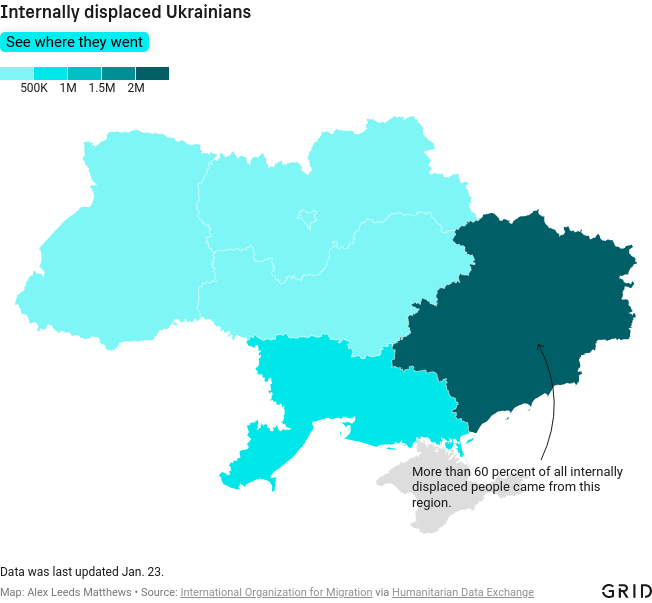
There are over 8 million Ukrainian refugees currently reported in other European countries. United Nations data indicates over 18 million Ukrainians have crossed the border since the start of the war, but millions have returned home, largely from Poland, as Nikhil Kumar and Kseniia Lisnycha reported. In late October last year, the International Organization for Migration’s latest survey of internally displaced Ukrainians found more Ukrainians returning home from within Ukraine, but an estimated 5.4 million remained displaced within their own country. (Updated March 1; source; source.)
Internally displaced Ukrainians: estimated 5.4 million
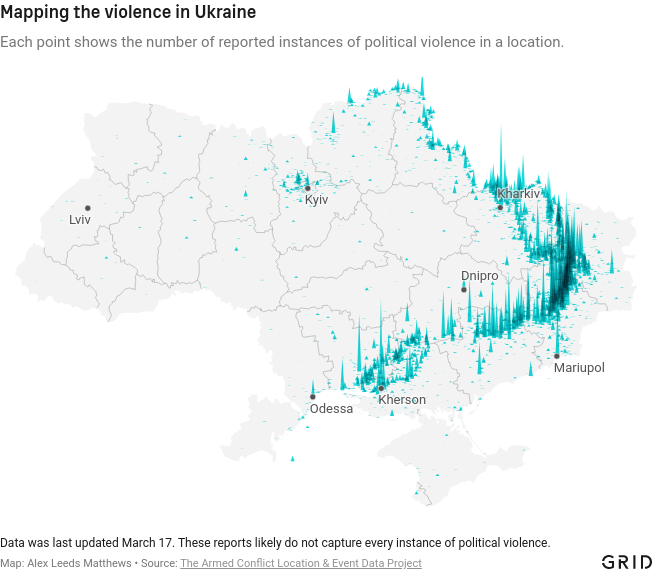
An overview of the violence
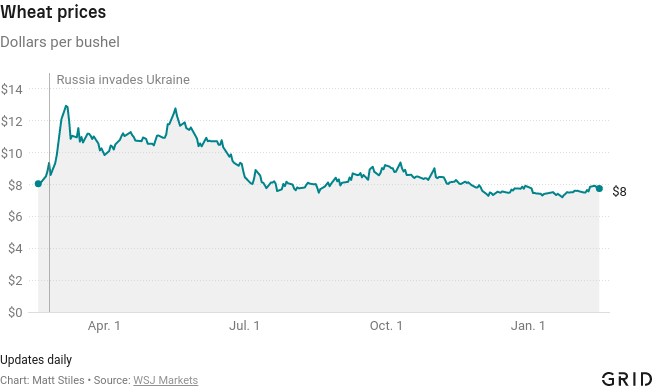
Global food markets: Wheat prices rose sharply after the invasion but have since fallen back to prewar levels.