At the heart of Yáng Shuāng-zǐ’s rich, heady book is the uneasy bond between a Japanese author and her Taiwanese interpreter
“The traveller sees what he sees. The tourist sees what he has come to see.” GK Chesterton’s pithy observation reflects the evergreen anxiety about the authenticity of foreigners’ experience when abroad.
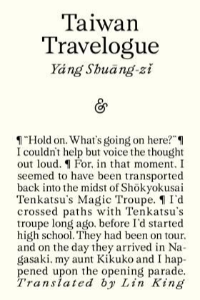
This theme runs through Taiwan Travelogue, the first major work by Taiwanese author and literary critic Yáng Shuāng-zǐ to be translated into English. Longlisted for this year’s International Booker Prize, it is a novel disguised as the Chinese translation of a fictional travel journal by a Japanese writer in 1930s Taiwan.
In 1938, Japanese novelist Aoyama Chizuko is invited to do a book tour of the island, which is then still a Japanese colony. Not for her, though, the vulgar business of being a tourist: “Rushing to catch a bus or a train, rushing from one attraction to the next — that kind of ‘touring’ is just moving around, not ‘traveling’ . . . Traveling is living in a foreign place.”
Even she, however, cannot escape becoming the bumbling outsider. “Excuse me,” she asks upon arrival, “Is there some shopping area nearby where the Taiwanese go?” It is soon apparent that she, too, is burdened by her own preconceptions of what is authentic and what is not.
Disdainful of sightseeing, she is gluttonous for food and describes herself as possessing a “monster’s appetite”. “We must eat our way across all of Taiwan Island!” she declares. “Is there something good to eat around here?” is one of her frequently used phrases. Indeed, the book itself is structured around food, with each chapter revolving around a different culinary discovery.
At the heart of the fictionalised travelogue is the uneasy bond between Aoyama and her interpreter on the island, whom she calls Chi-chan. What begins as a relatively conventional relationship between an overseas visitor and a local guide gradually takes on more layers of complexity.
Aoyama’s interest in Chi-chan, though well intended, leads to irritation rather than intimacy. The more she expresses genuine curiosity about Chi-chan’s impoverished background, the more disempowered she makes her feel. Kindness comes across as condescension.
Her insensitivity can be staggering. The insistence on having a kimono — the symbolic garb of the Japanese coloniser — especially made for Chi-chan reveals an astounding lack of awareness. “Aoyama-san, you really ought to listen to what other people are saying once in a while,” she finally reproaches her employer.
For all Aoyama’s efforts to get closer to Chi-chan, the novel lays bare the disparities that will ultimately pull the two women apart. “Friendships are between equals, are they not?” Chi-chan asks pointedly, saying out loud what they both know to be true: that, despite Aoyama’s pursuit of a deepening friendship, theirs could never be a relationship between peers.
Some of the keys to understanding the novel lie hidden in the introduction and the book’s many afterwords, penned by both fictional and real scholars and translators. A fictional academic alerts us at the outset to the fact that the “power imbalance is more subtle and delicate — as well as more ubiquitous — than most people imagine. Therefore, when reading this book, please remain cognizant of Aoyama Chizuko’s status as one of the colonizers within the story.”
One of the afterwords, purportedly written by Aoyama’s daughter, offers poignant closure to the abruptly interrupted story of the friendship between the two women. In a final translator’s note, the novel’s actual English language translator, Lin King, considers the irony of having had to consult “the Japanese translation of a Taiwanese novel that claims to be a Taiwanese translation of a Japanese novel”.
As rich and heady as some of the dishes that Chi-chan prepares for Aoyama, Taiwan Travelogue is a multi-layered meditation on language and longing, and on the many ways in which we travel only to arrive where we started.
Taiwan Travelogue by Yáng Shuāng-zǐ, translated by Lin King, And Other Stories £14.99, 280 pages