Álvaro Enrigue revisits Spain’s conquest of Mexico through the eyes of Cortés, the conquistadors and the vanquished natives
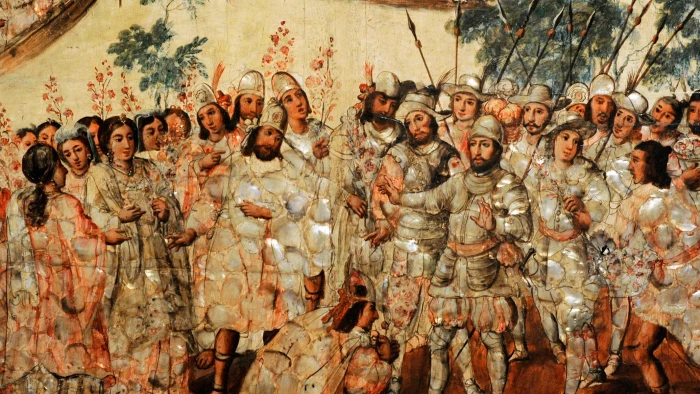
© PHAS/Universal Images/ Getty
Roula Khalaf, Editor of the FT, selects her favourite stories in this weekly newsletter.
Like the fall of Constantinople in 1453 or the reconquest of Granada in 1492, the capture of the Mexican city of Tenochtitlan by Spanish adventurers in 1521 was a pivotal moment in world history. Forever transforming global commerce and culture, it heralded an age of global Spanish supremacy.
Yet had the initial meeting between the two protagonists — Hernán Cortés, the cocksure Spanish conquistador, and Moctezuma, melancholy emperor of the Mexica — gone differently, events might have taken a dramatically different turn. Rarely, it could be argued, has the encounter of two individuals been of such consequence.
But was Cortés a canny soldier deploying superior technology and building strategic alliances to defeat a powerful empire, or simply a jumped-up chancer who got lucky? And was Moctezuma naive about the invaders’ intentions and capabilities? Or did he invite catastrophe upon his people in pursuit of his own political goals?
Where historians can only speculate, the Mexican novelist Álvaro Enrigue wades in to offer a riotously entertaining account of that fateful rendezvous. Dripping with irreverence, You Dreamed of Empires suggests that the conquest of Mexico was the product of mishaps piled upon misunderstandings and mistranslations, with a healthy dose of muddling through.
In Enrigue’s retelling, Cortés is “an ill-favoured and artless son of Extremadura”, but as fond of reading as he is of raping. His soldiers are “provincials, nobodies, hicks . . . a bunch of loudmouth bastards who claimed to have come in the name of an emperor they never had a hope of meeting”. To the Mexica, the Castilians are both a curiosity and an aberration: “They are savages, of course; they like the taste of the juice of rotting fruit that they bring from their own lands, so they can’t believe there is such a thing as chocolate.”
Central to the success of the real-life Spanish expedition were two translators who appear to have been doing all the diplomatic heavy lifting while also seeking to advance their own agendas. One, Malinalli, was a local princess whom Cortés had brought “into his entourage and his hammock”. She spoke Nahuatl, language of the Mexica, as well as Maya.
Malinalli’s fellow interpreter, Gerónimo de Aguilar, was a shipwrecked Andalucían friar who spoke Maya and Castilian: “he lived like a priest in every sense of the word. He was always praying, he spoke Latin and Greek, he was learned in church doctrine, he refused to wear military garb, he slept, ate and drank as austerely as a Carmelite, and he only bedded handsome youths.”
Moctezuma, “the most famous man in an entire world”, is troubled by portents of disaster but firmly committed to his daily nap — and addicted to magic mushrooms and hallucinogenic cacti. “People said that in recent months, ever since things had gotten out of hand, he had turned too frequently to the wisdom of the gods.” But might there be some tactical benefit behind his apparent obsession with the Spaniards’ horses?
Enrigue revels in the salacious and the scatological, serving up a sensory feast. Mexica priests reek of “coagulated blood.” Describing the chilling rattle of human skulls impaled on a religious altar, he notes that sound “— like smell and taste — was a form of prayer for the Mexica.” He depicts Moctezuma “raising a grasshopper taco with avocado sauce to his mouth — the imperial finger and the little finger cocked”, followed by “trout wrapped in pápalo leaves in a pumpkin seed sauce”, before the “turkey leg in ten-chile sauce with chocolate”.
The loquacious author is happy to pull back the curtain and reveal his own narrative tricks. Alongside real historical characters, Enrigue includes a fictional but well-read Spaniard — an informed observer introducing notes of both horror and awe — who, he admits “has to be a learned conquistador . . . for this novel to work.”
Nor is the author averse to parachuting readers into the present day, as if to prove the often-made point that the past is never dead; it’s not even past. Opinionated asides are offered in aid of storytelling as much as by way of contemporary political commentary: “If there’s anything Spaniards and Mexicans have always agreed upon, it’s that nobody is less qualified to govern than the government itself.”
Counterfactual fiction, though entertaining, is often lumbered by the need for exposition and explanation. Enrigue has more faith in his readers. As he proposes the biggest of all what-ifs, he does not simply ask us to consider an alternate historical outcome but forces us to confront what we know to be real.
The author is no stranger to weaving history and fiction together to great effect. His earlier, award-winning novel, Sudden Death, uses a made-up game of tennis between the Italian painter Caravaggio and the Spanish poet Francisco de Quevedo as a framing device to launch into a boisterous and wide-ranging exploration of renaissance art, the Catholic counter-reformation, and the clash of cultures in 16th-century Europe. Forthcoming in English translation, Now I Surrender to You and That Is All dramatises the last days of 19th-century Apache warrior Geronimo.
In a preface to You Dreamed of Empires, Enrigue acknowledges that the abundance of indigenous names and words may at first seem daunting for non-Mexican readers. “They look as strange to me as they do to you . . . Don’t worry too much about the Nahuatl words you come across . . . Let the meanings reveal themselves . . . As you read, everything will become clearer.”
All praise, then, for the translator, who has so magnificently grappled with multiple layers of language. As in her rendition of Enrigue’s encyclopedic novel Sudden Death, Natasha Wimmer brilliantly brings the author’s playfulness and idiomatic humour to life for an English-language readership. The result is a triumph of solemnity-busting erudition and mischievous invention that will delight and titillate.
You Dreamed of Empires by Álvaro Enrigue, translated by Natasha Wimmer, Harvill Secker £18.99, 224 pages
Join our online book group on Facebook at FT Books Café and subscribe to our podcast Life and Art wherever you listen