Cristóbal Hara/Mabel Palacín
PHotoEspaña 2009, Museu Colecção Berardo, Lisbon
Now in its 12th edition, PHotoEspaña, Spain’s largest photography festival, is focusing on the subject of “daily life”. While galleries across Madrid show the work of photographers including Franco Fontana, Dorothea Lange and Gerhard Richter, the festival is also expanding west to showcase Spanish photographers in Portugal.
For the second consecutive year, PHotoEspaña is collaborating with the Museu Colecção Berardo, in the Lisbon suburb of Belem. This time, it is the work of Spanish photographers Cristóbal Hara and Mabel Palacín on display in the bunker-like gallery by the Tagus river.
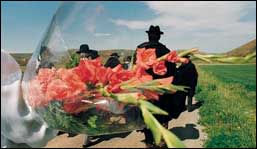
Hara is a veteran of Spanish documentary photography. He began his career in 1969, and since the 1980s has concentrated much of his attention on provincial, small-town Spain. His images, though rooted in village life, are far from folksy. Nor are they anthropological in their intent. Instead, Hara’s playfully skewed glance reveals a world steeped in traditions that make it both familiar and disturbingly alien.
More than 100 of Hara’s colour pictures are exhibited at the Berardo Museum, alongside two of his videos. The first few photographs are street scenes, almost cubist in their abstract composition. Angular and seemingly deserted, they resemble abandoned theatre sets.
The human presence is only gradually made apparent – in an empty, litter-strewn street, or in the reluctant appearance of a leg, or a covered face. In a picture taken in the Riojan village of Arnedillo (Hara’s photos are only given place names as titles), a dismembered arm reaches out of the darkness bearing an Epiphany cake. Elsewhere, a child’s outstretched arm points a toy gun at a lamb.
Hara began using colour film in the 1980s but, in keeping with the conventions of photo-reportage, printed in black-and-white. Now shown in their full garishness, the images have regained some of their casual brutality.
“Colour allows me to lie in ways that black-and-white doesn’t,” Hara says. He points at a picture in which most of the frame is occupied by a bald head, dripping in bright crimson, while a figure scowls in the background. At a glance, it conjures a scene of blood-spattered cruelty. In fact, the men are participants in a ritual tomato fight.
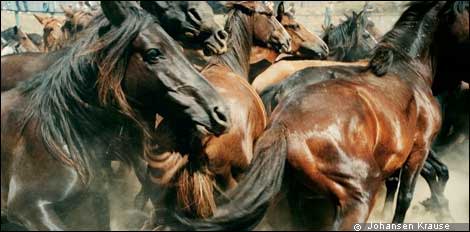
Amid the fake carnage, Hara’s pictures insinuate an unnerving undercurrent of real violence. He shows us the grisly aftermath of a car crash, made more unsettling by the dishevelled survivor’s velvety red dress. There is a powerful sequence depicting wild horses being wrangled into submission in the Galician town of Sabucedo. There are pictures from his infamous series on village bullfights, which, he says, even bullfight aficionados found shocking. Goya’s frightful imaginings hover over much of the work.
Rituals on holy feast days provide Hara with the best opportunities for observation. “The trick is to portray things out of context,” he says. So a Christ figure carried round a village during Easter week appears in the now too familiar pose of a celebrity trying to block a photographer’s view with an outstretched hand.
There is tension in Hara’s pictures, but there is humour, too. If Goya is one of the presiding spirits, then the other is the Surrealist film maker Luis Buñuel. As is shown by the photograph in which a lorry trailer seems to contain a child’s lower body, severed from an upper body as if within a magician’s box, it takes only a minuscule shift in perspective to make the commonplace weird.
Palacín, a video artist, also enjoys subverting expectations through shifts in perspective. Her main interest, however, is in exploring the interface between still and moving images. PHotoEspaña’s curator, Sérgio Mah, has declared his interest in widening the festival’s range to include other visual arts, and Palacín’s inclusion fits the bill.
The Berardo is showing three of her works. The most arresting, “Hinterland”, is a video made by applying digital tracking shots, close-ups and clever editing to a large-format photograph to tell an elaborate story. The method is not necessarily new, but Palacín has taken it to new technical heights. In doing so, she has enhanced the still image’s storytelling possibilities.
Her attempt to carry out the inverse operation is less successful. “Las puertas de España” (“Spanish doors”) uses blown-up frames from four different films showing people trying to open or walk through doors. Each film sequence is ordered horizontally, and hung above or below the others, in three different arrangements. The conceit is that by rearranging the sequences’ position in relation to the ones above or below, the viewer can discern different stories with different outcomes. It is one of those ideas that sound more interesting in theory than in their execution.
“La distancia correcta” (“The right distance”) is a video within a video that studies the relationship between moving images by depicting an actor – apparently involved in measuring the time it takes for a cigarette to ignite the fuse on an explosive device – against a backdrop of classic film noir scenes. The wordless dialogue between the actor and the films creates, with the help of foreboding music, a new and unexpected narrative.
Palacín’s inventiveness can hardly be questioned. Yet her work seems to be concerned mainly with the medium’s technical possibilities. It suffers by comparison with Hara’s disquieting series of images. Making art about the possibilities of art is all fine, but it is often better to have a real story to tell.