“Naturism is not condoned on this beach,” the sign says.
It’s just as well, given the late hour and the fierce wind blowing off the Thames Estuary. I am grateful for this wind, which has cleared the sky in the middle of a wet August week, making my assignment possible.
I am here for some stargazing. Not of the sort that requires any specialised astronomical equipment (there is none at hand) or even any knowledge of constellations (I can only identify Orion’s belt). Instead, I am hoping to indulge in the kind of stargazing that merely requires us to look up and revel in the wonder of a nocturnal sky.
With me is Emily Winterburn, former curator of the astronomy collection at the Royal Observatory in Greenwich. She is the author of a forthcoming book, The Stargazer’s Guide. Stargazers, she writes in the introduction, are “people interested simply in knowing a little more about what they can see in the night sky”. But there is more magic to it than that.
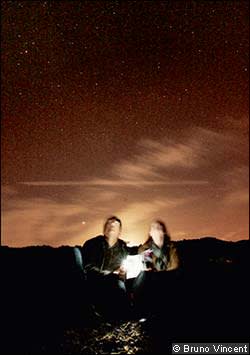
It is almost 11pm, and we are traipsing in the dark towards Long Rock Beach, a deserted stretch of shore halfway between Whitstable and Herne Bay, on the north Kent coast. In tow are Winterburn’s six-month-old baby, Sam, and her mother, Angela. We are joined by Bruno, the photographer, who is fretting about the lack of light. We have only a diminutive book-lamp to find our way.
We approach the sea and settle for a spot below the shingle ridge. Here we are protected from some of the stronger winds. We are also sheltered from the amber light of the waxing moon, rising sluggishly behind us. A marine wind-farm’s red beacons blink on the horizon; the estuary is alive with shipping. Lost in the darkness is an abandoned sea fort whose ghostly silhouette can be observed on a clear day.
I am quickly bored by studying the star chart and opt instead for direct contemplation of the pin-pricked blackness. “Stargazing has always been about storytelling,” says Winterburn, pointing out the constellations – the Plough, the Dragon, the Swan – and offering morsels of mythological lore.
The Stargazer’s Guide waxes lyrical about the August sky, and its ripeness for the contemplation of stellar phenomena. The nights are slightly longer, it tells us, but the air should still be warm enough for picnicking al fresco. There is no such warmth to speak of tonight – the chill wind seems to be blowing harder – but we have improvised a picnic of sorts. Our assortment of crisps, brownies and doughnuts should provide enough calories to keep us going all night.
Winterburn’s book also reveals the fundamental reason for being here tonight, shivering on a cold pebbled beach: “August has one of the most impressive meteor showers of the year to look forward to, the Perseids.” Though not as spectacular as the Leonid meteor showers observable in the November sky, the Perseids remain one of the highlights in the calendars of professional and amateur astronomers.
Such annual meteor showers occur when the earth’s orbit crosses a comet’s path. Fragments of matter left in the comet’s wake (meteors) burn as they enter the earth’s atmosphere, creating the impression of shooting stars. Perseids, named after the constellation of Perseus from which the meteors seem to originate, appear as our planet travels through the tail of the Swift-Tuttle comet.
I direct my gaze in the general direction of Perseus. In Greek mythology, it was he who killed Medusa. Winterburn tells me I should see stars roughly arranged in the shape of the striding hero holding aloft Medusa’s severed head. I do not. This hardly matters, though, because, even as I am struggling to identify the monster-slaying Olympian, I see my first meteor blazing through the sky.
It is shockingly bright – a diminutive flare zooming horizontally, leaving behind a luminous trail. A second, perhaps, and it’s disappeared. Did I really see it, or am I imagining things? Winterburn also saw it; so did her mother.
A minute passes. Like someone who has been given a tantalising glimpse of rare beauty, I ache for another meteor to materialise. It does, but not in the corner of the sky where I have fixed my gaze. This one seems to be falling towards the horizon. It is fainter, but produces a longer-lasting luminous imprint.
“Look at that one!” one of us shouts. “Another over there!” someone else chimes in. By the time the exclamation has been uttered, the meteors have already shot out of view.
At their peak (the night before), Perseids “fall” at a rate of up to 60 per hour. Tonight we see them every two or three minutes. No matter how intently we scan the darkness, they never fail to startle us.
Gazing at stars may be instructive, yet something about the evanescence of a meteor shower nudges us into the realm of pure fascination. The more you watch out for them, the more you long to spot the next one.
But it is getting decidedly chillier. It is past midnight. Baby Sam, who has slept through the outing despite our excited yelps, emits an almost inaudible cough, and we agree that it might be time to pack up. “Let’s look out for one more before we leave,” Winterburn suggests. It is not long before we see it, and cheer.
Shooting stars are still considered portents of good luck by some. Indeed, we cannot believe how exceptionally lucky we have been tonight. “If only we were used to looking up more often,” says Winterburn, “we’d be able to see beautiful things all the time, even in big cities.” We trail back to the car, cold yet exhilarated, finding our way by the light of the book-lamp.
………………..
The details
The Stargazer’s Guide, by Emily Winterburn, is published by Constable on September 25