Mammoth by Eva Baltasar, translated by Julia Sanches (And Other Stories)
Desire and maternal urges compete with the wish to be alone in this unsparing novella. The final instalment in a loosely connected trilogy, and a follow-up to the Catalan author’s International Booker-shortlisted Boulder, sees its protagonist giving up her life in Barcelona for a far-from-pastoral existence in an isolated farmhouse.
Dear Dickhead by Virginie Despentes, translated by Frank Wynne (MacLehose Press)
An epistolary novel for the age of Instagram and #MeToo. When Oscar, a male author, posts an unflattering comment about Rebecca, a middle-aged actress, he sparks uproarious exchanges as they spar digitally over sexism, cancel culture and harassment. A typical Despentes skewering of male entitlement — with a hint of forgiveness.
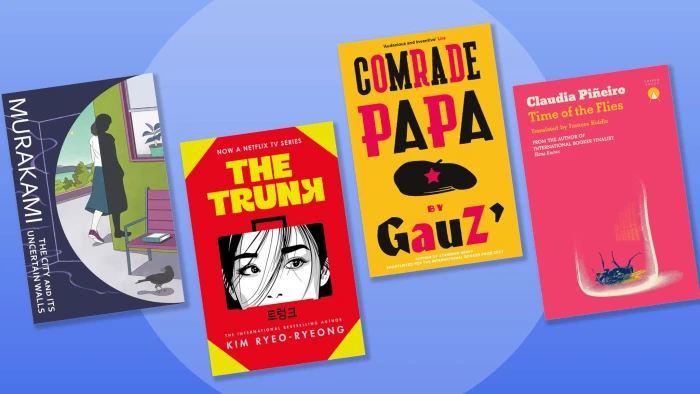
Comrade Papa by GauZ, translated by Frank Wynne (Quercus)
In the 1880s, a young white man called Maxime seeks adventure and personal advancement in Africa. A century later, a Black teenager called Anouman travels from Amsterdam to Côte d’Ivoire to visit his grandmother, and uncovers the traces of an unknown ancestor. A century-hopping, continent-spanning tale of colonialism and family ties.
If Only by Vigdis Hjorth, translated by Charlotte Barslund (Verso)
Ida, Oslo-based and married, meets Arnold, an unremarkable (also married) academic, and decides he is the man of her life. He clearly is not, but still Ida abandons her husband and sets herself up for heartbreak and public humiliation. A rollicking account of the consequences of loving the wrong person.
Eurotrash by Christian Kracht, translated by Daniel Bowles (Serpent’s Tail)
A jaded novelist takes his terminally ill and dementia-afflicted mother on a riotous road trip across Switzerland. As they attempt to unburden themselves of her ill-gotten savings, he reflects on the dark histories and unspeakable secrets underpinning his family’s wealth. Hilarious, unsettling and unexpectedly moving.

The Empusium by Olga Tokarczuk, translated by Antonia Lloyd-Jones (Fitzcarraldo)
“A health resort horror story” is the subtitle of the latest offering by the 2018 Nobel laureate, which pays playful tribute to Thomas Mann’s The Magic Mountain. In 1913, Mieczysław Wojnicz takes up a room at a Guesthouse for Gentlemen where tubercular patients spend their time drinking and dissing women.
The Book of Disappearance by Ibtisam Azem, translated by Sinan Antoon (And Other Stories)
Ariel, an Israeli journalist, wakes up to find that the entire Palestinian population of Jaffa has inexplicably disappeared. As he tries to understand what happened, he reads the diary of his Palestinian friend and neighbour, Alaa. The surreal premise triggers a thought-provoking examination of the complex dynamics of Israeli-Palestinian cohabitation.
The City and Its Uncertain Walls by Haruki Murakami, translated by Philip Gabriel (Vintage)
Based on a short story he wrote decades ago, the Japanese author’s latest novel is a love letter to books, libraries and librarians. An unnamed narrator, grieving the disappearance of his first love, seeks her out in an imagined city behind a wall separating real and shadow worlds.
Time of the Flies by Claudia Piñeiro, translated by Frances Riddle (Charco Press)After serving a 15-year sentence for killing her husband’s mistress, Inés sets up a pest-control company that doubles as a detective agency for women in distress. Her feminist principles and her yearning for lawful reintegration are challenged when a new client asks her to murder her own husband’s lover.
The Trunk by Kim Ryeo-Ryeong, translated by The KoLab (Doubleday)
Inji is employed as a “Field Wife”, rented out to wealthy clients, by a secretive matchmaking service. When one of her “husbands” asks to have her for another year, the borders between Inji’s personal and professional life collapse. Sharp Korean satire with a feminist edge, boasting that greatest of modern accolades: now a major Netflix series.