Rain has been forecast all week, but on the day the weather is benign and summery.
Tepid air and a grey-blue East Anglian sky offer the perfect climate for a vigorous walk along Fleam Dyke, a four-mile defensive barrier built by Saxons 1,200 years ago.
I am also in perfect company for such a jaunt. Robert Macfarlane tells me that when he first did this walk he was trying to break in a new pair of boots. Instead, he got blistered toes and bloodied socks. Here is the first indication that this will not be a placid country stroll.
Macfarlane is hardly into placid strolling. A Cambridge-based writer and lecturer, he came to readers’ attention with his debut Mountains of the Mind, an examination of the allure that peaks and crags have had for western minds – including his own. More recently, in The Wild Places, he wrote about his journeys in search of Britain’s remaining pockets of unspoiled wilderness.
Fleam Dyke sits on a chalky seam linking Cambridgeshire to the North and South Downs and the Isle of Wight. As we drive out of Cambridge, Macfarlane explains why chalk is one of his favourite landscapes. “It’s the most English of soils. What can be more emblematic than the white cliffs of Dover?”
But chalk, he says, has been unfairly tainted by attempts to make it embody an exclusive sense of Englishness. It was dear to postwar writers such as Henry Williamson (author of Tarka the Otter) and H.J. Massingham, whose association of chalky substrates and English identity acquired unsavoury nationalistic overtones.
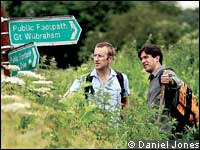
We leave our bicycles at the village of Fulbourn, on the dyke’s north-westernmost point. Joined by Dan, the photographer, we drive to the smaller village of Balsham at the opposite end. We are soon tramping through fields of ripening rapeseed. A few weeks ago they would have delivered a shock of electric yellow. Now they are lime-green, splashed with the neon-red of errant poppies.
In no time, Macfarlane the academic has been eclipsed by Macfarlane the naturalist. He imparts his attentiveness, communicates his childlike enthusiasm. He stoops to pick up shards of flint and to sniff at rabbit-holes. He points out the skylarks, congregating loudly in the trembling hedges, and observes a green woodpecker, swinging up and down in flight “as if it were stitching”. He plucks a pink clover and invites us to sample its dewy nectar. “This is the sweetest I’ve ever tasted,” he says.
I wonder what the mountaineering enthusiast makes of East Anglia’s seemingly flat landscape. He admits that, having grown up in Scotland, he was used to vertiginous panoramas, and found this region uninspiring when he arrived 13 years ago. “I’ve had to learn to read the landscape, adjust to its scale, to its subtlety. You learn to look at things laterally.” It requires effort, he adds, but is rewarding.
And how does his passion for pristine wilds translate into love for this implacably domesticated region? Even the nearby Fens are manmade, and all around us is intensively cultivated farmland. Macfarlane tells me the desire to find somewhere untouched is misguided. “It’s the wrong thing to look for. What interests me is how nature adjusts to human presence. I’m interested in the places where nature shows its urgency.”
Soon we are confronted by a perfect example of nature restaking its claim. The dyke is concealed by a curtain of greenery. Pushing aside nettles and brambles, we find ourselves on a carpet of moss beneath a mottled canopy of sycamores. To our left is a yawning ditch, dense with undergrowth.
The hum of roads is never completely extinguished, but it soon blends into the swish of leaves and scurrying creatures. Woodpigeons, flapping furiously out of the branches, give us a start.
Our guide is especially fond of beeches. Their bark, he says, is perfect for writing on with chalk. We stop to admire an ancient yew, its roots like aged tendrils gripping the manmade structure below.
At the point where the dyke runs past a farm, the woods are overwhelmed by ivy. It strangles the conifers and covers the ground. Massingham hated ivy, Macfarlane says, and took an axe to any he came across. But ivy had its revenge when he tripped over a rusty ivy-covered trough and died of septicaemia.
We step out of the cool, canopied path. The trail continues over an area that is open to pasture. Flowering thistles and wild thyme surround wind-stunted junipers. Further ahead, the Saxon earthwork clashes dramatically with modernity. “The pastoral colliding with the anti-pastoral,” Macfarlane says as we climb the pedestrian footbridge at the place where the dyke and the A11 dual-carriageway intersect.
The top of the bridge offers the best view of the “linear forest” we have been walking through: a foliaceous scar on dreary terrain. “A wild line,” Macfarlane calls it, when we stop to rest at Mutlow Hill, a Bronze Age burial mound and the highest point along the route.
We walk past a ditch that houses the vestiges of a disused railway, and descend towards Fulbourn Nature Reserve. It is a boggy remnant of the old wetlands, rich in marsh reeds and speckled with delicate clusters of purple and blue orchids. A magnificent oak fenced off by a scrum of nettles signals our return to civilisation.
Macfarlane revels in Fulbourn’s postcard-pretty tidiness. “It calls for lashings of ginger beer.” Now all that remains is a five-and-a-half-mile bicycle ride back to Balsham. Unexpectedly, most of the route appears to be uphill. Who said Cambridgeshire was flat, I wonder, as Macfarlane powers on ahead.
…………………………..
The details
Cambridge to Balsham (via Fulbourn), by car, 11 miles; Balsham to Fulbourn, on foot along Fleam Dyke, 4 miles; Fulbourn to Balsham, by bicycle, 5.5 miles