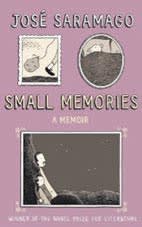
By José Saramago
Translated by Margaret Jull Costa
Harvill Secker £12.99, 199 pages
FT Bookshop price: £10.39
José Saramago, the Portuguese novelist and Nobel laureate, is no stranger to autobiographical writing. He has already published five volumes of his diaries, covering the years 1993 to 1998. Small Memories, however, is his first memoir, spanning his birth in 1922 in the village of Azinhaga, to his family’s move to Lisbon and his first years of schooling.
Saramago writes with fondness about his rural upbringing. He grew up in the house of his grandparents, who used to tuck piglets into their bed at night. His father took a job as a policeman when the family moved to Lisbon. His mother was illiterate. Saramago, Dyslexic and a stammerer, taught himself to read by poring over the newspapers his father occasionally brought home. Remembering when he came top of his class for dictation, he says: “That was where the story of my life began.”
As a child he entertained friends by inventing the plots of movies after seeing the posters. “I would heap lie upon lie, almost believing that I really had seen what I was merely inventing.” A career in fiction beckoned. What and how we remember is one of the themes Saramago has explored in his novels, and he is the first to admit that the sequence of recollected events can be fuzzy. He admits that his only memory of his brother, Francisco, who died as a baby, “may well be false”.
The humiliations and joys of childhood, magnified by time, are delicately revisited. In one touching vignette, Saramago remembers his pride in tugging around a balloon – “I was as proud as if I were dragging the whole world through the air tied to a piece of string”. This soon turned to shame when he discovered the balloon had deflated – “That grubby, shrivelled, shapeless things was the world.” Two other stories, already recounted in newspaper articles, are retold here. One is the author’s overnight journey to a neighbouring village, by foot, to sell the family’s pigs. The other is a reminiscence of his grandfather, days before his death, saying goodbye to each of his olive trees.
Small Memories bears many of the hallmarks of Saramago’s fiction and gives clues to its origins. There are the long and coiling sentences, made readable through Margaret Jull Costa’s clear translation. There is the same persistent sentimentality. “I’m still suffering from the effects of a fall from a horse I never rode,” he writes, about an uncle’s horse he was never invited to mount. “There are no outward signs, but my soul has been limping for the last 70 years.” He recalls a blind acquaintance; what the young Saramago disliked most was “the smell he gave off, a rancid odour of cold, sad food and ill-washed clothes, a smell that would be associated for ever in my mind with blindness and which probably resurfaced later in my novel of that name”.
Elsewhere, Saramago remembers how a visit to Mafra monastery, with its statue of the flayed St Batholomew, might have inspired his novel Baltasar and Blimunda. “I can’t swear to it,” he warns, “I’m just saying it’s possible.” Memory is an unreliable thing indeed.