Alex Sebastian peels back the layers to examine how investing in the Middle East and North Africa can aid portfolio diversification

The Middle East and North Africa (MENA) region covers an enormous 15 million square kilometres, extending east from the Atlantic coast of Africa to the border of Pakistan, and north from the southern boundaries of the Sahara Desert to the shores of Malta. Comprising 21 countries with a combined population of 493 million – greater than that of the EU – its size and strategic location make it an economically significant area, enhanced by vast human, financial and natural resources.
But while the region has long-established economic and financial links with G10 nations, several MENA countries are yet to fully exploit their economic potential. These frontier and emerging markets bring with them different, and arguably greater, risks than their more established counterparts. But the other side of the coin, of course, is larger potential rewards.
Diversification opportunities
According to Mike Hollings, Chartered MCSI, a partner at London-based wealth and asset manager Shard Capital, the appeal of MENA as an investment opportunity stems partly from its limited correlation with Western markets. “The MENA region is a living manifestation of demographic diversity,” says Mike. “This means that each market has its own unique characteristics and demand trends, so correlation to developed markets is inherently lower, thus adding significant diversification benefits to global portfolios.”
For Sudaif Niaz, co-manager of the BlackRock Frontiers Investment Trust, the domination of MENA markets by local investors underpins the portfolio diversification they offer, as it makes them less affected by global economic issues and external worries. “The fact that many of the countries in the region have enormous sovereign wealth funds can help ameliorate the periodic concerns that investors have about all investments and jurisdictions,” Sudaif says.
The GCC region demonstrates considerable robustness in the face of diverse economic and political uncertaintiesSovereign wealth funds are a notable feature of Gulf Cooperation Council (GCC) nations, many of which have significant wealth and cash-abundant economies, says Mike. “In this regard, the GCC nations stand in sharp contrast to many other global regions currently wrestling with rising budget deficits and other financial challenges.” Mike also notes that over the past decade, the GCC nations have adjusted their strategies in response to their strengths and vulnerabilities. For example, the area is a hub for innovation, with ambitious transformation plans, such as the Dubai 2040 Urban Masterplan – which aims to redevelop parts of the city into eco-friendly finance and technology districts – in place. On the other hand, the region recognises that regulatory uncertainty is a stumbling point.
These insights have guided their economic policies, increasing controls and diversifying revenue streams towards tourism, technology, renewables and financial markets, while conserving existing wealth. The result, according to Mike, is remarkable economic resilience, with the GCC region demonstrating considerable robustness in the face of diverse economic and political uncertainties, making it an attractive investment destination within global multi-asset portfolios.
Growth potential
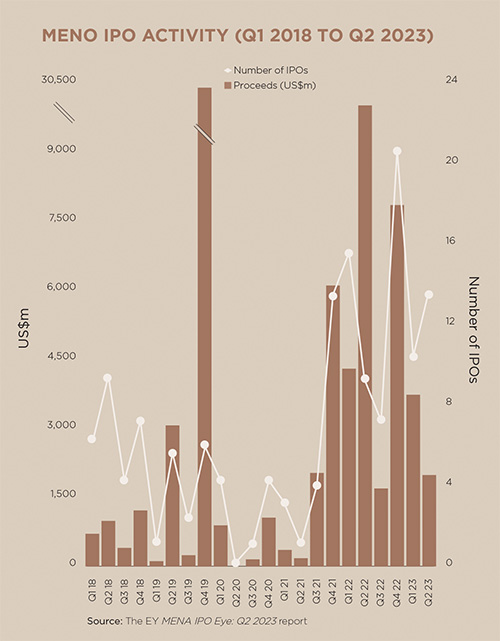
An important indicator of global investors’ warming interest in MENA is an uptick in initial public offerings (IPOs). According to EY’s MENA IPO Eye: Q2 2023 report, MENA IPO markets saw 13 IPOs during Q2 2023 – a 44% increase from Q2 2022 – raising US$1.8bn in proceeds.
Mike adds that the combination of an increasingly prosperous and well-educated consumer base, coupled with the emphasis on diversifying economic growth, has driven high demand for local, cash-generative companies in recent years. “The growth potential from regional IPOs very often exceeds those currently available within developed markets,” he says. “Recent IPOs in the region have exhibited characteristics reflecting the high-growth potential typically associated with emerging economies. This unique combination makes these IPOs exceptionally attractive investments, especially in the present climate of global uncertainty.”
This is particularly true for the Gulf states, with Saudi Arabia leading the way with 11 IPOs on the Tadawul (Saudi stock exchange) during Q2 2023, according to the EY report. Notably, these listings came from companies spanning several sectors, as Saudi Arabia continues to focus on diversifying its economy in line with its Vision 2030 plans.
Similarly, the report mentions the launch of an IPO accelerator programme by the Dubai Financial Market in H1 2023, aimed at family businesses and large private companies. As a result, Al Ansari Financial Services PJSC was the UAE’s first family-owned company to be listed, raising US$210.4m in proceeds.
Sudaif adds: “As the region is increasingly seen as a stable and more convenient place to do business, there has been an influx of capital into these countries, often in conjunction with capital backing from the local governments. This has led to a boom in IPOs in recent years. It is also worth noting that the stock markets of these regions are still developing, and IPOs are considered a way for the local populations to partake in the domestic GDP evolution.”
With 23 Saudi Arabian and two Egyptian companies announcing their listing plans in H2 2023, the EY report notes a “strong pipeline of IPOs to come”.
Population momentum
The importance of demographics should not be underestimated when weighing up making an investment in MENA, particularly in comparison with developed economies. Demographic trends in the area strongly favour sustainable longer-term growth prospects, Mike says. While developed regions such as Europe and Japan have relatively low birth rates and ageing populations, the MENA region is experiencing population growth of 1.5% per year, according to data from the World Bank – well above the global rate of 0.88%. This, says UNICEF, will see MENA’s population nearly double by 2050, with 271 million children, adolescents and youth (0–24 years) coming of age in the region by the middle of the century.
It’s clear that growth in the region will be accompanied by a youthful, productive and financially motivated population, with asset classes such as consumer spending and tourism set to be the key beneficiaries. The UAE is a prime example in this regard, as shown by the popularity of Dubai as a shopping and tourism destination.
Each MENA market has unique characteristics, offering portfolios significant diversification benefitsMike adds that while the demographic headwinds facing developed economies will, to an extent, be offset by technology-driven productivity gains, these same factors will add to the already strong growth prospects for the MENA region in the decades ahead.
Another important growth factor is the ongoing transition to renewable energy. “Despite these markets’ reliance on oil prices, which entails that the growth trajectory will be somewhat cyclical, we’re excited by their growth opportunities and note that the general direction of travel has been positive,” Sudaif says. “For example, the recent measures taken by the governments of UAE and Saudi Arabia to diversify away from hydrocarbon reliance will pay dividends in the long run. The countries also use their natural endowments to develop significant renewable power industries.”
Risks vs rewards
While there’s a compelling case for allocating some portion of portfolios to the MENA region, there are, of course, risks. Arguably, these are more pronounced than in developed markets. Political instability and regulatory uncertainties give reason to be cautious.
Mike says one challenge is linked to the centralised political and economic decision-making prevalent in some MENA nations. While it might be argued that this has an advantage – offering policy consistency and clear future directives – it can also pose significant risk. For instance, Mike says, if such a singular party or individual were to be displaced, there could be abrupt and radical policy shifts.
Currency volatility can present another material risk, although it is worth noting that not all countries in the region share this concern because many peg their currencies to the US dollar, mitigating fluctuation risks.
Governments in the region are also taking steps to improve transparency and governance in their financial markets, aiming to boost investor confidence. The Dubai Financial Services Authority, for example, requires financial institutions to comply with international regulatory standards, while Saudi Arabia’s Capital Market Authority has increased transparency in the Tadawul by making it a requirement for listed companies to provide more detailed information to their investors.
These efforts to reduce risk exposure may not yet be standard across all MENA countries, but with an increasing desire to attract foreign investment, it seems likely that most will follow suit in the near future. When they do, the region’s potential to weather the challenges posed by global uncertainty could see it thrive.
Alex Sebastian is a freelance financial journalist specialising in business, investing and wealth management. He has over a decade of experience across national consumer media and investment industry titles.
