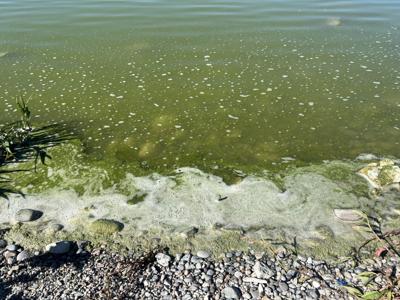
The Wyoming Department of Environmental Quality is advising that people and animals avoid portions of Lake DeSmet after the discovery of a harmful bacteria.
The agency issued a recreational use bloom advisory at Mikesell-Potts Recreation Area on July 15 due to the discovery of a harmful cyanobacteria bloom. Under the advisory, officials are advising that people and animals avoid contact with water in the vicinity of the bloom and especially to avoid ingesting water in the area of the bloom. Boiling and other filtration treatments do not remove toxins.
Fish should be rinsed with clean water and only the filet portion should be eaten. If people, pets or livestock come into contact with the bloom, the environmental department advises rinsing off with clean water as soon as possible and contacting a doctor or veterinarian.
“While initial sampling and field reporting occurred at the Mikesell-Potts Recreation Area, the Bloom Advisory applies to the entire waterbody,” Rachel Eyres, HCB Program Coordinator with DEQ, wrote in an email. “Cyanobacteria blooms can rapidly form, dissipate, and move to different areas of the lake depending on wind and water currents.”
An HCB advisory was last issued for Lake DeSmet in December 2021. That was the first report of a bloom on the lake, according to previous Bulletin reporting.
Cyanobacteria are naturally present in Wyoming waters, but they can explode into harmful blooms when specific environmental conditions align, Eyres said. These conditions include warm water temperatures, abundant sunlight and calm, slow-moving or stagnant water.
“When you combine those physical conditions with nutrients already present in the waterbody, the bacteria can rapidly multiply into harmful floating blooms or thick mats along the bottom,” she said.
Blooms can resemble grass clippings, blue-green scum or spilled paint floating on the water surface, Eyres said. HCBs can also be dark green or brown mucous mats that detach from submerged surfaces, float to the surface and accumulate along shorelines or stream banks. In humans, symptoms of skin contact or breathing in tiny droplets of water from an HCB include rash, eye irritation, nose irritation, sore throat and cough, according to the Centers for Disease Control and Prevention. Ingestion of water or fish from an HCB include stomach pain, vomiting, diarrhea, headache, muscle weakness, dizziness and liver damage.
Signs of illness in animals include vomiting, loss of energy, staggered walking, excessive drooling, difficulty breathing and tremors and seizures. Long-term health effects of HCBs in humans and animals remain unclear, according to the CDC.
The DEQ has 12 additional bloom advisories currently issued at other water bodies throughout the state.
More information about cyanobacteria blooms is available at WyoHCBs.org. Suspected blooms can be reported at that website.
Bloom-related human or animal illnesses can be reported to the Wyoming Department of Health at https://tinyurl.com/3u92swz4.