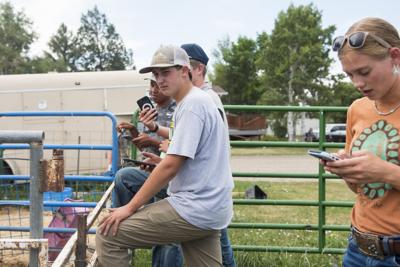
In the waning weeks before the county fair, four pigs meandered around a barn outside of the Johnson County Extension Office under the watchful eyes of five seasoned 4-H livestock judges honing their craft.
The 4-H’ers scrutinized the swine for physical characteristics such as body mass, shape, gait, muscle tone and height. Typing notes into their phones, Jace Foss, Quentin Agyemang, Beth Campbell, Henry Shoup and Emily Rice, members of the local senior livestock judging team, ranked the pigs one through four and prepared their justifications for doing so.
After taking some time to perfect and memorize their reasons for their rankings, it was the livestock judges’ turn to be scrutinized. The team took turns presenting to the judge who would ultimately critique their judgement.
Opening with a polite greeting, each 4-H’er shared their prepared ranks and reasons. Bryce McKenzie, the team’s coach and the county’s 4-H youth educator – himself a former livestock judging participant in 4-H and in college – gave them each critiques on their reasons and their deliveries and shared what he as a judge would score them out of 50. McKenzie is also called on to judge certain livestock judging competitions.
Livestock judging, McKenzie said, is an activity that teaches young participants a lot about both agriculture and life.
“I want them to be competitive as far as livestock judging contests go, but my goal has never been for these guys to be champions in the reasons room or in the contest,” he said. “I want these guys to have practical knowledge where they can go back home and make influential decisions on legitimate, real world practices.”
Knowing how to accurately evaluate animals is a valuable skill for professionals in the livestock industry.
“I want Jace Foss here to be able to go back home and influence his father to buy a bull because he thinks the numbers are correct or he thinks that this bull steps and follows his track better than one or another if they’re at a sale,” McKenzie said.
Judging spans several livestock species, including swine, beef, goats and sheep. Each species has various subspecies, which the judges are expected to be able to identify and know certain associated characteristics, strengths and weaknesses. Foss explained that participants can touch certain animals, such as lambs and goats, during the judging process to feel for muscle around their backs and ribs.
“We’re asking them to accurately evaluate things across the gamut,” McKenzie said.
How detailed judging is depends on the age of participants. 4-H’ers as young as 8 years old can start livestock judging. Those who stick with it will get more precise with time, McKenzie said.
“Those starter ones, we’re like, ‘Hey, today we’re going to talk about sheep, here’s what we look at,’” McKenzie said.
What’s important to do when explaining their rankings is compare animals to one another and point out their advantages and weaknesses.
“Accuracy in the reasons room is the biggest thing,” McKenzie said. “If you’re making it in the 40s, that means you’re accurate. If you’re talking 45-plus, it means you have some presentation and you have some pizazz and some terms in there that are kind of next level.”
Each competitor has their own sort of formula. Campbell said that her first year of competition was focused on finding a format that worked for her.
“I take those notes I took and I start plugging them in, because you want to say why you put that pig to the top, the reason why he has to win that class, then you want to grant that pig that goes second because you can see why he’s there, but you also have to criticize and say this is why he doesn’t beat the pig that goes to the top of it,” she said.
This year, Campbell said, she has been working on implementing more terminology, which also affects scoring.
Livestock judging at a high level also provides scholarship opportunities. Wyoming, in particular, has a very competitive crop of livestock judging participants right now, McKenzie said. Foss, Agyemang and Campbell are ranked in the top 35 of the state’s senior 4-H’ers, and everyone at practice on July 16 indicated they have thought about judging in college.
Beyond knowledge of livestock, the other piece of competition is public speaking. Even their stance and body language during the proceedings are judged.
“That’s one of the alternative goals of livestock judging, that’s why we’re doing this. Really, it’s evidence-based critical thinking and defending logic,” McKenzie said. “That’s all we’re asking these guys to do is go in and tell us how you placed it and why.”
Confidence is a key component to scoring well, McKenzie said.
Rice said that livestock judging has made her more confident in public speaking.
“I’m a lot more comfortable now being able to stand up and talk, just more comfortable and better at voicing my opinion,” she said. “Because livestock judging is, I’m telling you that I’m right and you’re wrong.”