We all watched in awe as a man selling intelligence to the world admitted to something painfully short-sighted. But at least there’s one thing on his side.
COMMENT
Often seen draped in designer leather jackets, microphone in hand, Jensen Huang rarely comes across as a man concerned with the possibility his confidence might be misplaced.
It’s a trick many high-profile business leaders use to get places. Sell your confidence in the product, and the sales often follow.
In the case of Nvidia, Mr Huang has become the man at the helm of the world’s most valuable company behind Apple, surging ahead as the AI boom accelerates beyond most people’s imaginations.
He’s been very vocal about the purported benefits of the industry that has helped make his company a global titan, coolly dismissing the hordes of naysayers calling for restraint. Much to the industry’s chagrin, increasingly popular safety campaigners continue to question the reasoning behind Mr Huang and several of his peers’ full-speed-ahead philosophy.
But this week, the billionaire chip baron found that questions about judgment can get a bit more personal than that.


The world watched on in awe as a man working in the intelligence space faced allegations that he had fallen for the oldest and perhaps most embarrassing trick in the book.
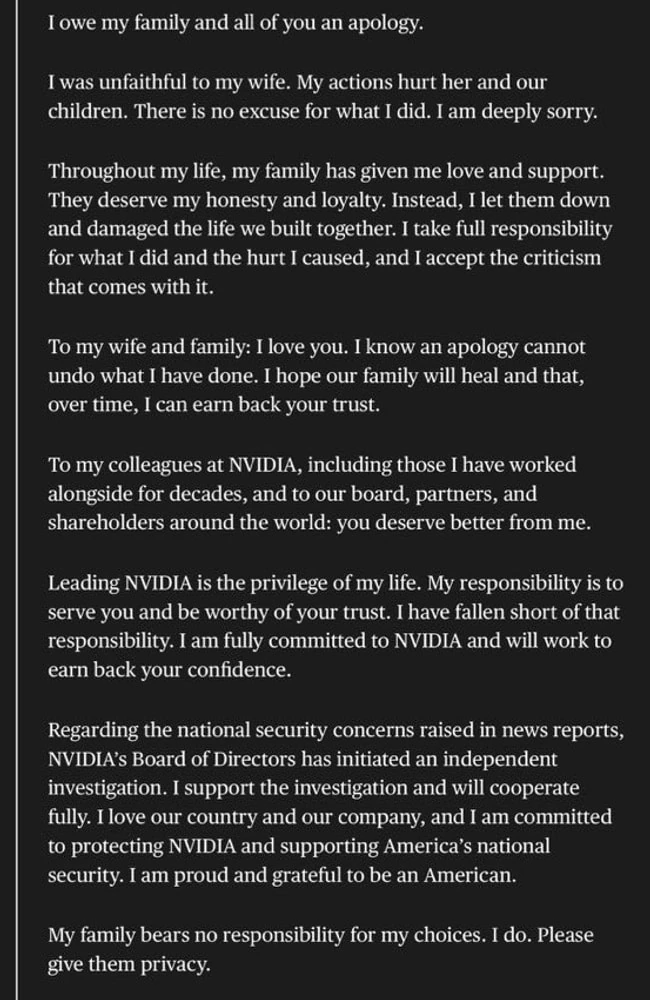
Mr Huang has admitted an affair with a business executive whom US intelligence assessed was gathering information for Beijing, according to The New York Times.
Nvidia has now opened an independent investigation as it weathers this excruciating PR storm. Its board says it has “no reason to believe that either national security or NVIDIA secrets were compromised”, but the inquiry remains ongoing.
There is no public finding that Huang knowingly assisted a foreign intelligence service or supplied it with secrets. Still, watching Huang deal with the resulting fallout has been wince-worthy.
“I was unfaithful to my wife,” Huang acknowledged. “There is no excuse for what I did.”
The hurt to his family is one thing, but if we’re buying the fact that Nvidia is inextricably tied to US security, the broader consequences could have been enormous.
Forbes valued his fortune at $161.7 billion (about A$235 billion) on November 5, and Nvidia at $4.45 trillion (about A$6.5 trillion).
He also advises Donald Trump through the President’s Council of Advisors on Science and Technology.
But amid the sh*tshow, Mr Huang can rest easy knowing he’s not alone.
There’s been plenty of bigwigs who have collapsed under the weight of a wink from a mystery woman.
The cases on display throughout humanity’s sticky timeline show just how badly things can unravel.
Our colourful history of honeypotting
The intelligence business has always had a deep interest in extracting secrets out of the other side.
Tools come and go, but even after thousands of years of civilisation, spy agencies have yet to retire one trick that continues to get results.
The good old-fashioned honeypot.
Some would say it goes all the way back to the biblical story of Samson and Delilah, which involves a powerful man, an intimate relationship and enemies paying to discover his weakness.
At that point, you could probably argue cavemen were doing something similar as well. Maybe even monkeys.

By the 17th century, history shows governments were certainly thinking about the diplomatic possibilities of a well-positioned lover.
Louise de Keroualle became King Charles II’s mistress with encouragement from the French government, which hoped she would be a useful political asset.
According to Britain’s National Portrait Gallery, she entertained French diplomats in apartments beside the king’s and exercised influence by providing access to him.
During World War II, American-born operative Amy Elizabeth “Betty” Pack, codenamed Cynthia, developed a relationship with Charles Brousse, a diplomat at the Vichy French embassy in Washington. He then helped her obtain secrets from the embassy’s safe.
Around the same time, Soviet operative Ramon Mercader worked up a relationship with Sylvia Ageloff, an American connected to exiled revolutionary Leon Trotsky’s circle.
That relationship helped him gain access to Trotsky’s household in Mexico. On August 20, 1940, Mercader attacked Trotsky with an ice axe. Trotsky died the following day.
Trotsky was not romantically involved with his assassin, but an exploited relationship opened a path through his protective circle.

Britain’s ambassador to Moscow between 1965 and 1968, Sir Geoffrey Harrison (yep, a knight), was another senior target of a classic honeypot.
It seems even after hundreds of years of evidence, and after surviving the biggest, most spied-upon conflict in world history, even the most experienced can be fooled.
He became involved with a Russian maid known as Galya, who was identified as working for the KGB in historian Daniel Lomas’s research into Foreign Office security.
Harrison was recalled from his post in 1968. Lomas cites journalist John Miller’s recollection of photographs of the pair travelling to Leningrad for a “cultural weekend”.
A cultural weekend sounds respectable enough … until a hostile intelligence service takes an interest in your holiday snaps.
The account does not establish that Harrison supplied state secrets, but it does show that a compromising relationship could cost an ambassador his job.
‘Any man would have fallen’
Then you have the real eyebrow-raisers.
The 1984 case of Richard Miller, a two-decade veteran in the FBI who worked in counterintelligence, is a humdinger.
Professionally acquainted with the possibility that an interested stranger might have another motive, he still began a sexual relationship with Soviet contact Svetlana Ogorodnikova.
According to the US Justice Department’s history, she used sex and gifts to compromise him before seeking classified documents, personnel information and the whereabouts of defectors on behalf of the KGB.
Miller admitted passing her at least one classified document.
His defence included the contention that he was attempting to infiltrate the KGB himself. It did not save him.
After earlier trials and an overturned conviction, he was convicted again in 1990 and sentenced to 20 years as the first FBI agent convicted of espionage.
The conviction was upheld in 1993.
“It was a crime of lust. It was a crime of dissatisfaction,” prosecutor Adam Schiff said.

In yet another case, US Marine embassy guard Clayton Lonetree became romantically involved with Soviet embassy employee Violetta Seina in Moscow.
She later introduced him to “Uncle Sasha”, a KGB agent.
Lonetree subsequently supplied information identifying covert American intelligence personnel and describing the layouts of the US embassies in Moscow and Vienna. He was convicted of espionage in 1987.
In another well-covered case, former Israeli nuclear technician Mordechai Vanunu supplied Britain’s Sunday Times with details of Israel’s secret nuclear program.
An Israeli intelligence operative he knew as Cindy then befriended him in London and persuaded him to travel to Rome.
There he was abducted and taken to Israel and spent 18 years in prison.
Discussing the operation in a 2015 television interview with Danny Kushmaro, he extended his defence to the rest of the male population.
“Any man would have fallen … including you,” he said.
History shows Vanunu’s defence contains a morsel of truth, in that some things might just never change.
But we live in 2026. We’ve seen some s**t by now. We have flying cars, for crying out loud.
If this tech race against China was as important as the industry says it is, then you’d think the blokes orchestrating it would be a little more careful.
Maybe he can ask ChatGPT what to do next time.