US President Donald Trump has arrived in Manilla amid much fanfare ahead of an annual ASEAN summit meeting with Australia, India and Japan.
Mr Trump complimented leaders from the three countries, calling them “phenomenal people”.
It comes as the President said claims that Iran has a“dirty bomb” it will detonate in Washington, DC are being taken “very seriously”.
On Monday, CNN reported that US spy agencies believe Tehran may have already smuggled nuclear material into the country.
When asked during a Tuesday on the sidelines of the ASEAN summit whether there was an imminent threat to the nation’s capital, Mr Trump told reporters: “Well, if there is, they will pay a price the likes of which no country has ever paid before.”
Albo greets Trump at Philippines summit
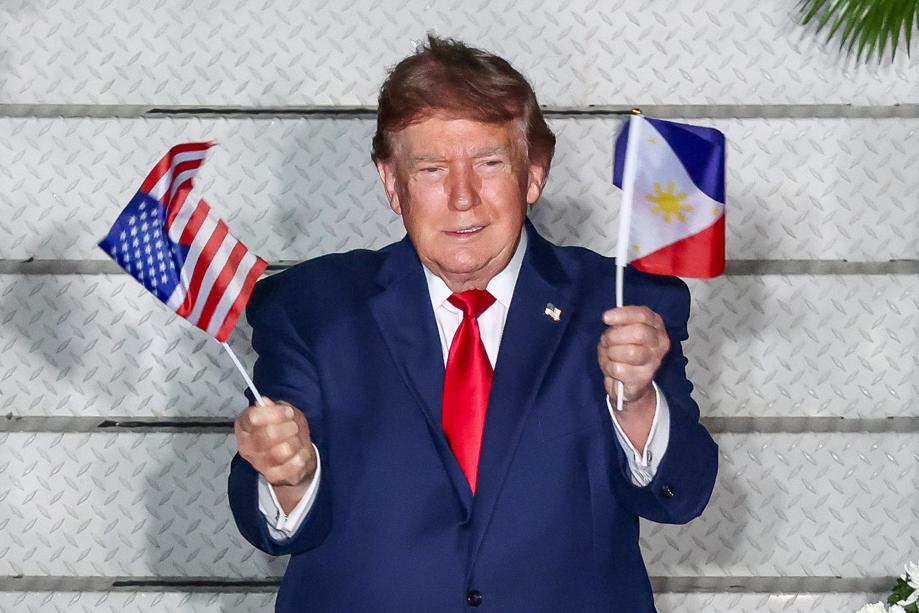
US President Donald Trump arrived in Manila on Tuesday, where thousands of people protested his attendance at a regional summit he will seek to dominate after bruising election losses back home.
Mr Trump was greeted by a marching band and honour guard on the tarmac. Some 13 kilometres away, 2,000 demonstrators faced off with police while carrying banners reading “Trump out now” and “Reject Pax Silica”, a reference to a US supply chain initiative that has divided opinions in the Philippines.
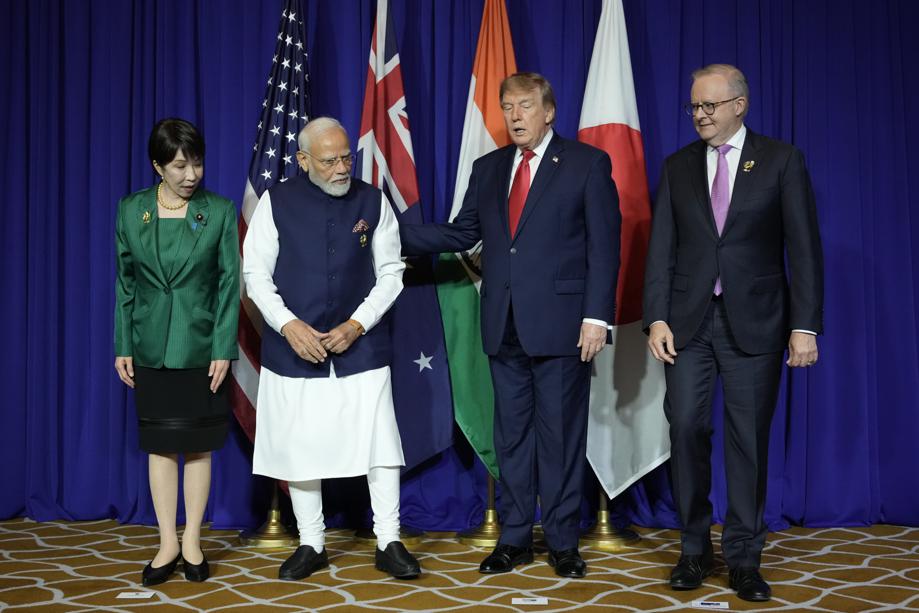
The US president was to be immediately flown by helicopter to a meeting of the so-called Quad security alliance, with India’s Prime Minister Narendra Modi, Japan’s Sanae Takaichi and Australia’s Anthony Albanese.
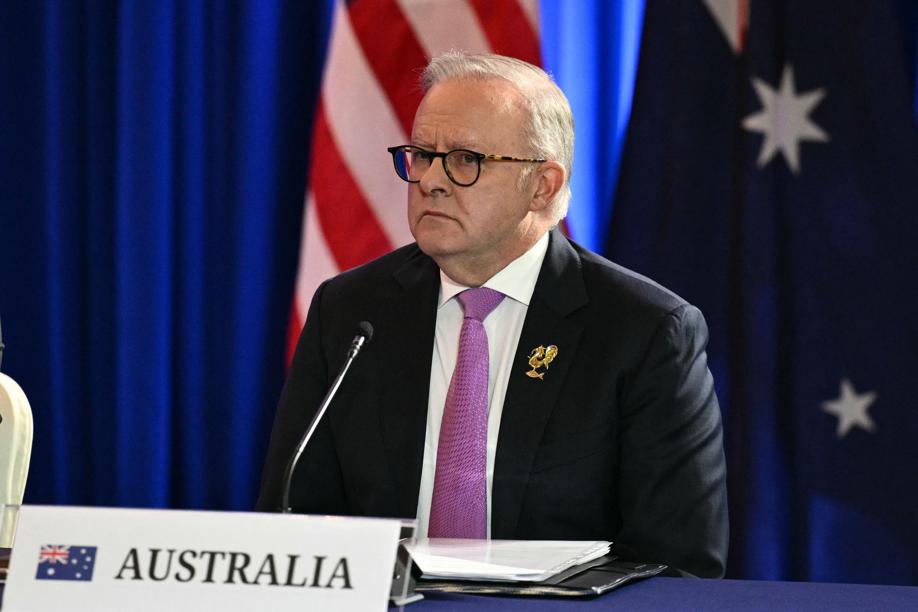
The gathering on the sidelines of the 11-member Association of Southeast Asian Nations (ASEAN) summit is the Quad leaders’ first since Mr Trump’s January 2025 return to power, and comes after his Republican party took a drubbing in this month’s midterm elections.
While the Quad – broadly aimed at counterbalancing China’s regional influence – has quietly progressed in deepening coordination, the short time allotted for Tuesday’s meeting meant it was unlikely to extend beyond pleasantries, Ryan Hass of the Brookings Institution told AFP.
The timing, however, carried significance, he said, given the historic meeting Trump will attend with China’s President Xi Jinping and Russia’s Vladimir Putin in just two days.
“It’s a way of inoculating Trump against criticism of caving to authoritarians when he meets with Xi and Putin in Shenzhen,” Mr Hass said.
This would be the first ever three-way meeting between the leaders of the United States, Russia and China.
Hayley Channer, economic security director at the Sydney-based United States Studies Centre, said Mr Trump’s decision to include ASEAN on his travel agenda was noteworthy, as “Southeast Asia has never been a high priority for the United States”.
Tariffs and chips
Japan’s foreign ministry said the Quad agenda would include discussions of the East and South China Sea – areas where multiple parties have overlapping claims with China.
Mr Trump will later attend a meeting with ASEAN heads of state before going to a gala dinner.
While ASEAN leaders have spent three days grappling with a raft of regional issues, the spectre of Trump’s ongoing tariff blitz has loomed large.
Chinese Premier Li Qiang on Monday slammed what he called a “countercurrent of unilateralism and protectionism” while touting Beijing’s own expanding trade with the bloc.
Brazilian President Luiz Inacio Lula da Silva and Canada’s Mark Carney sang a similar tune on trade, with both explicitly citing a need to wean themselves off dependence on the US market.
Mr Trump’s arrival comes on the heels of an announced US rules shift on the transfer of advanced AI chips, a move that could potentially rankle ASEAN members.
Companies shipping high-end chips to Singapore, Malaysia, Thailand and Indonesia will now require a special licence, as the countries were said to represent a “higher-than-normal risk of diversion”.
Singapore responded by saying it was now exploring ways to facilitate “trusted access” for firms based in the city-state.
Mr Trump is set to meet with Philippine leader Ferdinand Marcos at the presidential palace on Wednesday before heading to China’s Shenzhen.
Aimed at countering China’s dominance in semiconductors and rare earths, the initiative has been the focus of months of protests in the Philippines, as its flagship 1,620-hectare AI manufacturing hub north of Manila threatens to displace Indigenous families.
'Crazy': Trump responds to ‘dirty bomb’ threat from Iran
US President Trump said Tuesday that a reported plot by Iran to detonate a so-called “dirty bomb” in Washington, DC is being taken “very seriously” — all but confirming a CNN report that US spy agencies believe Tehran may have already smuggled nuclear material into the country.
When asked during a meeting with the leaders of Australia, India and Japan on the sidelines of the annual ASEAN summit whether there was an imminent threat to the nation’s capital, Mr Trump told reporters: “Well, if there is, they will pay a price the likes of which no country has ever paid before.”
‘Overrun’: Trump ally scrambles to stop tech panic
America’s homeland security chief has attempted to calm nervous citizens as a string of massive technology failures disrupted flights, banking and email services this week. He has floated an AI — or “SI” — explanation that clashes with accounts from two of the organisations involved.
Department of Homeland Security Secretary Markwayne Mullin sought to reassure viewers during an appearance on Fox News’ Hannity on Monday. But his address has raised more questions than answers.
“Well, breathe. The homeland is secure. Our banking system is secure and when something like this happens, we’re able to react and react fast,” he said.
“I can tell you with 98 per cent certainty we’re not seeing the cyberattack.”
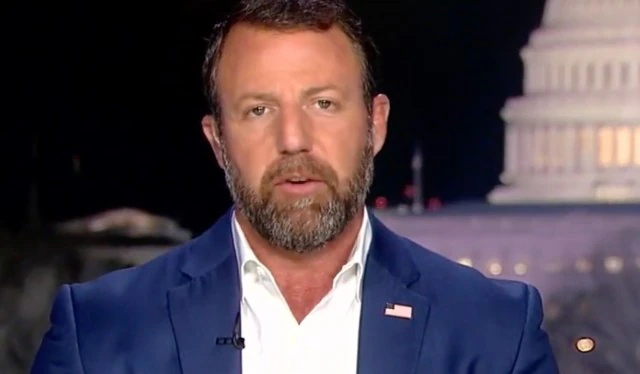
Mullin described the incidents as “individually unrelated”, saying investigators were not seeing the digital footprints expected from an intrusion.
But his subsequent suggestion that artificial intelligence could be overwhelming older systems was not an announced investigative finding, but more of a loose theory he attempted to roll out to millions.
Public statements from the FAA and Microsoft following their outages pointed in a different direction.
“We see zero evidence of anything nefarious, and zero evidence of anything AI-related,” FAA Administrator Bryan Bedford said on Saturday.
Microsoft executive Charles Lamanna was similarly explicit on Friday: “This was not a cyberattack or an issue caused by AI tooling.”
Mullin said his technology contact believed systems were struggling to accommodate AI programs capable of writing and modifying code, which is exactly the concerns of several AI safety campaigners urging organisations against incorporating agents across their systems.
“And so when they put in a program that’s able to write codes, and it goes in and it self-fixes itself, as it starts self-fixing itself, it’s like doing a change order on a house,” Mullin said.
“When you change one thing in a house, everything else starts changing. That’s a ripple effect.
“It causes these systems to be overrun that weren’t designed to run as fast as the SI technology is today.”
Mullin did not identify the technology contact, only claiming it wasn’t Elon Musk.
His account described a possible explanation, rather than evidence connecting a particular AI deployment to any of the failures.
The succession of failures has understandably attracted attention, including among prominent conservative commentators.
Pro-Trump influencer Benny Johnson listed Microsoft, FAA, Workday and banking outages before asking: “What is going on?”
Fox News analyst Brit Hume also raised the possibility of adversarial involvement while discussing the cluster of disruptions.
Even before his own airline’s Monday disruption, United chief executive Scott Kirby had urged action over Friday’s FAA failure.
“This moment must be a call to action,” he said, calling for investment in technology and staffing.
Technology analyst Patrick Moorhead pointed to the consequences of relying on highly concentrated infrastructure, urging the world to heed the early warnings.
“When one piece fails, it fails at national scale,” he told USA Today.
And then Virginia Tech professor Ali Butt offered a more practical response than anything dished out by a politican this week.
“Should people panic? No. Should we ask for better engineering? Yes,” he said.
China warns of 'necessary measures' after US chip crackdown
China is fuming at a new move from the US that aims to restrict its access to advanced AI chips through overseas data centres.
The workaround has come under intense scrutiny from some of China’s leading officials right as Donald Trump prepares to meet leader Xi Jinping about a swath of other pressing matters concerning the two rival superpowers.
The chip crackdown followed former Nvidia chief Jensen Huang’s admission of an affair with an executive at Singapore-based Megaspeed, a computing company under scrutiny over possible illegal diversion of chips to China.
The restrictions announced on Monday extend Washington’s attention beyond where powerful processors are shipped to who can actually use them.
Put simply, Chinese companies could rent computing power from chips housed overseas without bringing the hardware into China. The new rule now imposes licensing requirements on huge volumes of that remote access.
It also introduces export-licensing requirements for advanced chips destined for Singapore, Malaysia, Thailand, Indonesia and Brazil, which Washington identifies as heightened risks for diversion.
Beijing naturally pushed back hard against the proposed restrictions.
“China opposes abuse of export control measures, which disrupt the stability of global industrial and supply chains and serve no one’s interests,” foreign ministry spokeswoman Mao Ning said.
Reuters reports Treasury Secretary Scott Bessent had criticised Commerce’s handling of Megaspeed, while President Donald Trump has defended Commerce Secretary Howard Lutnick.
Dire study lays bare the cost of America's data centre boom
Amid the widespread condemnation of the tech sector’s newest obsession lies a few eye-opening figures that have raised alarm. Giant data centres appear to be here to stay, but their ongoing costs remain at the centre of the concern.
A new Harvard-led study has estimated that electricity powering 403 of America’s biggest data centres was associated with about 25.7 million tonnes of carbon dioxide emissions in a year.
The vast computing facilities support cloud services and artificial intelligence, but behind those seemingly weightless digital products sits some extremely complex plumbing.
Published in Nature Sustainability, the research estimated electricity consumption between May 2024 and April 2025 at between 68 and 99 terawatt-hours, depending on operating levels. The upper estimate approaches the annual electricity consumption of states including Michigan and Tennessee.
Roughly 54 per cent of the electricity came from fossil fuels.
“Data centers are growing incredibly fast, driven largely by AI,” lead author Gianluca Guidi said.
The researchers also warn the footprint could already be substantially larger following further expansion since their study period.
The broader trajectory offers little suggestion that demand is settling down. The International Energy Agency projects global data-centre electricity consumption will roughly double between 2025 and 2030, with consumption at AI-focused facilities tripling.
About a quarter of the countries on Earth already face chronic water scarcity – and that’s just drinking water.
Europe is steaming towards a particularly ugly crossroad.
According to experts from leading data and analytics firm GlobalData, the issue of water scarcity has now outstripped skyrocketing electricity demands.
A 2023 OECD study estimated that AI systems will consume between 4.2 and 6.6 billion cubic metres of water per year by 2027. That’s more than the annual water use of Denmark, or nearly half the entire United Kingdom.
'No daylight' with Trump, VP Vance insists
US Vice President J.D. Vance has insisted there is “no daylight” between himself and President Donald Trump on the Iran War, despite his screed after the midterm elections blaming the war for the Republican Party’s abysmal performance.
“You said the Iran War was really the major reason for the Republicans losing,” Fox News host Laura Ingraham put to Mr Vance during an interview.
“Is there daylight between you and the President on this issue today that the people should know about, or that informs your current thinking?”
“No, there’s no daylight,” said Mr Vance.
“The President of the United States, he makes decisions. And obviously, within the administration, we have debates and discussions about exactly what to do. When the President makes a decision, he is owed a cabinet that helps implement that decision.
“And I think there’s not daylight between the President and any other senior member of the administration. Now, politically, yes, I think the President himself has absolutely said this as well: there was a political cost – the higher gas prices, the higher energy prices. And the thing that I try to remind people is that higher energy prices are the consequence not just of what’s going on in the Middle East, but of the fact that we’ve under-invested in American energy infrastructure for decades.
“Why haven’t we built a refinery since the 1970s? That increases energy costs. Why do we spend trillions of dollars on a Green New Scam rather than actually building out our own oil and gas facilities?”
He went on at some length. I will note, though, that Mr Vance’s answer there made it clear that Mr Trump made the decision to go to war, not him. His opposition to the idea was more than hinted at.
What's on the agenda at the APEC summit?
Here’s a helpful primer on the issues on the table for APEC, courtesy of AFP.
Obviously, the biggest event will be the meeting between Donald Trump, Vladimir Putin and Xi Jinping. But there’s other stuff going on too.
Trade
Trade tensions will loom over the economic leaders’ meeting, held from Wednesday to Thursday.
Mr Trump has upended the global trade order by imposing wide-ranging tariffs on many countries, which China has met head-on with counter-levies and threats to withhold crucial exports.
On the sidelines of last year’s APEC summit in South Korea, Mr Trump and Xi reached a tenuous truce in their trade war, but it will expire in January.
“The key overriding goal is to prevent another round of aggressive destabilising tariffs and trade wars rather than to produce any single major milestone,” Dylan Loh, from Singapore’s Nanyang Technological University, told AFP.
The leaders’ “priority” would be “keeping the truce alive”, especially with another Trump-Xi meeting expected at the G20 summit in Miami in December, said Lizzi Lee, a fellow at the Asia Society Policy Institute (ASPI).
Countries like Canada will also be looking to broaden their trade partnerships – including with China – to reduce their dependence on the United States.
Ukraine
China has confirmed that Xi, Mr Trump and Putin will meet on the sidelines.
Beijing has said the three leaders will discuss “safeguarding world peace”, but US officials say Trump is not expected to bring up Russia’s war in Ukraine.
Kyiv is concerned about being sidelined, with Foreign Minister Andriy Sybiga saying a meeting between US, Chinese and Russian leaders would “only encourage Putin to continue this war”.
Beijing, insisting it is a neutral party, has never denounced the Russian invasion, and has instead called for peace talks.
“Beijing will remain respectful of Russia’s own aims in the war and balance that with growing calls from Europe to exert a little more influence in that regard,” NTU’s Loh said.
Putin would probably have the most to gain from the trilateral meeting, ASPI’s Lee added.
“Just being at the table with Trump and Xi would elevate Russia’s standing and potentially shift the conversation toward a broader great-power bargain over European security,” she said.
Nuclear weapons
The Trump administration is keen to push for denuclearisation at the summit, having criticised China’s rapidly expanding nuclear arsenal.
Analysts however, are sceptical that Trump, Putin and Xi can achieve a three-way deal to reduce arms.
“From Beijing’s perspective, the starting point is fundamentally unequal,” said Lee.
“The US and Russia have much larger arsenals, and China sees its own buildup as necessary for a credible deterrent.” Washington has repeatedly accused China of conducting secret nuclear tests and demands that Beijing be part of any future arms control treaty.
The lapse in February of New START – the last treaty between top nuclear powers the United States and Russia – presented the possibility of striking a “better agreement” including China, Washington said.
Beijing declined to join disarmament negotiations then.
Speculation has also been mounting of a potential meeting between Trump and North Korean leader Kim Jong-un, with the US president having made repeated overtures to Pyongyang for nuclear talks.
AI
Countries have called for stronger governance and regulation of AI, as worries grow about its potential for military use and the risks posed by rogue autonomous-agent tools.
China-US talks could build on the AI “communication channel” agreed when Trump and Xi met in Washington in September.
“The next step should be to agree on what constitutes a reportable incident, who has authority to communicate, how quickly notifications must occur and how information can be verified without disclosing sensitive capabilities,” said Marina Zhang from the University of Technology Sydney.
Media reports have also suggested Xi, Putin and Mr Trump may discuss the use of AI in nuclear weapons command systems.
Mr Trump’s predecessor Joe Biden and Xi had agreed in 2024 that any decision to use nuclear weapons should be controlled by humans, not by AI, the White House said.
“There’s actually some common ground to build on,” Lee told AFP. “(The) question is whether they can move beyond a general statement… toward something more practical.”
This would be a “much easier political sell” for Beijing than arms reductions, and “could give Trump something to announce without requiring anyone to compromise their nuclear posture”, she said.
'What are the chances?': US worries about latest tech glitch
Another US TV host, this time Fox News’ Jesse Watters, has expressed some scepticism at the idea that all the tech issues that have affected America in recent days are unrelated.
Today’s latest outage hit several of the country’s big banks.
“What are the chances of all of this happening in the same couple of weeks? Why is every computer on the frits? The government is telling us everything is fine. Is it? It doesn’t seem like it,” said Mr Watters.
“Now CNN is reporting that Iran wants to detonate a dirty bomb in D.C.; we’re not worried, they’ve wanted to kill us for a long time. But half of Trump’s cabinet is moving onto military bases, and telling us not to worry. ‘It’s safe out there, you’ll be fine.’
“But this is a little eerie. What happens tomorrow? There needs to be a plan.”
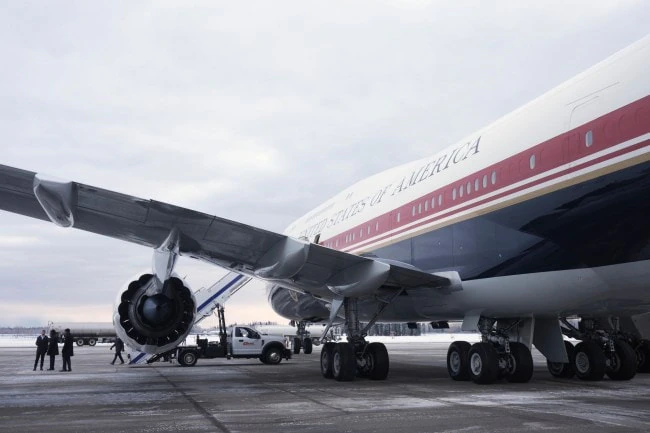
Air Force One en route to APEC summit
Donald Trump is currently en route to the Philippines for the APEC summit; below is an image of Air Force One refuelling in Alaska.
You’ll notice that it’s the new Air Force One, the luxury jet given to Mr Trump by Qatar and refitted at presumably considerable expense by the Americans.
The refuelling happened in a place called Fairbanks, which isn’t the usual spot. Apparently the plane was diverted by poor weather.
Forensics expert concludes Epstein likely didn't kill himself
A prominent forensics expert has concluded the death of sex trafficker Jeffrey Epstein, who died in jail in 2019, was likely a homicide.
Officially, Epstein was found to have killed himself. But Dr Michael Freeman, editor-in-chief of The Journal of Forensic and Legal Medicine, has serious doubts.
According to CBS News, Dr Freeman and two other experts – Anders Eriksson and Itiel Dror – spent months reviewing “never-before-published autopsy records”, provided by Epstein’s brother.
“The injuries that were documented by the medical examiner were not consistent with the suicidal hanging,” he told the network.
“And the injuries that were attributed to something other than potentially a physical struggle or assault were just overlooked.”
Dr Freeman said he’d found the very first image he examined, showing ligature wounds on the right side of Epstein’s neck, arresting.
“When I saw this photograph, my first reaction was that that is a very unusual looking injury for a hanging on the neck,” he told CBS.
We should note that an academic journal declined to publish Dr Freeman’s report; he claims the rejection was because the journal felt it wasn’t appropriate to criticise a medical examiner’s findings in a peer-reviewed publication. He plans to resubmit the report.