Russia has signalled that it is preparing for an end to the war with Ukraine in a meeting behind closed doors.
Prime Minister Sergei Kiriyenko told MPs to be “ready for victory” in a possible sign Russia is preparing for an end to the five-year war.
It comes as Estonia said it was planning to close its road border crossings with Russia after authorities foiled what they describe as a Moscow-backed intelligence operation to blow up a drone factory.
The Baltic nation’s foreign ministry announced the planned December 1 closure following Saturday’s attempted attack on Threod Systems in Viimsi, situated north of the capital Tallinn.
Meanwhile, Yemen’s Houthis have reportedly arrived on the outskirts of Aden, the country’s temporary capital city and home base of its internationally recongised government.
Government forces have been forced to retreat from other areas to focus on defending the city from the rebels.
Shocking Russia twist
MPs in Russia have reportedly been told to prepare for the war with Ukraine to end.
Speaking during a closed-door session, former PM Sergei Kiriyenko told Putin’s cronies to be ready to “interact” with returning soldiers.
A source at the event said: “He said that everyone must be ready for victory, when those taking part in the fighting return all at once from the special military operation.”
It raises questions about whether Putin is preparing to halt the near five-year war amid a string of devastating Ukraine attacks on Russia‘s power grid.
It comes as US negotiators have floated the idea of ceding the entire Donbas region to Russia in exchange for Nato membership during ongoing peace talks.
How billionaires 'lost the podcast bros'
Donald Trump’s former tech-and-podcast alliance is picking through the wreckage of the midterms, and boy is it a sight to behold.
Earlier this month, it was made abundantly clear that huge portions of the Republican’s base had jumped ship, and now some of the nation’s extremely wealthy magnates are shaking.
On the All-In podcast, investor David Sacks admitted Republicans had lost the podcast hosts who helped sell Donald Trump’s return to power. His comments attracted a lot of glee from around the web, with independent news channel Breaking Points having a field day with his concern that billionaires had lost an inch of influence.
“We lost all the podcast bros,” the investor and Trump ally said on the November 7 episode of All-In.
“A house divided against itself cannot stand. I mean, we lost a huge part of our base.”

Sacks blamed the Iran war and its economic consequences for fracturing the Republican coalition. He also argued the administration should have maintained closer relationships with influential alternative-media hosts as it pushed through increasingly controversial policies.
“We should have done a better job giving them all front row seats in the White House press room,” he said, all but admitting that one of the keys to good press is rubbing shoulders with popular voices in the media.
His proposed seating arrangement received a fairly unambiguous response, namely from the biggest podcaster in the game.
“How about no? How about real journalists?” Joe Rogan said on his November 13 podcast.
Rogan, who endorsed Trump before the 2024 election, said the administration’s problems extended well beyond the PR sphere.
“They didn’t just lose the podcast bros,” he said. “They lost most of the country.”
He pointed to “a war that no one wants to be in” and “militarized police in the streets wearing masks”. He still credited Trump with tightening the border, while criticising the removal of established, otherwise law-abiding community members.
There was disagreement inside All-In, too. Co-host Jason Calacanis challenged Sacks’s war-focused explanation, pointing to earlier damage from tariffs, immigration enforcement and the administration’s handling of the Epstein files. The disillusionment, he argued, had started before Iran.
The anxiety about lost influence comes from a political world in which extraordinary private wealth already buys extraordinary reach.
Forbes counted 989 American billionaires on its March list, collectively worth US$8.4 trillion (A$12.3 trillion). For scale, that fortune was equivalent to roughly 4.6 per cent of the Federal Reserve’s estimate of all US household and nonprofit net wealth that quarter.
Their appeal in 2024 was not especially mysterious, either. Trump and supporters such as Elon Musk offered disruption, business competence and an alternative to an establishment many voters believed was failing them.
The underlying frustration was real. AP VoteCast found about three in 10 voters said their finances were falling behind, up from roughly two in 10 in 2020.
Trump decisively won that group, with around six in 10 voters who prioritised the economy and jobs supported him.
It is widely accepted that the Democrats helped create the opening. Reassurances about Joe Biden’s fitness collided with his disastrous debate performance, while their economic messaging struggled to connect with household budgets.
Tiny Spanish island doubles in size after migrant surge
A small Spanish island is teetering on the edge of collapse after more than 12,000 migrants flooded the tourist hotspot in a matter of weeks.
Spanish authorities have declared an emergency in El Hierro, in the Canaries, as local services buckle under the unprecedented number of arrivals – surpassing the entire island’s 11,500 permanent residents.
It comes after a record-breaking weekend in the sun-kissed archipelago, which recorded its highest single-day total of migrant arrivals ever on Saturday after 1,580 people were rescued at sea.
Ukraine hits Russia’s Crimea bridge in 1,300-drone barrage
Ukraine fired hundreds of drones at Russia overnight, aiming towards Moscow and hitting a symbolic bridge that links the annexed Crimean peninsula to Russia.
The strike on the bridge appeared to inflict only minor damage, though it drew an angry response from the Kremlin.
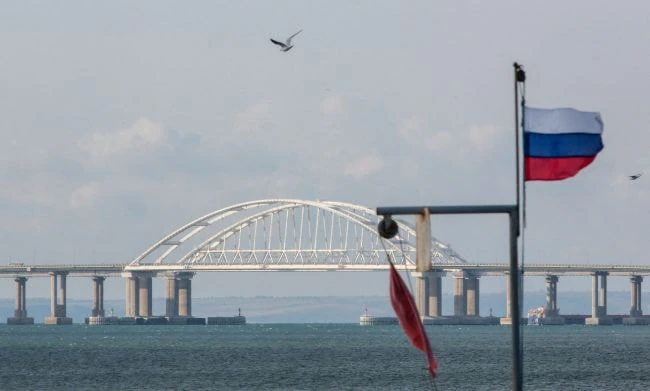
Ukraine launched 1,336 drones in the barrage, Moscow’s defence ministry said in a statement — the second-highest daily figureso far this year, according to an AFP tally of official Russian statements.
The barrage came days before a summit in Shenzhen between President Vladimir Putin, US President Donald Trump and Chinese President Xi Jinping.
US officials say Russia’s war against Ukraine is not expected to be a focus of the talks.
“The enemy has hit the Crimea bridge,” Crimea’s Russian-installed governor Sergey Aksyonov wrote on Telegram.
He did not say whether anyone was killed or wounded in the strike. Kremlin spokesman Dmitry Peskov later told reporters that there was “minor damage” and that traffic was continuing.
He also issued a rare admission of vulnerability in Russia’s air defence system. “Unfortunately, no system in the world can provide 100 percent protection against such large-scale strikes on various targets,” he said.
The bridge has been a key target for Ukraine since Russia launched its offensive in February 2022.
It has been struck several times, including an October 2022 blast in which an explosive-packed truck was detonated on the bridge, causing months of disruption.
Around 600 of the drones were intercepted on approach to the Russian capital, Moscow’s Mayor Sergei Sobyanin said.
The interceptions came hours after Ukrainian forces struck a major Russian petrochemical plant, an oil refinery and a military production site.
Kyiv says its retaliatory strikes are justified retribution for Moscow’s own missile and drone barrages of its cities and energy grid — attacks that have killed hundreds of civilians and regularly knock out power and heating for millions.
Russian attacks on Ukraine left 50,000 without power in the southern Odesa region on Monday, the DTEK power company said.
Strikes were also recorded in several other parts of the country, including the frontline Zaporizhzhia region where one person was killed.
In the Russian border region of Belgorod, a Ukrainian drone killed a truck driver, local authorities said.
Diplomatic efforts on ending the almost five-year war have so far gone nowhere. After a fresh round of talks in Abu Dhabi last week, Russian President Vladimir Putin reiterated his hardline territorial demands and said any deployment of foreign troops would be seen in Moscow as a “continuation of war.”
Ukrainian President Volodymyr Zelensky said the United States hadproposed Kyiv ceding some territory in exchange for being given NATO membership.
Peskov on Monday criticised Zelensky for divulging that publicly, though offered no comment on Moscow’s assessment of the idea.
Moscow has repeatedly said it will not accept Ukraine being admitted to the US-led alliance.
Against that backdrop, China confirmed on Monday that Xi would hold talks with Trump and Putin in Shenzhen on November 19 on the sidelines of the Asia-Pacific Economic Cooperation (APEC) summit.
The Kremlin and White House had previously confirmed the meeting. Beijing said the trio would discuss “world peace”.
Trump has said he intends to discuss denuclearisation and the Iran war. He is not expected to discuss Russia’s war against Ukraine in the trilateral talks, according to US officials.
Zelensky has warned that the Shenzhen meeting risks becoming a 21st-century version of the 1945 Yalta conference, where major powers could attempt to redraw spheres of influence without smaller countries at the table.
UN chief's grave warning over 'merciless' new war tech
The United Nations chief has urged governments to impose binding rules on “killer robots”, as defence companies openly promote technology designed to coordinate death more conveniently.
Antonio Guterres called for action on Monday as countries gathered in Geneva to consider the future of autonomous weapons — systems that can select and attack targets without a person making each individual decision.
“I call on you to move towards negotiating a legally binding instrument to regulate autonomous weapon systems – including clear prohibitions and restrictions,” he said in a video message.
He urged countries “to seize this moment, take action to prevent the use and spread of these merciless weapons”.
There is something distinctly uncomfortable about governments still discussing where to draw the line while the companies building the technology are already explaining its devastating advantages to prospective customers.
Palantir, the American data-analysis and military software giant, markets its Gotham platform as supporting soldiers with an “AI-powered kill chain”, including “seamlessly and responsibly integrating target identification and target effector pairing”.
It essentially boils down to identifying a target and match it with a weapon or other means of acting against it.
Anduril, another American defence technology company, is similarly explicit about the purpose of its work.
Announcing a partnership with Singapore’s defence agencies, it said its Lattice autonomy software could enhance the air force’s “effectiveness, lethality, and deterrent capability”. The project involved exploring collaboration between crewed and uncrewed systems.
Human rights campaigners are now fighting an accelerating battle against the prospect of new horrors being committed with the help of increasingly powerful systems.
The International Committee of the Red Cross wants prohibitions on unpredictable autonomous weapons and systems designed to target humans directly, alongside restrictions on other autonomous weapons.
There is no new treaty yet, but this week’s conference is considering whether to launch negotiations, with decisions requiring a total consensus — meaning a single country can obstruct agreement.
ICRC president Mirjana Spoljaric addressed the stakes recently, warning today’s leaders that their decisions will go down in history.
“Future generations will judge whether leaders acted to prevent a world where machines autonomously kill humans,” she said.
Nation closing its Russian border after attack, Moscow fumes
Estonia is planning to close its road border crossings with Russia after authorities foiled what they describe as a Moscow-backed intelligence operation to blow up a drone factory.
The Baltic nation’s foreign ministry announced the planned December 1 closure following Saturday’s attempted attack on Threod Systems in Viimsi, situated north of the capital Tallinn.
Eight people were detained following the alleged plot.
“Any attempt to threaten Estonia’s security, sow fear, or act hostilely against us will be met with a decisive response,” Foreign Minister Margus Tsahkna said.
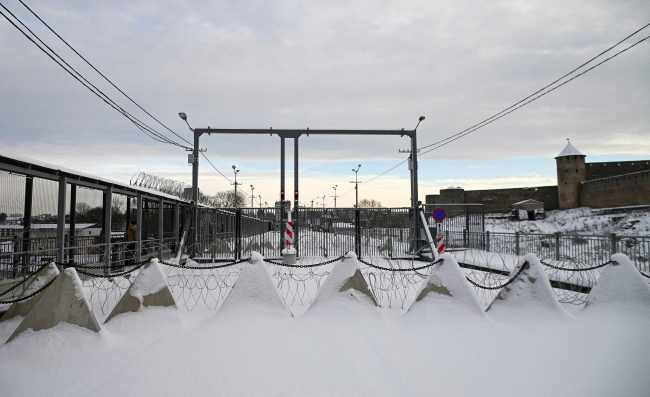
Estonia’s Internal Security Service says Russia’s military intelligence agency, the GRU, ordered the operation. That claim has naturally been disputed by Russia.
The incident is another sign that the war’s reach extends well beyond the battlefield in Ukraine. For Estonia, a NATO and European Union member, it has come as a reminder of the stakes living so close to a nation fundamentally opposed to the bloc.
Russia’s posture has solidified in recent months, and there are constant fears the regional conflict will expand outwards and wreak more havoc across the developed world and its fragile economy.
Prime Minister Kristen Michal said Russia’s aim was to “make us afraid, make us hesitate and weaken our support for Ukraine. Estonia’s response is the opposite.”
Public broadcaster ERR reported that this was the second attempted arson attack on an Estonian defence company since August, when Milrem Robotics was targeted.
They have now conceded that their border cannot remain open, given the purported threat.
The proposed closure would affect the crossings at Narva, Luhamaa and Koidula, including pedestrian traffic.
Officials have yet to settle whether the measure would be temporary or indefinite.
Russia’s foreign ministry spokeswoman Maria Zakharova came out in force, saying the closure would represent “aggressive and unbridled Russophobia”, AFP reported.
'Failure': Army whistleblower's haunting claims
A US Army officer who survived an Iranian drone strike that killed six soldiers has filed a whistleblower complaint alleging commanders ignored warnings about inadequate protection.
Army Reserve Major Stephen Ramsbottom’s account challenges the Pentagon’s description of the makeshift operations centre at Kuwait’s Shuaiba port, which was struck on March 1 shortly after the war began.
“We just did not plan this well, and this needs to be a lesson that we learn,” he told CBS’s 60 Minutes.
Ramsbottom described a “tactical failure” involving “the Army, our leadership, and myself”.
The six reservists were the first US service members killed in the Iran war. Ramsbottom himself was among those wounded.
He said he repeatedly raised concerns about protection from aerial attacks, only to be told: “We don’t have to worry about protection.”
Military leaders then discussed obtaining a counter-drone system, but Ramsbottom said “it never arrived at Shuaiba and we don’t know if it was ever even ordered to or requested”.
His complaint also alleges the installation lacked a doctor and a fixed aid station, with just one ambulance available.
Ramsbottom’s lawyers confirmed he submitted a protected disclosure to congressional committees on November 13, alongside a confidential complaint to the Pentagon’s inspector general. They are calling for an independent investigation.
The central dispute is what the troops were protected against.
Ramsbottom has previously said the site was prepared for older threats, such as mortar fire and car bombs, rather than the drone warfare now confronting American forces.
Defence Secretary Pete Hegseth offered a very different explanation immediately after the strike, saying a projectile had penetrated US air defences.
“Every once in a while you might have one — unfortunately, we call it a squirter — that makes its way through,” he said on March 2.
Hegseth described the operations centre as fortified, while acknowledging the destructive power of the weapons involved.
The complaint adds to pressure for answers as Democrats prepare investigations into the administration’s handling of the war after taking control of Congress in January.
Senator Richard Blumenthal has requested a classified briefing from Hegseth and “all force protection assessments” for the facility.
World braces for historic Trump, Xi, Putin meeting
President Donald Trump will meet with China’s leader Xi Jinping and Russian President Vladimir Putin this week in what’s considered a historic sit-down between the three countries.
The meeting, which will take place on the sidelines of the APEC summit in Shenzhen, will focus on nuclear non-proliferation and stockpiles.
“The President has made it clear that, among other topics, he will discuss the reduction of nuclear weapons in the world. This proliferation, President Trump believes, is very dangerous,” a White House spokesperson told US media.
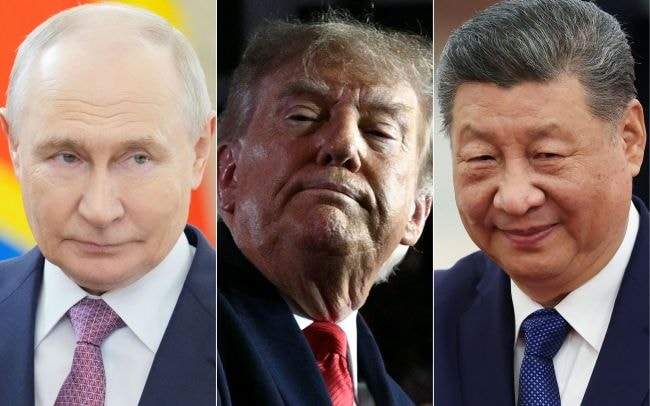
Mr Trump is not expected to address the ongoing war in Ukraine, nor is he expected to raise allegations of a Chinese intelligence operation involving former Nvidia CEO, Jensen Huang.
He is, however, expected to address the war in Iran, despite the nations’ vastly opposing views on the matter.
“I think the president does intend to talk about Iran in the trilateral meeting with Xi Jinping and Vladimir Putin,” a senior US official, speaking on condition of anonymity, told reporters.
Mr Trump has embraced Mr Xi following their short-lived trade war last year, going so far as to host a White House state dinner in honour of the Chinese leader.
Similarly, Mr Trump has sought to build his relationship with Mr Putin, even as the Russian leader continues to double down on his war with Ukraine and deepening diplomatic ties with Iran.
The meeting will mark the first time the world leaders have met together in a trilateral summit.
'We will find you': Iran's chilling warning
Iran has sent a chilling warning to two US Navy officers that it claims were involved in a missile strike that killed 168 children at an elementary school in southern Iran.
In a post to X, the Iran Embassy in South Africa wrote: “We will find you,” accompanied by images of Commander Leigh R. Tate and Lieutenant Commander Jeffrey E. York.
The embassy had previously singled out the officers in March, accusing them of orchestrating the strike and questioning whether the pair had children of their own.
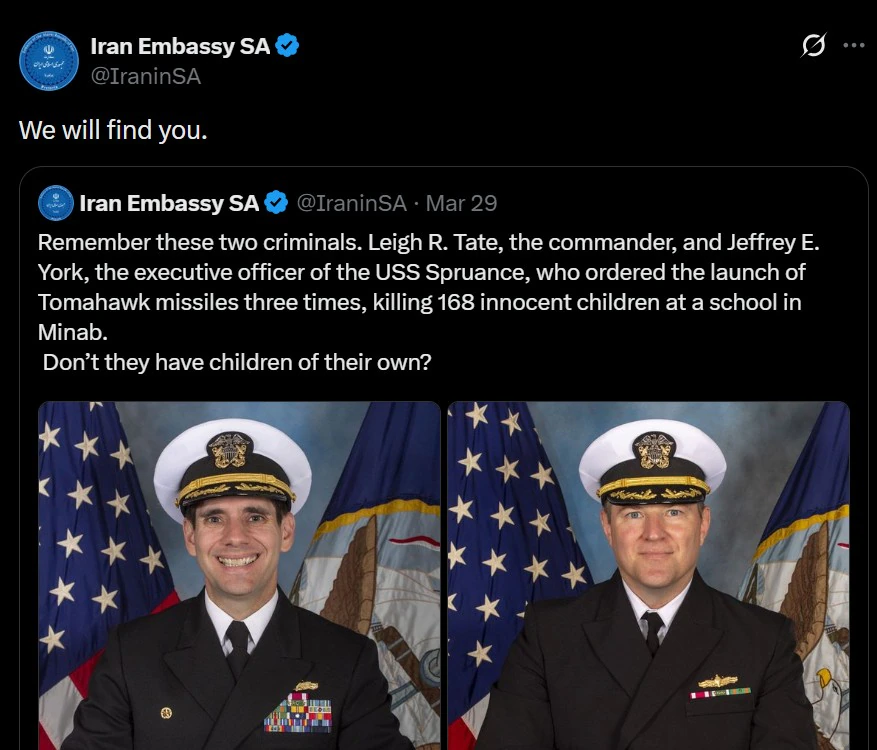
The threat from Iran came a day after President Donald Trump warned Tehran against assassinating senior American officials.
Last week, Treasury Secretary Scott Bessent confirmed he had relocated from his Washington-area residence to a military base amid Iranian threats against his life.
Secretary of State Marco Rubio, Defence Secretary Pete Hegseth and senior White House official Stephen Miller have also reportedly moved into military or other protected housing amid security concerns.
Huge software company goes down
Another software company has experienced a major outage, as big tech’s week from hell shows no signs of slowing down.
Workday, a popular software that handles payroll and human resource management for thousands of businesses, went down late last week – locking prominent companies out of its services.
The software is used by over 11,500 companies, including: Walmart, Target, Netflix, Salesforce, PNC Bank, Chipotle, Southwest Airlines, General Electric and Nasdaq.
Additionally, numerous government agencies rely on the platform, including the cities of Dallas, Seattle, Philadelphia, Charlotte and Denver.
It’s the second major business software outage to occur in recent days after Microsoft experienced a global shutdown that impacted over 430 million people worldwide.