“The Elephants in the Room from AI to Teacher Retention.”
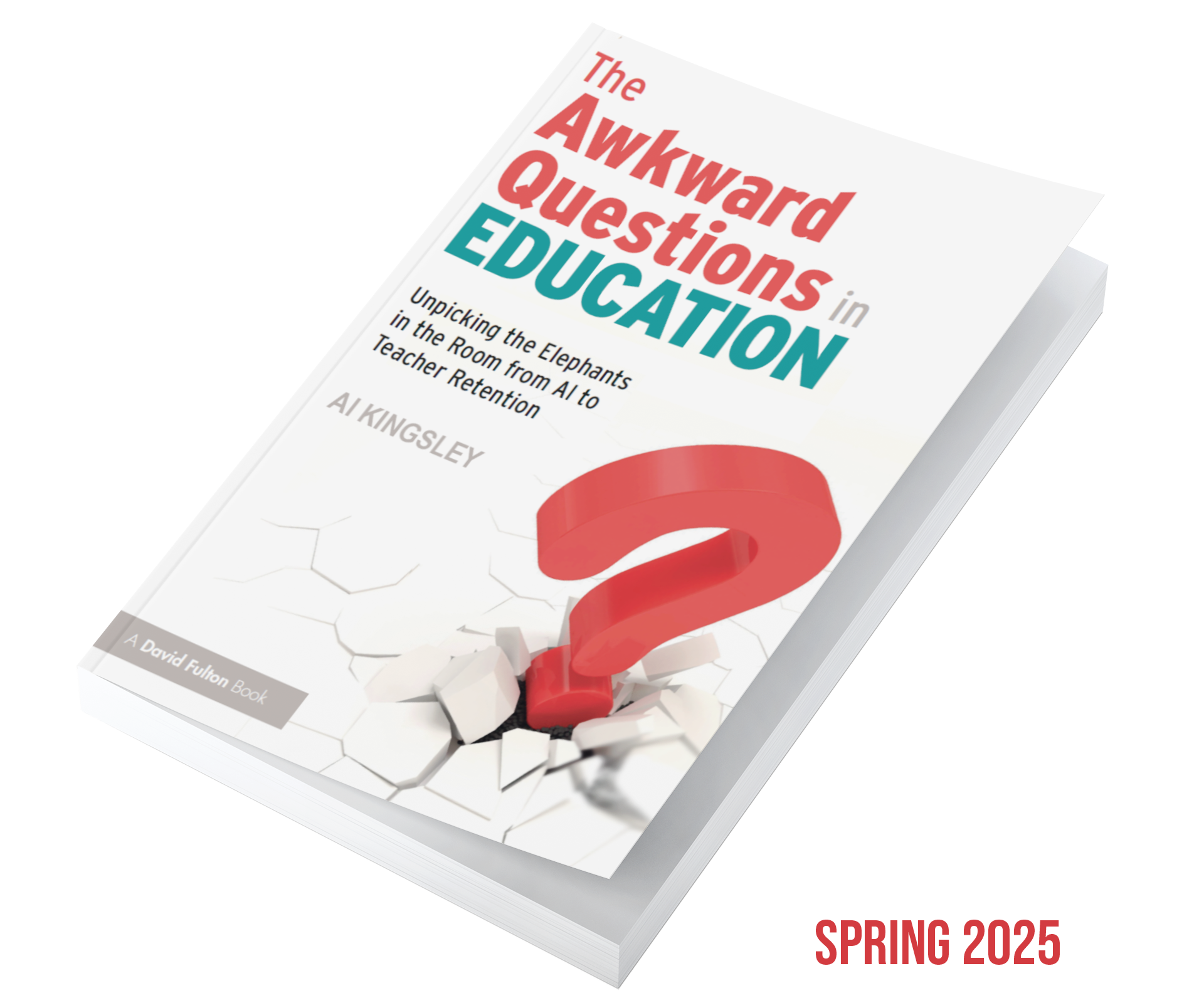
The book is now with the publishers and due for release in spring 2025.
Publisher: David Fulton / Routledge Education
ISBN: 978 1032883144
In today’s ever-evolving educational landscape, schools and systems face unprecedented challenges; from the advent of artificial intelligence, hybrid learning to a future ready curriculum, the need for skills through to the critical issues of teacher retention and student wellbeing. In The Awkward Questions in Education, Al Kingsley, tackles the tough, often avoided, questions plaguing the sector today.
Drawing on over 35 years of experience, Kingsley explores the deep-seated challenges that many in education encounter daily. Are we teaching students the right skills for the future? Is the system truly inclusive? How should we handle the integration of AI in classrooms? What can be done to solve the ongoing teacher recruitment and retention crisis?
This book doesn’t offer one-size-fits-all solutions, but instead opens critical conversations that we need to have if we’re to enact real, sustainable change. Kingsley provides insights and perspectives from educators, administrators, and thought leaders worldwide, making this a must-read for anyone passionate about the future of education.
Prepare to be challenged, informed, and inspired to think differently about the future of schools and the students they serve.
Below are reviews of the manuscript from some trusted voices.
“A much-needed dose of honesty and insight….
With decades of experience in education, Al Kingsley is uniquely qualified to address the most pressing issues facing our schools today: Are schools doing enough? Are teachers being asked to do too much? Is the system fit for purpose?”
“Kingsley challenges the status quo and offers a roadmap for a better future for education.”
Sugata Mitra - Professor Emeritus at NIIT University
-----------
“What’s so impressive about Al Kingsley’s way of working is that he draws from his wide and deep knowledge across the educational landscape, not just in the UK but internationally. Quite how he manages to be all over the data from different systems and also synthesise and share it is remarkable!
‘The Awkward Questions in Education’ provides important provocations and considerable research for us to reframe how we currently conceive of and improve the experiences and outcomes for our young people, together with an engaged, committed and fulfilled community of professionals. This engaging book will provide the stimulus for many a deep conversation across the sector. It’s written from a place of great experience and deep generosity and I’m sure readers will enjoy it as much as I do.”
Mary Myatt - Education writer and speaker
-------
“An important book for those who, deep down, know there is another way.”
“The world is progressing at unprecedented speed, and our education system struggles to keep pace. ‘The Awkward Questions in Education’ confronts the consequential ‘Elephants in the Room’—those pivotal questions that stir debate and ignite our shared passion for a better future. Al Kingsley is sounding out a rallying call for educators, policymakers and parents to co-create an offering that prepares our children for success.
This book challenges us to move beyond comfort zones, ultimately leading us to empower students to actively shape the future they envision.”
Dan Fitzpatrick - The AI Educator
------
“Al Kingsley’s The Awkward Questions in Education is an insightful exploration of critical issues shaping education today. With clarity and conviction, Al tackles the pressing challenges and complexities educators, policymakers, and leaders face, highlighting the conversations that are essential for meaningful change. This book serves as a powerful resource for those committed to reshaping the future of education, prompting us to ask the difficult, yet necessary, questions.
This is an indispensable guide for anyone invested in creating a more inclusive, innovative, and responsive education system.”
Matt Pitman - Head of Secondary, Global Village Learning & author of "The Connection Curriculum", Australia.
---------
The topics at a glance
What makes a good school, and how do we measure that?
“In this chapter, the question of what truly defines a “good school” is examined from various perspectives. The chapter opens by challenging the traditional metrics used to assess schools—standardised test scores, league tables, and inspections—arguing that these measures offer a limited view of success. The chapter emphasises that a school’s true value lies in its ability to nurture individual students, foster inclusivity, and prepare them for a future that is rapidly changing. It engages educators, parents, and policymakers in a conversation about the need to redefine success, moving beyond conformity to embrace a more holistic approach. The chapter invites readers to consider how schools can balance academic achievement with wellbeing, creativity, and the skills required for life in the 21st century.”
The shifting need for skills vs. current curriculum offers.
“This chapter dives into the ongoing debate around whether the current school curriculum is adequately preparing students for the demands of the future workforce. It examines the tension between a traditional curriculum focused on content and standardised testing, versus the growing need for soft skills like communication, adaptability, teamwork, and critical thinking. Drawing on historical context and contemporary examples, it discusses the mismatch between traditional educational approaches and the rapidly changing skill sets required by modern industries. The chapter calls for an evolution of the curriculum that not only maintains core academic knowledge but also embraces the “power skills” that will empower students to thrive in an unpredictable and increasingly technology-driven world.”
When it comes to system growth are leadership always putting the children first?
“This chapter critically examines the motivations and outcomes surrounding system growth in education, particularly focusing on the English Academy system, but also looking beyond. It discusses how system growth, while intended to improve educational quality and resource allocation, can sometimes be driven by financial incentives, political motives, or administrative autonomy, rather than what’s fundamentally best for the students. It explores the expansion of Multi-Academy Trusts (MATs) and the shift from Local Authority control, highlighting both the opportunities and challenges this presents. By posing the provocative question of whether leadership decisions truly prioritise children’s needs, it encourages stakeholders to reflect on how policies and system changes affect the core mission of education—ensuring every child has access to high-quality learning environments.”
Does AI change the role of the Teacher?
“This chapter explores how the advent of artificial intelligence is reshaping the role of teachers in education. With the rise of AI tools, from ChatGPT to various automated systems, teachers are finding new ways to integrate these technologies into their classrooms. It delves into both the opportunities and challenges AI presents—such as reducing workload through AI-driven lesson planning, offering personalised learning pathways, and addressing administrative burdens. However, the chapter also highlights concerns about AI’s potential to replace human connection, personal guidance, and the essential role of teachers as mentors and facilitators. Through perspectives from educators around the world, the chapter emphasises that while AI can be a valuable tool, it cannot replace the emotional and interpersonal elements of teaching that are vital for student success.”
Improving attendance in education – do we need more and different “spaces”?
“This chapter confronts the pressing issue of student attendance, which has steadily declined in the post-pandemic era. While attendance is critical for ensuring a continuous learning journey, the causes of absenteeism are complex and multi-faceted. It examines factors such as social, emotional, and mental health (SEMH) issues, anxiety, and changes in parental attitudes, alongside broader challenges such as school capacity, suitability and resource limitations. The chapter also suggests that rethinking the physical and curricular “spaces” in schools may hold part of the key to improving attendance. By creating more engaging, inclusive environments that cater to diverse student needs, schools may find ways to bring students back to the classroom. It emphasises that improving attendance requires addressing not only the educational system but also societal factors that contribute to student and parent disengagement.”
Is the future of education going to become hybrid or online?
“This chapter explores the evolving role of hybrid and online education spurred by the COVID-19 pandemic. The chapter delves into the potential of a blended learning model, combining in-person and virtual elements to offer greater flexibility and accessibility. It considers the benefits of online education, including cost-effectiveness, increased accessibility for geographically remote or underserved populations, and the potential to personalise learning based on individual student needs. However, it also addresses the challenges, such as digital equity, maintaining student engagement, and ensuring that technology complements rather than replaces critical human interaction. The chapter ultimately raises the question of whether, as teacher shortages grow and student needs evolve, we may be pushed toward more hybrid solutions.”
Recruitment and retention – do we undersell the profession?
“This chapter unpicks one of the most urgent challenges facing education today: the recruitment and retention of teachers. It explores the systemic issues that have led to widespread teacher shortages, focusing on factors such as overwork, level of pay, and the profession’s declining public image. He argues that a multi-pronged approach is needed to resolve the crisis, including better compensation, improved working conditions, and a national campaign to elevate the status of teachers. By addressing these issues, it believes education can become a more attractive career path, capable of retaining talented educators and drawing in new recruits. The chapter offers both a critical look at current policies and practical solutions to ensure a sustainable teaching workforce for the future.”
Why can’t we have a long-term plan for education?
“This chapter examines why long-term planning in education remains elusive, particularly in the face of frequent political changes. It argues that the short-term focus of many educational reforms often leads to disruption, as each new administration introduces its own policies. It advocates for a non-partisan, independent body that can oversee education policy with a long-term perspective. The chapter also highlights the need for stable, multi-year funding to allow for better and more sustainable planning, resource allocation and, linked to funding levels, support teacher retention. Focusing on consistent long-term planning the chapter highlights that schools could avoid the instability caused by shifting political priorities, ultimately ensuring a more robust and sustainable education system that meets the evolving needs of students.”
The barriers to growth in our education systems (are they within)?
“This chapter explores the internal and external barriers that impede the growth and evolution of education systems. It highlights how political, bureaucratic, and systemic resistance to change often stifles innovation and growth. Drawing on the concept of a “growth mindset,” it emphasises the need for a collective willingness to adapt and evolve to meet the needs of students in a rapidly changing world.
The chapter breaks down the specific challenges to growth, such as fear of change, underfunding, and a lack of long-term vision, and also argues that addressing these barriers requires a shift in how leaders view education—not as a static system, but as a dynamic and evolving ecosystem. Additionally, the chapter questions whether current assessment models and resource allocation strategies truly serve the needs of modern learners, advocating for a more inclusive and equitable approach.
Through international examples and reflections, the chapter encourages education stakeholders to reconsider the current structures and policies that prevent meaningful growth, ultimately advocating for a system that is responsive, flexible, and future-ready.”