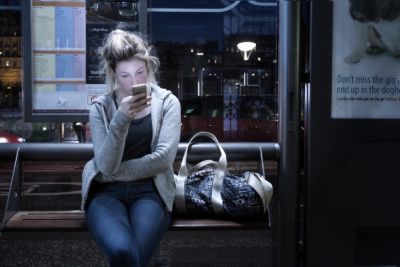
Do you ever find yourself down a never-ending rabbit hole of negative news? Is the fear and uncertainty oddly addictive, even if it’s scary? Do you reach for your phone during stressful times, only to end up feeling worse? If these sound familiar, you might have a doomscrolling habit.
Don’t worry. There’s nothing wrong with you, and you’re in good company: millions (if not billions) of people doomscroll. It’s addictive! It may not feel like it now, but you do have the power to control this. Read on to find out why people doomscroll, how it affects us, and how you can actually stop.
Why your brain is drawn to bad news
We’re attracted to bad news because of something called the negativity bias, or the brain’s tendency to prioritize negative information. This is a very smart design that exists to help keep us safe. It’s also one of the reasons why it’s so hard to stop engaging with negative news.
While it has evolved tremendously, there’s one way the human brain is quite primitive: it's still wired to prioritize survival. Though it doesn’t sound so bad on the surface (because yes, staying alive is important), it’s frustrating because we’re not usually in real danger — at least not in the way our brains think.
Constant exposure to negative news creates a fear loop that engages our brains to crave more of the same. All of this combined creates chronic overstimulation, leaving us feeling drained and depleted instead of informed and empowered.
The anxiety/dopamine loop
If you’re aware of dopamine at even the most basic level, you’ll know that it’s the brain’s pleasure chemical. More accurately, it's the neurotransmitter responsible for that rewarding feeling we get when we accomplish a goal or experience something enjoyable. That feeling is quite addictive, and it can also contribute to anxiety.
Picture this cycle:
- You feel uneasy, overwhelmed or anxious about something
- You start scrolling to distract yourself or “check something real quick”
- You get a small hit of novelty, engaging your dopamine response
- The content you absorb increases/sustains stimulation, leading to more anxiety
- You continue scrolling to feel better
- Rinse and repeat
This loop prolongs the anxiety/overwhelm rather than resolving it, making you feel worse than when you started. It’s like trying to find safety by walking through a warzone; it just doesn’t work that way.
Signs you’re scrolling to self-soothe
Many of us scroll mindlessly out of boredom or habit. However, certain behaviors signal that scrolling might be your way of self-soothing during times of stress, overwhelm, or anxiety. Think about it for a minute, and be honest: do any of these sound like you?
- You instantly reach for your phone during downtime/silence
- You feel worse after scrolling, not better
- You keep going longer than you mean to (sometimes much longer)
- You’re avoiding a specific feeling/emotion (stress, uncertainty, loneliness)
- Scrolling becomes your default transition behavior between tasks, commitments, etc.
If you recognize any of these behaviors you’re definitely not alone. This does not mean there’s something wrong with you! It’s just a sign that part of you isn’t being met in the way it needs to; like a message from yourself that you need more of your own attention.
5 Real ways to interrupt the cycle
So now that you know why you do it, how about a few ideas to help yourself stop — or at least minimize — your doomscrolling? Even a small reduction can benefit your brain, body and mood. Try these next time your phone calls your name:
Pause before opening
It’s natural to grab your phone when you have a little downtime. But what if you paused for a second first? No purpose, no judgement, just pause. Maybe take a few deep breaths. You might just find you have something better to do!
Replace the first scroll
Ever scroll before you’re fully awake? Not great for your brain. Instead of grabbing your phone first thing, try getting out of bed and stretching, drinking a glass of water, or looking outside. The smallest intentional shift reminds your brain that you’re in control, not your habit.
Soften your discipline
We naturally rebel against what doesn’t feel good, which is why past attempts to stop scrolling likely haven’t worked. Instead of setting strict rules, just try putting your phone down randomly throughout the day. This removes harsh limits and helps calm that resistance.
Be intentional
It’s harder not to scroll when your phone is always nearby. Schedule check-ins for specific times, put limits on your sessions, and leave it alone in between. This gives you a little reward for your patience and stops you from over-scrolling. Win!
Decompress differently
Many of us use scrolling to decompress, but there are plenty of other ways to do this. Walk outside, take a few deep breaths, stretch or move, talk to a friend, play with your pets. Decompression achieved, no phone required!
Reframing the habit
Chances are you’ve told yourself something like “I need to quit scrolling,” or “I need to be more disciplined" at some point. This makes sense, because you genuinely want to stop, right? But have you ever thought about reframing your self talk to be more supportive?
It works like this: if you’re scrolling to escape a certain feeling, you might try telling yourself “My mental wellness needs my attention.” If you’re scrolling purely out of habit, “I want to be more present” could be helpful.
A simple shift in tone, perspective or mindset makes a huge difference in how your brain responds to your efforts. Bonus tip: changing “need” into “want” makes it a choice, which is even more effective!
You’re not doomed
Doomscrolling exists because humans are drawn to negative news. It’s not our fault; we’re naturally wired to pay attention to things that scare, worry, or intimidate us! But free will is our secret weapon here: we have the power to choose differently.
Using these tools, interrupting the cycle and creating new, healthier habits is more than possible. Even if you don’t stop completely, just slowing down can make a huge difference in your mood and overall wellness. Give it a try. What do you have to lose?