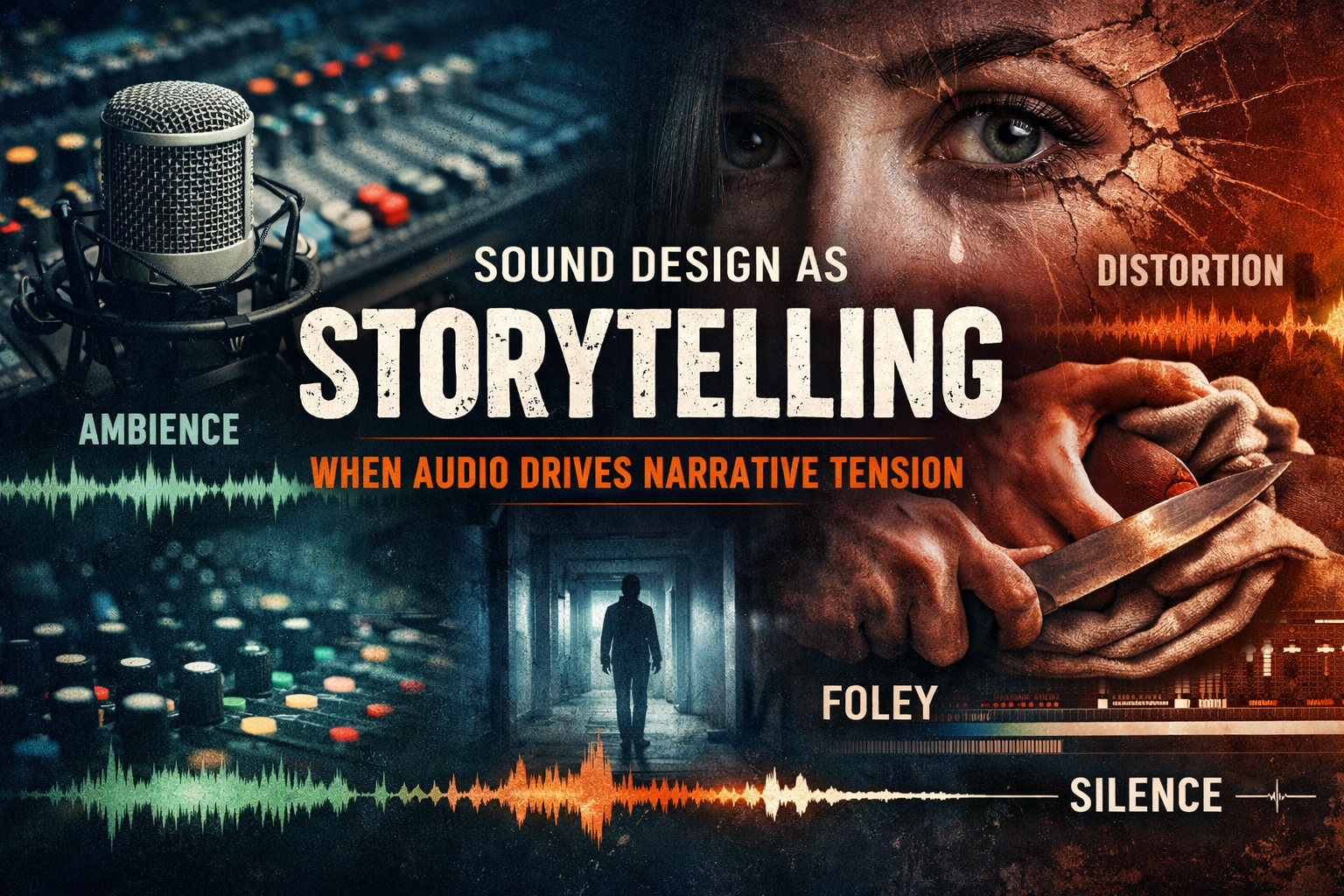
Discover how ambience, Foley, silence, and distortion shape narrative tension—and learn practical sound design workflows indie filmmakers can apply on any budget.
New filmmakers often focus first on cameras, lenses, and lighting setups. That makes sense—film is visual. But cinematic tension rarely lives in the image alone. More often, it lives in what the audience hears.
Sound design is not decorative. It is structural. It shapes perception, directs emotion, and manipulates anticipation. From the restrained sonic landscape of No Country for Old Men to the carefully engineered quiet of A Quiet Place, filmmakers have demonstrated that audio can carry suspense with remarkable precision.
The good news for emerging filmmakers is this: strong sound design is less about budget and more about intention.
Why Sound Influences Tension So Effectively
Humans are wired to respond quickly to sound. A sudden noise behind us triggers instinctive alertness before we visually confirm its cause. Film leverages this biological response. Sound primes the nervous system.
A static hallway might look neutral. Add a faint electrical hum and distant mechanical clatter, and it feels uneasy. Remove those layers entirely, and the space becomes exposed. Introduce a subtle low-frequency rumble and the mood turns ominous.
Sound createsan emotional context before the audience consciously processes what they are seeing.
Ambience: The Emotional Foundation
Ambience, often called room tone, refers to the environmental sound that exists beneath dialogue and action. It includes wind, air conditioning hum, distant traffic, insects, fluorescent buzz, or subtle architectural reverberation.
Many beginners treat ambience as filler. In practice, sound is one of the most powerful tools for shaping tone.
In Hereditary, low tonal beds swell subtly during moments of emotional stress. The audience senses tension building without identifying a clear source. That is intentional sound architecture at work.
Raising low-frequency ambience slightly can make a space feel unstable. Reducing high frequencies can create a sense of enclosure. Even a small shift in background sound can dramatically alter how a scene feels.
Practical Indie Approach to Ambience
Record at least 60 seconds of clean-room tone at each location. Do not rely entirely on production audio. In post-production, layer subtle environmental elements to support the scene’s emotional trajectory.
Use EQ to sculpt the mood—boost low mids for weight or soften high frequencies for intimacy. Most importantly, automate ambience levels so they evolve as the scene builds.
Ambience is not static. It should breathe with the story.
Foley: Texture and Physical Presence
Foley recreates the sounds of physical interaction—footsteps, clothing movement, object handling, and environmental contact. When tension rises, detailed Foley sharpens the audience's focus.
Consider the sound of fingers tightening around a glass or the faint scrape of a chair leg on concrete. These micro-sounds amplify stillness. They anchor performance in tactile reality.
In The Social Network, subtle keyboard taps and environmental textures heighten dialogue scenes without overt action. The sonic detail keeps the moment alive and kinetic.
Practical Indie Approach to Foley
You do not need a dedicated Foley stage. A closet filled with clothing provides natural dampening.
Record multiple variations of each action. Sync Foley slightly tighter than real life for heightened tension. Emphasize transient peaks to make key sounds more pronounced during suspenseful beats.
The goal is immersion. When the physical world sounds authentic and intentional, tension becomes more immediate.
Silence: Strategic Subtraction
Silence is often misunderstood as absence. In storytelling, it is a deliberate subtraction.
Ultimately, silence works best in contrast. If everything is quiet all the time, nothing feels exposed. But when a richly layered scene suddenly empties, the effect is immediate.
When music drops out and ambience thins, the audience becomes hyper-aware. Breathing feels louder. The smallest sound feels amplified. Silence removes emotional cushioning and creates vulnerability.
A Quiet Place demonstrates how silence can become a narrative engine. The absence of sound transforms minor noises into potential threats.
Practical Indie Approach to Silence
Silence should create anticipation, not emptiness. Rather than muting all tracks completely, experiment with controlled dropouts. Try lowering the background ambience just before a reveal. Conversely, remove high-frequency content to simulate pressure or isolation.
For a psychological effect, let dialogue sit unaccompanied for a few beats longer than feels comfortable.
Distortion and Sonic Manipulation
Distortion introduces uncertainty. It destabilizes clarity, which is precisely what tension thrives on. The trinity of distortion, filtering, and modulation allows you to shift the audience’s perception of reality. These tools can represent psychological stress, panic, or emotional fracture.
In Black Swan, subtle sonic warping mirrors the protagonist’s instability. The effect is not overt, yet it deeply affects how viewers interpret the experience.
Practical Indie Approach to Distortion
Use restraint; more is rarely better. Subtlety often feels more psychological and less theatrical. Aim for unease rather than spectacle.
Light acoustic saturation can increase aggression without sounding artificial. Whereas gentle pitch shifts or reverb automation can heighten emotional peaks. For moments of anxiety, introduce underlying low-frequency pulses.
Layering for Narrative Impact
Think of your soundscape as a composition. Tension is not a single cue; it is a progression. Strong sound design emerges from the interaction between elements. Ambience sets the emotional tone, while foley adds tactile realism. In this way, silence creates contrast, and distortion destabilizes perception.
Imagine a suspense sequence where ambient low frequencies rise gradually, Foley becomes more pronounced, music fades unexpectedly, and a barely perceptible tonal distortion enters just before a reveal. Each layer contributes to the overall effect.
Workflow Tips for Indie Productions
Effective sound design requires organization and foresight more than expensive tools.
First, consider sound early. During pre-production, evaluate locations for sonic characteristics. Plan scenes with audio intention, not as an afterthought.
Create separate track groups for dialogue, ambience, Foley, music, and effects. This structure allows precise control over emotional layers.
Before mixing levels, identify the emotional goal of each scene. Decide where tension should rise and where it should release.
To improve production consistency, use automation extensively. Gradual changes in volume, EQ, or spatial positioning create dynamic movement.
Avoid over-compressing your mix; dynamic range is essential for suspense. Quiet moments must remain quiet for loud moments to feel impactful.
Common Pitfalls to Avoid
One frequent mistake is over-reliance on music. Continuous scoring reduces contrast and dulls tension.
Allow scenes to breathe.
Another detractor is neglecting a consistent room tone. Abrupt changes in background sound between cuts create a distraction and breaks immersion.
Most importantly, avoid treating sound as a secondary layer added late in post. It should be integrated into your storytelling strategy from the beginning.
The Strategic Shift
If you want your films to feel more cinematic immediately, shift your mindset. Sound does not merely support the image. It shapes narrative experience.
When audiences describe a film as intense or immersive, they are often responding to sound design choices they cannot consciously identify.
Those unconscious tensors are always built through sound frequency, rhythm, texture, and contrast. Luckily, these tools are accessible at every budget level.
Ultimately, when sound design drives narrative tension, your film stops being something viewers observe and becomes something they feel (and remember).