
I'm subscribed to 58 YouTube channels. But how many of them do I actually watch? Just five. The other 53 may as well be ghosts.
Don't get me wrong; the people who launched those 53 channels are surely talented creators who deliver clever or entertaining content—I subscribed for some reason, after all. But at this point, I couldn't tell you what most of them are truly about because there’s nothing there to draw me back. I don't know who the creators are, and I don't return to their channels, because they're not building worlds I want to be part of. They're just…posting.
But those five I know and love? I know what they're about. I recognize each channel instantly because each creator has figured out how to build something bigger than a collection of individual videos.
They built a franchise. Not the Hollywood or McDonald's kind, but the repeatable, recognizable kind. A consistent concept your audience can count on, recognize immediately and follow wherever you take it. As in the physical world, a franchise is how you turn casual digital viewers into loyal followers. It's how you stop starting from zero with every post and begin building momentum instead of just producing content.
As a small business owner, entrepreneur or member of the creator economy, you can do this, too. And as you’ll discover, you don’t need a studio. You don’t need a 12-person team. And you certainly don’t need a Hollywood budget. What you do need is to stop thinking like a content creator—posting one-offs and hoping something sticks—and start thinking like a franchise builder instead.
Understanding franchise thinking: The mindset shift you need

Franchise thinking means building everything you create around one recognizable, repeatable concept. One clear promise. One world your audience can step into, no matter where they find you.
Think about James Clear. He built Atomic Habits into an empire complete with a book, a newsletter, and talks and courses, all reinforcing one concept: Make tiny changes, get remarkable results. His franchise offers the same idea, but through different doorways.
That's franchise thinking. Instead of posting whatever feels right that week, you build around a central idea. Every blog post, every video, every email and every social post becomes a different doorway into the same house.
Your audience doesn't have to relearn who you are each time you show up. They know what you stand for and what you're about, and they keep coming back because you've created something they can count on.
Here are the differences between one-off posting and franchise thinking.
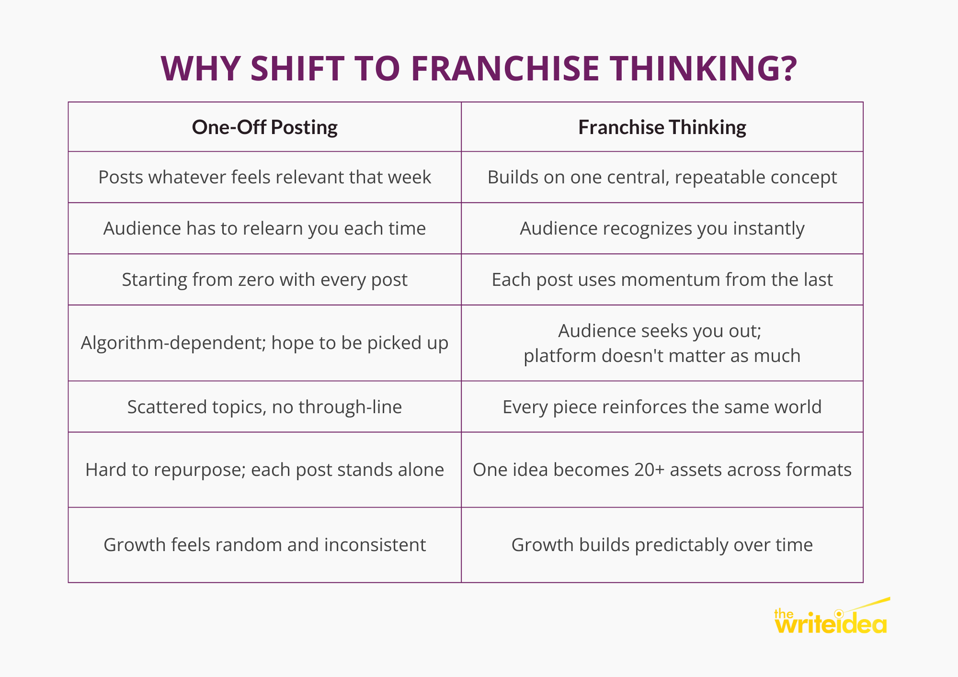
The shift from scattered content to posts based on franchise thinking won’t happen overnight, but once you make it, everything will change. You’ll stop exhausting yourself by reinventing the wheel with every post and start building a world your audience actually wants to return to.
Let me show you what that looks like in action through one creator who turned this exact principle into a multi-million-subscriber empire.
How one creator used franchise thinking to build an empire

Parker Hajiaskari grew Luxury Productions into the most consistently viewed horror franchise on YouTube. He didn’t have a studio or a massive team. And he certainly didn’t have a Hollywood budget.
Yet today, his company operates four YouTube channels—Life of Luxury, LuxuryDark, LuxuryPranks and LuxuryReacts—that together reach 16.8 million subscribers. His flagship series, Life of Luxury, earned a 7.6 out of 10 rating on IMDb. It's even expanded beyond YouTube to a featured Tubi series and a Roku streaming app.
None of it happened because Hajiaskari got lucky with one viral video. It happened because he figured out how to build a franchise—a recognizable, repeatable world audiences could step into again and again.
What franchise thinking looks like in action
Take one of Life of Luxury’s standout episodes, It Waits Until You Fall Asleep.
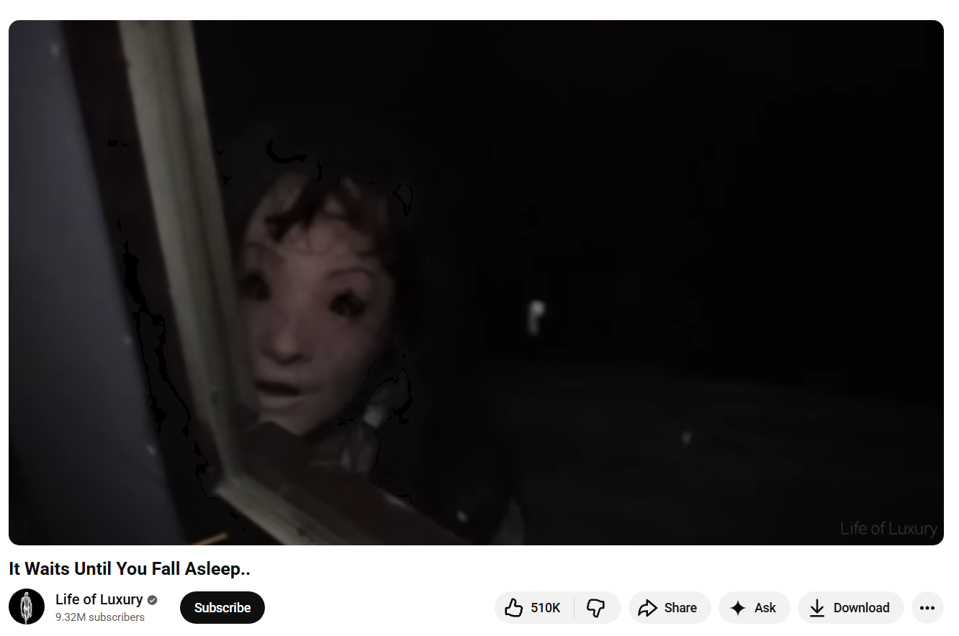
In it, Parker and his co-host, Chester, respond to a message from someone named Olivia, who claims an older woman is stalking her house at night. When they show up, “Olivia” turns out to be a guy named Chad, who admits he catfished them but insists the threat is real. They decide to stay and investigate.
The camera work is handheld, shaky, intimate. Small movements in hallways and windows build tension without special effects. A figure appears at the glass. Someone is dragged out of frame. By morning, Chad has vanished, and Parker and Chester barely make it back to their car.
Like most Life of Luxury episodes, they escape—but the mystery stays open, pulling viewers into the next investigation.
There's no larger team of writers and producers. No studio lighting. Just a real location with paid actors, the most basic setup and that sinking feeling lovers of the horror genre come for.
That video hit 38.2 million views, but not because Hajiaskari spent a fortune. The video pulled so strongly because it captured what makes every Life of Luxury episode instantly recognizable: investigative horror that feels disturbingly real.
Franchise thinking: How the franchise began

Hajiaskari didn't set out to build a franchise, though. "I wasn't thinking, 'I'm going to create a show,'" he says. "I was thinking, 'I want to build a brand.'"
Before founding Luxury Productions in 2018, he'd already spent three years testing what worked on YouTube. He tried prank videos and social experiments in different video formats. Some landed. Many didn't.
But one genre he tested—horror—kept winning. So he paid attention to the data, looking at retention rates, which videos people kept requesting more of and especially the comment sections, where viewers debated what happened and tried to explain the videos to each other. That It Waits Until You Fall Asleep video? It’s approaching 34,000 comments.
Once Hajiaskari saw that horror consistently outperformed everything else, he committed. “I realized pretty quickly that to build a loyal audience, I needed a repeatable niche they could rely on," he says. "It's easier to grow a channel around one clear lane than five competing ones."

But something bigger shifted along the way, too. Hajiaskari realized the best-performing videos weren't just scary. They were recognizable. People kept coming back because they knew what they'd be getting. A world they could return to. A format they could count on.
And that's when it hit him. "The moment I realized I was really creating a franchise was when I started to see viewers genuinely living with the videos after they ended," he says. "They were collecting ideas, concepts, characters and storylines from different uploads and talking about them together in the comments. People weren't just reacting to a single scary video. They were connecting dots, quoting moments back to us and treating it like an ongoing world."
That shift—from "I'm making videos" to "I'm building a franchise"—changed everything. "Once I noticed that, my mindset shifted," he says. "I realized I couldn't just think one video ahead; I had to be years ahead. I started consciously building and mapping out the cinematic universe behind Luxury Productions—its rules, its tone, what can and can't happen in that world."
Franchise thinking: Expanding the franchise without losing what made it work
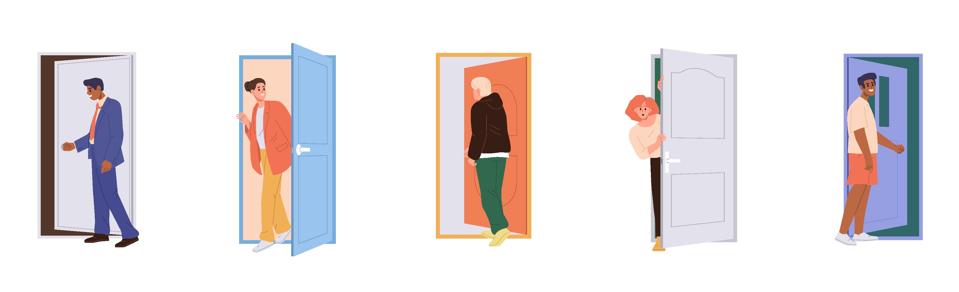
Once Hajiaskari had a format that worked, the temptation to replicate it everywhere hit. But he didn't. Instead, he created what he calls "a real degree of separation" between channels. Same universe. Different entry points. "Life of Luxury began as a series about two creators going out to viewers' houses to investigate something scary," Hajiaskari says. "LuxuryDark lives under the same story rules and characters, but flips the premise. Instead of us going out to help someone else, we bring the scary or unknown element into our own home."
That distinction matters. Audiences don't want the exact same video reposted to four different channels. They want variations on a theme—different doorways into the same house. "Having distinct series also gives us room to experiment without burning out the audience or ourselves," he says. "If we try something new on one series and it doesn't quite land, there's a good chance a recent upload on another series did connect."
As the franchise grew, the team focused on deepening what already resonated, not just widening distribution. "The most reliable way to keep the community engaged is to focus on making the strongest videos we can," he says. "And to release only ideas we're genuinely excited about. If we're interested in the concept, the craft and the execution, it usually means the audience will feel that energy too."
Why franchise thinking works: It compounds momentum
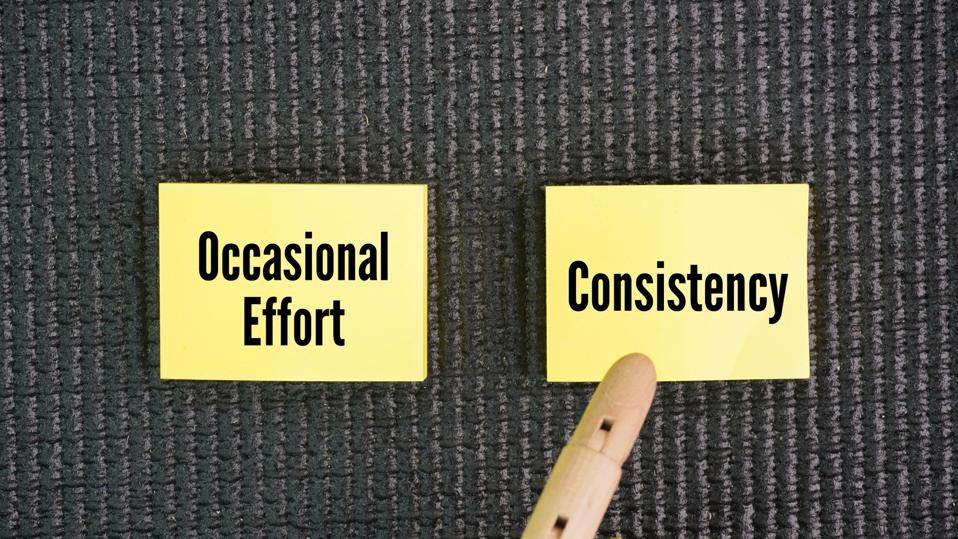
Hajiaskari says he knows he’s still on the right track by looking at what happens to views when he's not uploading. "A major sign that our franchise model is working is the ability to step away for a while and then come back and still see a spike in interest," he says. "We've had series where we didn't post for over a year, and the first video back ended up over-performing."
On a platform like YouTube, where constant momentum drives most viewership, that's huge. "It tells me the work is sticking in people's minds long enough that they're actually waiting for our return instead of forgetting we exist," he says. “When you can pause, come back and still have an audience that's eager to re-enter the universe you've built, that's a strong signal the franchise itself is resonating. Not just the last upload.”
Carson Spitzke, co-owner of Vision Management, a consultancy that helps B2B companies turn content into qualified leads, says the clearest signal is simple: Are the right people actually responding to your content? “If you're consistently attracting real prospects—not just likes and views—and those prospects turn into calls and revenue, you've got a repeatable content system,” he says.
If you don’t have analytics tools, Spitzke recommends tracking one post at a time. Add a unique link to each piece of content so you know exactly which one made someone click. Then check your platform’s basic stats to see how many people viewed that specific piece, be it an email, a video, or a blog post, and note which ones led to actual sales calls. That’s the metric to watch.
The most common mistake? Averaging everything together. “One viral post can make your whole month look great, even if the other nine posts did nothing,” he says, “Tracking each post separately shows you what’s actually working.”
In other words: Don't just count views. Count what those views actually do.
Franchise Thinking: Building Hollywood quality on a YouTube budget

Hajiaskari’s franchise may look expensive, but he didn’t have to spend like a studio. "For the past four or five years, our north star has been to make work that feels like it has Hollywood-level visual effects, style and design," he says. "We want to make content that leads viewers to wonder: 'How did they do that?!'"
The answer isn't more money. It's a lean team structure and a focus on strengths. "As a small team, we divide production roles based on what each of us is actually best at," he says. "My focus is on storytelling, editing and directing—shaping the narrative, pacing and overall tone. My partner, Chester Beckington, focuses more on character and costume design—how the creatures look, move and feel on screen."
A project starts with Hajiaskari building out the story and structure. Then he walks Beckington through it so his partner can start imagining the physical world—characters, wardrobe, design details. From there, they figure out what other collaborators they need. "I try to act as the 'glue,'" he says. "Pulling all those pieces together into one coherent final product."

What really drives the team's success is their willingness to accept honest feedback from each other. "We didn't start out with that clarity," Hajiaskari says. "It took time, trial and error and a lot of honest conversations to figure out where each person's strengths actually lie. As a habit, we try to keep each other in check. We're not afraid to tell one another when an idea, an effect or a workflow just isn't working."
Sandra Rives sees the same pattern in her own work. She’s a leadership coach who built her business around a single message: helping high-capacity people move from mask to mirror—from performing for approval to leading from clarity. “Committing to one central idea forced me to practice what I teach,” she says. “It created clarity, consistency and boundaries in my brand.”
Once Rives centered everything on that message, her clients started repeating it back to her. They referenced the mask-to-mirror shift in their own language and quoted her phrase: “Lead from who you are, not who you think you're supposed to be.” That’s when she knew she’d built a recognizable framework, something people could remember, apply and share long after the session ended.
That kind of clarity—choosing one idea and committing to it—is exactly what makes a franchise work, whether you're building a coaching practice or a YouTube empire.
What you can learn from the franchise thinking approach

Hajiaskari’s advice for a creator just getting started? "Even if you're starting out alone, pay close attention to what parts of the process feel natural and energizing versus what you constantly avoid or struggle with," he says. "The things you're strongest at are where you should double down. The parts that consistently drain you are the ones to hand off to collaborators or specialists eventually."
But his most excellent advice cuts straight to the heart of franchise thinking. "Be brutally honest about whether you'd actually want to watch what you're making," he says. "Look at your product, video, newsletter—whatever it is—and ask yourself: As a normal consumer with no emotional attachment, would I choose this thing over everything else I could spend my time on? If the answer is no, that's your signal to rethink the idea, if not the audience. If you wouldn't genuinely choose it, it's unlikely other people will either."
How to start using franchise thinking in your business

You don’t need Hajiaskari’s 16.8 million subscribers or James Clear's bestseller to make franchise thinking work for you. You just need to start building intentionally instead of posting randomly.
Here's how.
First, pick your one thing. Ask yourself: “If someone remembers only one thing about my work, what should it be?” That becomes your franchise. Not five things. One. A local bakery might be known for "seasonal sourdough experimentation." A SaaS company might own "no-BS software demos with real workflows, not marketing slides."
Next, create your repeatable format. What's the consistent experience people will get from you? A CRM consultant might publish "5-minute Friday fix" videos every week. A freelance designer might showcase "before/after teardowns" with the same structure every time.
As you build, focus on your strengths. You don't need to do everything. Hajiaskari focuses on storytelling and directing, while Beckington handles creature design. Figure out what you do best, then structure everything around that.

When you’re ready, expand thoughtfully. If your core franchise works, resist the urge to blast it everywhere identically. A project management tool might turn its "async collaboration framework" into a blog post series, a LinkedIn carousel deck, a podcast interview format and a two-minute YouTube explainer. Same concept, different entry points.
Finally, stay honest about what's working and play the long game. Hajiaskari's team keeps each other in check. They're not afraid to call out when something isn't landing. Build that culture of honest feedback into your process. And remember that franchise thinking isn't about going viral next week. It's about building something people recognize, trust and return to over months and years.
Start small. Pick one concept. Build around it. Stay disciplined. And then? Watch what happens when your audience stops scrolling past you—and starts actively seeking you out. That's when you know you've built something that lasts.