
We’re all drowning in content, most of which we’ll never consume. Blogs, newsletters, podcasts, social posts—they’re all fighting for our attention in saturated feeds.
And if you're the one creating that content? I feel you! It’s a never-ending effort: publishing two to three times a week, adapting to ever-changing algorithms, and staying visible in feeds that refresh every three seconds. Honestly? All of the churning can easily lead to mind-numbing exhaustion.
But here’s a question: What if you could stop competing for attention and start commanding it? What if your audience came to you willingly and eagerly, rather than you lobbing content at it and hoping something sticks? It’s the dream of every content creator—and it’s totally possible.
I know, because I experience it from the audience perspective every time I sit on my porch. See, I’m an amateur birder, but I don't read blog posts about birds. Instead, I use a phone app called BirdNET, from the Cornell Lab of Ornithology. When I hear an unfamiliar tweet from my sycamore tree, I grab my phone, open the app, and record a few seconds of audio to capture it. The app tells me which bird just sang that sweet song, whether the Northern Cardinal, American Robin, White-breasted Nuthatch or Carolina Wren. From within the app, I can also view a map of where the species lives, see what it eats, and learn whether it flies south for the winter.

I’m engaging with content, but I didn’t have to open a course or read an article. The content doesn't live in my inbox or my feed. It lives in the app and is available at the moment of my curiosity—a huge difference between content inside an app and content on the web. It’s almost as if the app turns my backyard into an interface where every interaction gives me a tiny lesson from a single moment of discovery. And because the app is tied to Cornell's citizen science project, my curiosity also contributes data to conservation research. I'm learning and helping at the same time.
MORE FOR YOU
Now imagine that for money. Or fitness. Or home maintenance. Or the thing you teach.
What if your expertise worked like the expertise within BirdNET? What if instead of publishing three blog posts a week and hoping someone reads them, you built something people opened every time they needed you—something that taught, guided and reflected back progress in the exact moment it mattered?
It’s possible—and it makes sense to pursue. Apps that embed education and guidance see 27% to 30% better retention than traditional content approaches. Small business owners, entrepreneurs and creators can build dedicated tools that earn attention by delivering value every time someone opens them.
You're about to meet someone who made this shift. You’ll learn the framework that makes it possible, see how to build your own app without a dev team and walk away with clear next steps.
Case study: How to develop an app that does what your blog posts can’t

As he tells it, Gregory M. True sat at his desk on an ordinary Tuesday, staring at a message that stopped him cold. It was an email from a coaching client. “Gregory, I read everything you post… but I still don’t know what to actually do,” they wrote.
True, a financial coach, had recently published a blog post he’d poured his heart into—a message about aligning money with personal values. But it barely reached anyone. His client’s note changed how he thought about content. “I realized people don’t need more information,” he says. “They need guidance. Structure. A place where learning and doing actually meet.”
His story made me think about my own content efforts—the articles I write, the Beyond Copy newsletters I send. How much of it actually helps readers do something right when they need to do it? How much just adds to the pile of “things I should read someday”?
The uncomfortable truth is… probably most of it.
True had the same realization. Like my philosophy that content is a holistic experience, his philosophy that wealth is more than money was solid enough. Instead of money, wealth is a great life you don't have to escape from. He'd built the philosophy on four pillars: authenticity (align money with your values), empowerment (replace overwhelm with clarity), inclusion (acknowledge that wealth looks different for diverse households), and sustainability (wealth is balance, not accumulation).

His book had already reached thousands. His coaching sessions changed lives. But he kept bumping into the same wall: How do you give personalized guidance to many people at once? How do you help someone in the moment? How do you teach without lecturing, guide without prescribing?
Books get read once and live on shelves. Blog posts get scrolled past. Coaching calls end. The typical delivery mechanisms weren’t working. “I needed something that didn’t just talk about money,” True says. “It had to live alongside the daily decisions where money actually happens.”
That’s the first principle of treating an app as content. An app doesn’t compete for attention in a crowded feed. It sits on someone’s phone, waiting for the moment when they actually need what you know.
He knew what to develop an app around; he’d used one that helped his business before

True sat with the problem for weeks. Then one day, a memory surfaced from years earlier. Before he wrote Proud Wealth and became a financial coach, he used GroomerIO, a platform that streamlined operations for his pet salon business. It managed appointments, client notes and reminders. All the day-to-day pieces that kept the salon running smoothly.
One regular client told him something he’d never forget. “’Gregory, I love your salon, but what I love even more is how easy it is to book with you now. I don’t have to think. I just tap, and it’s done.'”
That comment taught him an essential lesson: People will engage regularly when you remove the mental load. GroomerIO worked because it made a stressful task—scheduling—smooth and intuitive. That's when it clicked: GroomerIO removed friction from scheduling, but money decisions carry even more emotional weight. When it comes to money, people are afraid to tap the wrong thing, make the wrong move, or face something they don't want to see.
What if he could do for financial decisions what GroomerIO did for salon bookings? What if content didn't sit outside the financial experience but lived inside it? What if the app became the content, the coach, the steady hand people needed at the moment of decision?
What I love most about this idea is that True wasn’t trying to create a content strategy. He was trying to solve a problem his clients had. The fact that the answer was an app, and that it became a content channel—a way to deliver his expertise—was almost secondary. And that’s exactly what makes the idea so powerful: The best apps-as-content don’t start with “how do I distribute my content differently?” They start with “what does my audience need in the moment?”
The teach-guide-reflect loop: How to develop an app that transforms, not informs
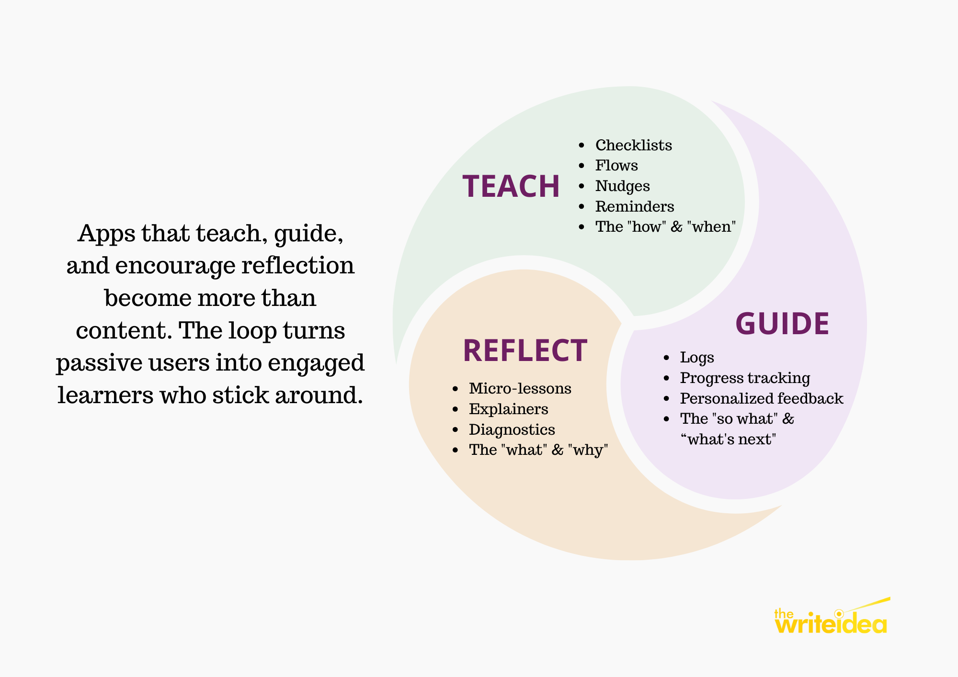
For True, the answer was confidence, not more content. “Most folks already know to ‘save more, spend less, be smart,’” he says. “What they struggle with is the emotion behind those choices—the fear, the uncertainty, the second-guessing.”
To help users build that confidence and trust themselves with money, True set out to transform rather than inform. He wanted to guide and reflect back to users what they were learning about themselves.
He started with what he calls the Financial Identity Scan. When users open the app, they don't see budgets or numbers. They encounter reflective questions—simple, human prompts about habits, fears, attitudes and aspirations. As users respond, the app builds a visual map showing who they are financially, emotionally and behaviorally, as it relates to money. Then they get a Clarity Snapshot: a warm, plain-language summary of where they are right now.
“I built it this way because money isn’t just math,” True says. “It’s identity. It's history. It's emotion. And if we don't start there, nothing else sticks.” That's real content. It’s not an article about understanding your money mindset; it’s an experience that shows you your money mindset.

Think about that for a second. Instead of writing “10 ways to understand your money mindset,” True built a tool that shows you your money mindset in less than five minutes. That’s the difference between content about a thing and content that is the thing.
The app then continues teaching through micro-interactions. Daily prompts surface as reflective questions or tiny assignments. Bite-sized lessons unlock contextually after key behaviors—log your first expense, set a savings rule, hit a milestone. Weekly recaps auto-generate progress summaries.
True also built the Aligned Decisions Engine. It turns a user’s identity, goals and emotional patterns into personalized recommendations that match their logic and values. “People often know the ‘right’ financial choice,” True says. “They just don’t know the choice that feels right for them. This feature ends decision paralysis.”
Every screen in the app becomes a teaching moment. Every notification is a nudge toward clarity. Every interaction reinforces the philosophy that wealth is personal, not prescriptive. It’s what True calls the teach-guide-reflect loop. The app teaches through micro-lessons, guides through prompts and nudges, and reflects back patterns and progress—all three, right in the moments when a user is actually managing their money.
You could apply this same teach-guide-reflect framework to almost anything. Fitness coach? Teach proper form, guide through workouts, reflect back strength gains. Writing mentor? Teach story structure, guide through daily prompts, reflect back word count and consistency. The medium changes, but the loop stays the same.
What early testers revealed about how to develop an app

Then came testing.
True asked early testers a simple question: “What does wealth mean to you?” Their answers surprised him.
One person said peace. Another said time with family. Another said not having to justify themselves anymore. Very few mentioned money. “Their responses shifted my approach,” he says. “It made me design the app not around financial accumulation, but around building a life that actually feels good. That was the moment I knew it was going to work differently than I thought.”
The app wasn’t about teaching people to accumulate more. It was about helping them build lives they didn’t need to escape from. I asked True if he would have discovered this lesson through a blog post or a coaching call. He said probably not. “The app forced the question in a way other formats didn’t,” he says. “When you’re building something interactive, you have to understand what people actually want, not what you think they need.”
This idea is worth sitting with. How many of us are creating content based on what we assume our audience needs rather than what they’re actually trying to do? Developing an app forces that clarity because people won’t use something that doesn’t serve them. A blog post? They might skim it to be polite. An app? It either works—or it doesn’t.
The hardest lesson about how to develop an app came last (but you, dear reader, get it first)

Looking back, True wishes he’d understood one thing sooner. “An app isn’t a collection of features. It's a relationship between you and your clients,” he says.
He spent months perfecting tools—calculators, trackers, dashboards—when what mattered more was the emotional journey. The small cues. The gentle transitions. “If I had understood earlier how important that was, I would’ve saved months of development time,” he says. “People don’t need another dashboard. They need a steady hand.”
That’s also when his GroomerIO lesson came around full circle. Money decisions carry emotional weight, so make the hard stuff smooth. Make it intuitive. Make it almost invisible.
The lesson is worth underlining. If you’re thinking about building an app as a content channel, don’t think about features first. Think about the experience. Think about what someone feels when they open it. Think about the relationship you’re building, interaction by interaction.

The Proud Wealth app is launching in the coming months to an already waiting audience of coaching clients, Proud Wealth readers, podcast listeners and early testers. “But they’re not waiting for an app,” True says. “They’re waiting for a new way to move through their financial lives.”
I asked him how he’ll know it’s working, and he said it won’t be from dashboards or download numbers, but from something else entirely. “I’ll know it’s working the first time someone says to me: ‘I finally understand my relationship with money’ or ‘I made a decision today I’ve been avoiding for years,’” he says. “When people move from avoidance to confidence, that’s the signal. That's when I'll know the app is doing what it's supposed to do.”
And that, right there, is how you measure success when your app is your content. Not in clicks or shares or time on page, but on transformation, movement, change. For a fitness app, it might be consistency and strength gains. For a writing app, it could be completed drafts and publishing frequency.
The metric becomes the outcome you’re helping people achieve, not the vanity numbers we’ve gotten used to chasing.
Your turn: Develop an app that delivers your expertise

Dr. Anvesh Tiwari, a computer scientist and CTO who builds AI-powered platforms across fintech and e-commerce, including India’s first virtual trial-based e-commerce platform, FashionKart.ai, sees the same pattern among founders who come to him to build apps. “The biggest misconception is that an app is a product,” he says. “In reality, an app is a distribution layer for expertise.”
He’s watched small business owners fixate on features—dashboards, notifications, integrations—when the real value lies elsewhere. “The moment creators stop asking 'What should the app do?’ and start asking 'What decisions do I help people make?' the app becomes viable.”
That question is your starting point. Not “what features should I build?” but “what does my audience need in the moment they need it?”
From there, think in loops, not lists. True's teach-guide-reflect framework works because it mirrors how people actually learn. They need a concept (teach), a prompt to act on it (guide) and feedback that shows progress (reflect). Your app doesn't need fifty features. It needs one loop that works.
Develop an app without overbuilding
Dr. Tiwari’s advice for the first version? “Build the smallest system that delivers certainty. If your first version removes confusion for a user—even once—it’s more valuable than 10 features that demand learning.” Early apps should reduce thinking, not require it.

Dhruv Motwani, founder of Mach11.ai, has seen what happens when founders ignore that advice. “The most common mistake is overbuilding—adding too many features instead of ruthlessly focusing on a single validated core problem,” he says. The excitement of building can easily lead to scope creep: advanced analytics, automation layers, multi-language support. What should be a fast minimum viable product (MVP) becomes a bloated prototype that delays launch and drowns out real user feedback.
But when founders resist that urge? Motwani points to StraightUp Collective. The company turned its operational know-how into an internal inventory app, replacing a tangled web of Excel spreadsheets. “Built with Glide in just a few weeks, the app automated calculations and introduced clear reporting while keeping the staff interface simple,” he says. “What surprised them most after launch was how much operational friction disappeared. Errors dropped, information became instantly accessible and day-to-day decisions became faster.”
For solo founders starting from zero, Motwani recommends Bubble. “It enables rapid full-stack MVP development through a visual editor while still allowing deep customization,” he says. “Ship the smallest version that solves one painful problem, validate how people use it and expand only after you see clear signals of success.”
Develop an app that meets your audience in the moment
Start with the transformation you're helping someone achieve. For True, it's financial confidence. For you, it might be consistency, clarity, skill or calm. Name the outcome. Then map backward to the micro-interactions that get someone there—one nudge, one lesson, one reflection at a time.
You don’t need a dev team to develop an app. You don't need a massive budget. You need your expertise, a clear outcome and the willingness to build something people actually open. Something that meets your audience in the moment, not the feed. And then your blog? Maybe one day, as your app starts to soar, you can abandon it.
