
Sometimes a moment happens when you’re not trying to have a moment at all. It could be when you’re scrolling through your feed, or stirring something on the stove, or staring at a sewing machine you probably shouldn’t have bought because Project Runway convinced you that you could drape fabric like a couture genius. (Spoiler: I couldn't.)
Yes, that was me. And if you've ever bought supplies after binge-watching a competition show, you get it. So I did what any hopeful beginner does: I wandered over to YouTube looking for an easy starter project, something simple enough that I wouldn't jam the bobbin and give up forever.
That's when I found it. A three-minute tutorial showing how to make a pocket wallet from two pieces of fabric. The strange part? There was no face. No voice. Just music and hands, walking me through each step. And that format—that deliberate facelessness—turned out to be the blueprint for an entire business model I didn't know existed.

Curious, I clicked into the channel—Hobby Crafting—and something unusual came into focus. Row after row of videos with the same format: no talking, no intros, no personalities holding court. Just hands teaching. I scrolled through uploads and counted 30 videos tagged "one month ago," plus a new video posted every single day since.
I've since learned that what I stumbled across is the world of faceless YouTube, which sounds like marketing jargon but isn't. The more I clicked and researched, the more I realized that people are quietly building thriving businesses without ever showing their faces. I wanted to understand how the model works and what it might teach the rest of us trying to build sustainable content businesses without working our fingers to the nub.
The shift from face-on to face-off: Why now is the right moment for faceless YouTube

Before diving into the "how," I needed to understand the "why." Why this format? Why now? The shift from face-on to face-off wasn't sudden, and it wasn't some viral trend. It happened gradually. The platform and its creators drifted toward faceless content at the same time, for reasons that make sense once you look closely.
How the YouTube algorithm rewards faceless content
These days, the YouTube algorithm doesn't care whether you show your face. It cares whether viewers watch, stay and come back for more. Watch time and click-through rate—those are the metrics that matter. Faceless videos often win because they skip the fluff and get straight to the point. No 13-minute warmup from a talking head trying to charm you into the lesson you came for. The algorithm rewards videos that deliver, and faceless creators do. Honestly? I find that refreshing.
Why audiences prefer faceless YouTube
Maybe you sense, as I do, that we've entered the era of "please don't perform at me." We want clarity, not character arcs. We want help, not hype. We want teaching without the emotional weight of following someone's every mood and milestone. Faceless videos give us exactly that—the lesson front and center, creator behind the curtain.

Why creators choose faceless YouTube
It's also true that showing your face every day becomes another full-time job layered on top of the full-time job of creating. Lighting. Angles. Energy. Presentation. It's exhausting. At a certain point, even the most charismatic people get tired of being charismatic. Faceless content removes that pressure. You can create when you're tired, introverted, anxious or just not feeling camera-ready. Your content continues even when you step back.
How AI makes faceless YouTube accessible
Editing, scripting and voiceovers aren't the barriers they used to be. The tools have opened the door, and creators are flooding in—they're still flooding in. A whole new group of people now has access to skills they never had before. YouTube doesn't mind; the platform loves it when those watch-time minutes stack up.
But at this point in my research, I wanted to understand how far the model could go.
How one entrepreneur built a faceless YouTube empire

That quest led me to Scott Smith, who specializes in YouTube automation and faceless content. Smith started by editing for other creators on Vine, so when he launched his own YouTube business, he already knew what worked—and what didn't. "From day one, I approached this as a company, not a side hustle," he says. "Editing for others taught me that success comes from systems and team management, not uploading random videos."
Smith says he now runs 22 faceless YouTube channels (Twenty-two!) that bring in more than $200,000 per month, and he's planning to launch a private equity arm to acquire and scale faceless channels. But what impressed me most? In 2025 alone, Smith built two successful faceless YouTube channels from scratch.
The proof: Zero to six figures with faceless YouTube in 90 days
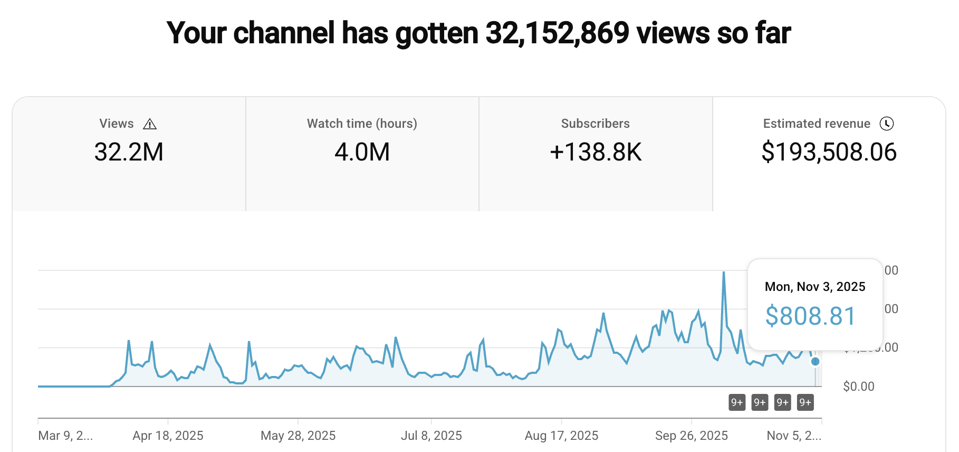
On March 9, 2025, Smith launched a new faceless channel with zero subscribers. Ninety days later, the revenue screenshot shows the channel had earned $36,000—and has since brought in more than $193,000 total. Current earnings? Between $800 and $1,000 per day, with 138,000 subscribers and 32 million views. He did it all without showing his face or using his voice.
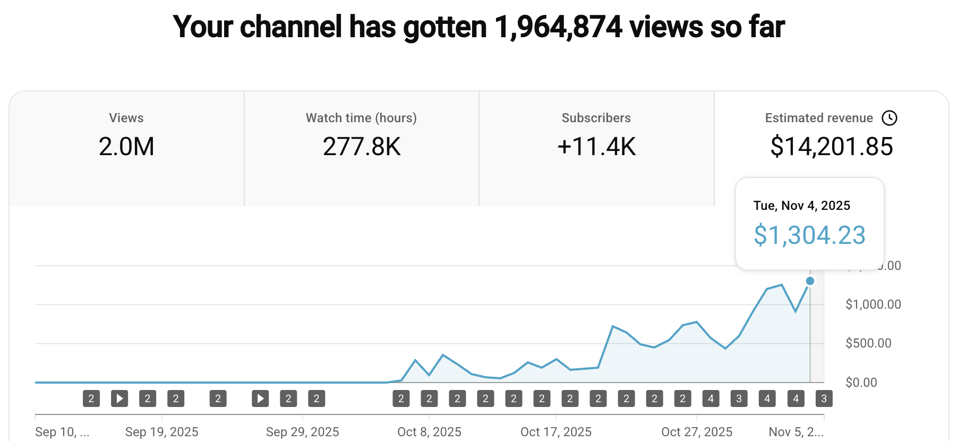
Then he did it again. On September 10, 2025, Smith started a second channel from scratch. By early November—just eight weeks later—it had generated $14,201 in lifetime revenue, with daily earnings hitting $1,304.
If you're new to faceless YouTube, you probably won't see numbers like those right away. But you can work toward them using Smith's system, which he's refined through years of testing.
A snapshot of Smith’s faceless YouTube portfolio
Smith shared performance data from five of his 22 channels, including the two launched in 2025. When he sent me this data, I stared at it for a solid 10 minutes. Then I created a table and labeled each channel by its development stage.
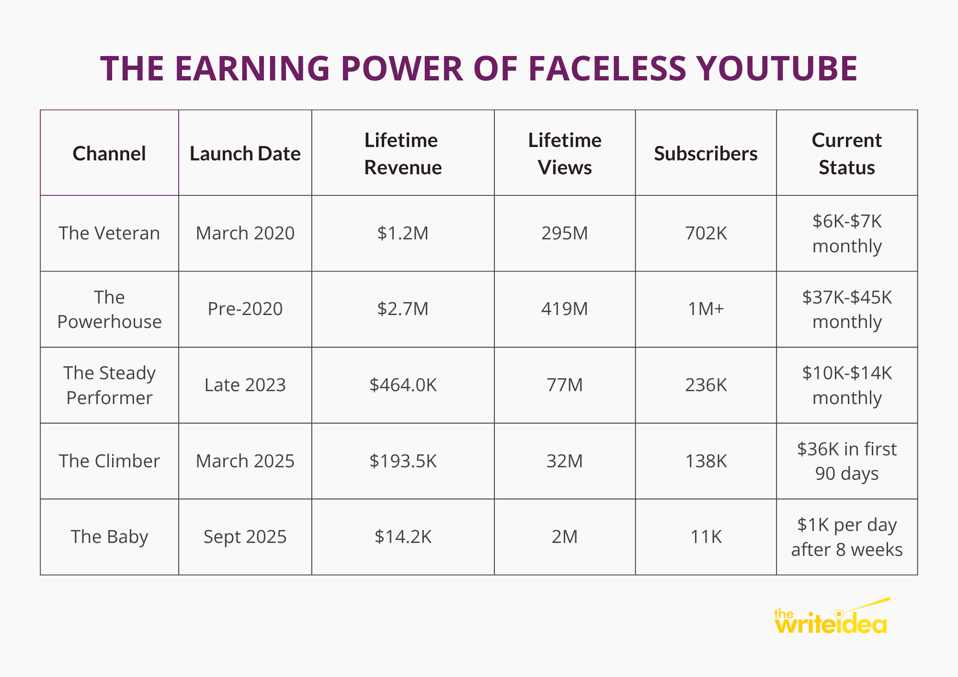
What stands out? Consistency. Look at the Veteran and Powerhouse channels, both launched more than five years ago. They're down from their peak earnings, sure, but they still generate steady monthly income, enough to fund retirement savings, reinvest in the business or take one dream vacation to Bora Bora a year.
You won't reach Smith's level through wishful thinking, though. It takes work, so let's break down the repeatable parts of his system.
The system: How to approach the first 90 days
Smith's work begins with research and testing. "The first 90 days are all about data and direction," he says. "I choose topics, test and then watch the signals—click-through rate and watch time. I adjust based on those metrics and scale up production once I know what's resonating." Notice that he doesn’t guess what might work or hope the algorithm will smile on him. He watches what people actually do when they land on his videos, then does more of that.
Start by choosing one broad niche and eight to 10 sub-niches under it. For example, if your main niche is finance, your sub-niches could include credit repair, budgeting, investing basics, side hustles, debt payoff and tax strategies. Test each sub-topic by posting two to three videos for it. Keep production quality consistent across all of them; you want to know whether the topic works, not whether one video got lucky because of a better thumbnail.
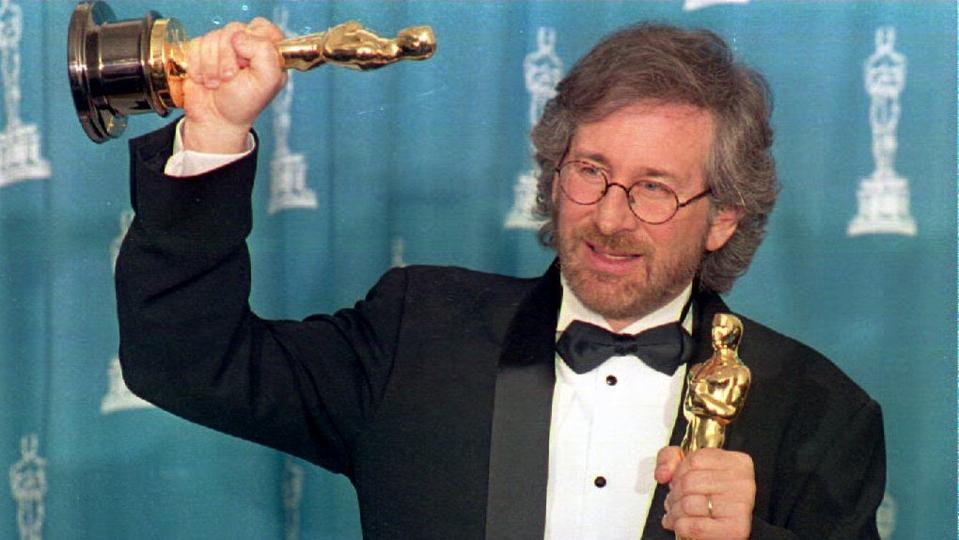
Nim Stant, CEO of International Impact Book Awards, emphasizes what many creators miss: Thumbnails and titles matter most. "Nobody wants to hear that because it's not sexy," she says. "You can have Spielberg-level content, but if people don't click, it may as well be invisible." She’s right—it’s not sexy, but it’s the difference between views as scrolls. The best production quality in the world means nothing if viewers never click in and view the content.
She's glad creators are finally treating YouTube as a long-term asset rather than a quick-hit platform. "YouTube's like a compound interest account—every video keeps working while you sleep," she says. That's the power of evergreen content. One strong video can generate views and revenue for years.
Once Smith figures out which sub-niches earn clicks and hold attention, he stops thinking about one-off videos and starts building content "lanes"—topics deep enough to cover with dozens of videos. He evaluates each potential lane with four questions. Yes, they’re boring, practical questions, but they are the ones that matter:
- Will people still care about the topic in six months?
- Can you create dozens of videos without repeating yourself?
- Do advertisers value this audience? You want niches with strong RPM—revenue per 1,000 views—which can range from $2 to $20 or more.
- Can you publish consistently without jumping into or chasing trends?
If nothing performs after testing, he abandons that niche. But the winners are usually evergreen: financial education, home maintenance how-tos, and other practical life skills people will always need.
Building the team: A must if you want a real faceless YouTube business

If you stopped there, you could build a decent side hustle. But Smith wanted a company, which meant he couldn't handle all the production himself. He hired scriptwriters, voice actors, editors and thumbnail designers. "You can outsource execution, but never vision," he says. "My team turns ideas into videos quickly. I study analytics, identify what's working and scale what succeeds."
For small business owners and solo creators, "team" doesn't mean a studio full of employees. It might mean one freelance editor who handles your footage once a week, a contractor who creates thumbnails once you've found a format that works or a writer who turns your outlines into scripts.
How AI fits in faceless YouTube: assistant, not CEO
When I asked Smith about AI, he didn't talk about replacing people—a common comment and fear these days. He talked about getting rid of bottlenecks. "AI is an enhancer, not a replacement," he says. "The real power is in speed and precision." But don't let AI override your judgment about what audiences actually want to watch. AI should accelerate the thinking you were already doing, not think for you. That distinction matters more than you might think.
Del Andujar, who runs the gaming channel MooPlays, uses AI for tedious production work—drafting titles, summarizing transcripts and editing videos. "Over the past year, faceless YouTube has really taken off due to AI," he says. His channel focuses on gameplay walkthroughs and gaming tips, content that needs quick turnaround to stay relevant. The AI tools he uses handle repetitive tasks so he can focus on ideas and pacing. "Giving your viewers regular content is essential if you want to earn from your channel," he says. "AI shortens the gap between idea and upload."
Your 90-day faceless YouTube channel launch plan

Smith’s blueprint is simple. Not easy, but simple. If you’re starting from zero today, here’s what your first 90 days could look like.
Weeks 1 and 2: Launching your faceless YouTube channel
Start by studying 10 successful channels in niches close to what you want to cover. What formats perform? What titles get clicks? What thumbnails stop the scroll? Take notes—you're looking for patterns you can repeat.
Next, pick your main niche using Smith's criteria. Look for topics that stay useful for months or years, not weeks. A tutorial like "how to fix a leaky faucet" will matter long after this week's celebrity drama disappears.
You also want depth—topics that can support dozens of videos without running dry. Home repair, sleep and energy, small-business systems, even learning a new language, are all examples of wells, not puddles.
Finally, look for earning potential. Some topics generate far more revenue per 1,000 views than others. Niches that help people make or save money, protect their homes and solve painful problems get paid more for ads than pure entertainment does.
Once you've chosen your main niche, identify eight to 10 sub-niches to test. For instance, if you pick home repair and maintenance, your sub-niches might include quick plumbing fixes, basic electrical safety, seasonal home checklists, landlord how-tos, tool basics, moisture and mold prevention, and even "before you call a contractor" guides.
Then set up your channel with simple branding, with just a basic banner and profile image. Don't get fancy yet. You're building to test, not to impress.
Weeks 3 and 4: Assemble your first tiny faceless YouTube team
Even if you're bootstrapping, Smith recommends delegating at least one task. For most creators, that's editing. A solid video editor will turn your raw footage and voiceover into watchable content, giving you time to focus on strategy, titles and data.
Bring in extra support as your budget or revenue allows:
- A scriptwriter who turns your ideas into structured, audience-friendly scripts.
- A voiceover artist—AI or human.
- A thumbnail designer who knows what gets clicks.
You don't need to create a full production studio in a month. Just start handing off tasks that others can handle as well as you can.
Months 2 and 3: Testing your faceless YouTube strategy

Publish eight to 10 videos across your different sub-niches. Aim for two to three videos per week. Create multiple ideas and scripts at once so you stay ahead of production.
Track two metrics closely: click-through rate and watch time. After 15 to 20 videos, Smith says, one or two sub-niches will show themselves as winners. Cut what isn't working and focus resources on what is.
The hard truth is that when creators fail, it’s often because they didn’t stick with it. They published a few videos, saw weak results and quit. Or they stayed attached to a losing niche because they loved the content. Don’t be like them. Be like Smith, who stays detached, focusing on analytics, not feelings.
Month 3: Growing your faceless YouTube channel
Choose your winning topic based on the data. If "before you call a contractor" videos outperform everything else, commit to that niche. You’re now the owner of a channel that helps homeowners make smarter repair decisions.
Publish more often. Move toward three videos a week if you're not there already. Remember the Hobby Crafting channel? It posts a new video every single day, and that steady rhythm drives its growth.
Update your titles based on click-through performance. YouTube Studio lets you A/B test title variations on the same video, so use it. Do the same with thumbnails. Replace weak-performing thumbnails based on what's earning clicks.
Finally, build your content calendar for the next 30 days. Plan two to three weeks ahead so you're never scrambling to create under pressure.
One last thing about Smith, you and faceless YouTube…

Here's what stands out in Smith's story: He didn't wait for perfect conditions. He didn't have some secret advantage. He just started, tested and refused to quit when the first few ideas flopped. Now he's running 22 channels that bring in more money than I'd ever know what to do with. (Not really, but you know what I mean.)
And the best part? You don't need to be an expert, a celebrity or even particularly charismatic to make faceless YouTube work. You just need the willingness to start, the discipline to build a system and the patience—and determination—to follow the data. The technology exists. The audience is waiting. If you've been wondering whether there's room for you in the creator economy, there is. You just need to begin.