As Bethlehem Area School District begins a redistricting process that could lead to redrawing boundaries or consolidating schools, the future of Thomas Jefferson and William Penn elementary schools is top of mind for some community members.
District officials emphasize that no decisions have yet been made, but a history of deferred facility maintenance and a recently released capital improvement plan that says the future of the Thomas Jefferson and William Penn buildings is “still pending” has some questioning how the two schools will be treated as consultants develop scenarios for the school board to consider.
“The language in the Capital Improvement Plan reflects that the District had begun initial planning for Thomas Jefferson and William Penn, but that their long-term future has not yet been determined. As noted in the plan, these projects are part of a larger list of facility needs that require ongoing review, discussion, and future investment,” Bethlehem Area Chief Facilities Officer Mark Stein said in a statement.
“This year, the District included updated cost estimates for both buildings to provide decision-makers with relevant information for long-term facilities planning. The ‘still pending’ language should not be interpreted as a predetermined outcome or an indication that either school has been targeted for a particular decision. Both buildings, like all of our facilities, are part of the broader District Design process, which is intended to take a comprehensive look at our facilities, educational needs, and long-term priorities. No scenarios have been developed, and no decisions have been made about any schools.”
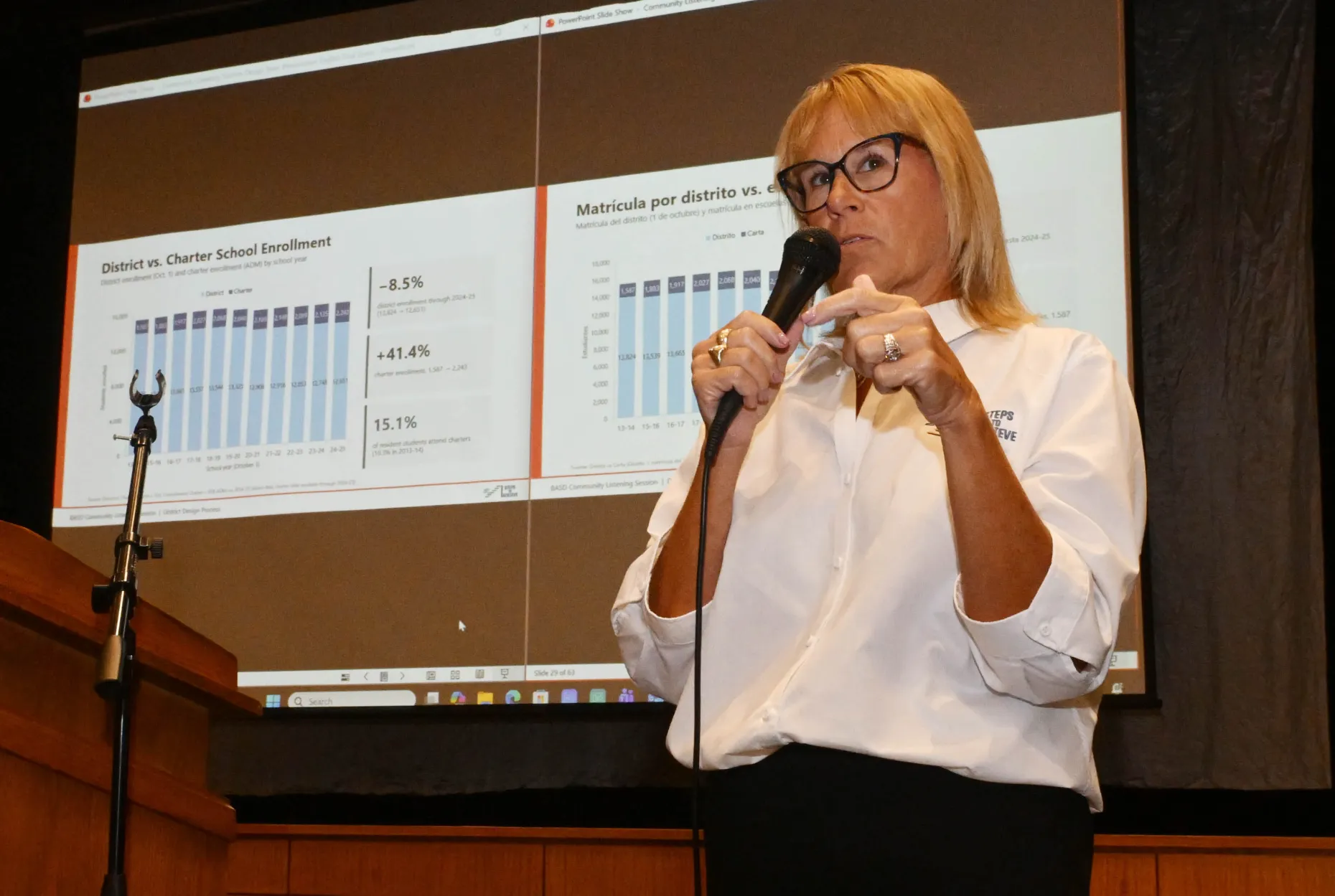
Educational consultant Jane Coughenour facilitated five listening sessions last week, with more public meetings anticipated between December and April.
The project timeline would see potential future scenarios presented to the school board by April, with board review and approval coming by September.
“The timeline shared during the community sessions represents the anticipated process and key milestones. As with any comprehensive planning effort, the timeline may be adjusted as the work progresses and additional information is reviewed,” Superintendent Renato Lajara said in a statement.
“The District wants to ensure the Board has the information it needs and that the community has ample opportunities to participate. We do not want to rush a process of this importance simply to meet a date on a calendar.”
Concerns about methodology
Three district parents organized a group called BASD Community Voices and gathered more than 100 signatures on an open letter that argues more information is needed to compare the long-term operating costs of all Bethlehem Area schools and to account for the full financial and neighborhood impacts of closing schools before the district narrows its future options.
“For several years, BASD has publicly discussed the future of Thomas Jefferson and William Penn Elementary schools, including potential renovation, replacement, consolidation, and closure scenarios, while acknowledging uncertainty about the best path forward. As a result, these schools entered the District Design Process with greater public attention and speculation than other schools,” the letter reads.
“BASD has since presented select building repair and upgrade costs alongside enrollment figures presented as measures of utilization without a complete financial comparison or context. Taken together, this has contributed to a growing public perception that closing Thomas Jefferson and William Penn is a fiscally responsible choice, even though BASD has not explicitly stated that conclusion. The information presented to date does not establish that conclusion, and a complete analysis later cannot undo the public impression created by incomplete information today.”
Schools that need major infrastructure investments now might not be the schools that are the most expensive to operate long term, BASD Community Voices parent organizer Dan Sobrinski told The Morning Call, calling for a wider lifecycle analysis of each school that would take into account past and future costs and include factors such as transportation expenses.
The “financial reality facing the district” is on leaders’ minds, school board President Michael Faccinetto said in a statement.
“There are significant capital needs across BASD, and the funding available to address those needs is limited,” Faccinetto said. “As we look at the future, we must consider facility investments alongside budget pressures, enrollment, and the educational needs of our students.”
Faccinetto pushed back at the perception that the district has neglected facilities at Thomas Jefferson and William Penn, saying Bethlehem Area’s annually updated facilities plan “uses actual building data to help prioritize renovations and investments based on need.”
“The District has renovated or replaced facilities in that order, with Nitschmann Middle School among the most recent major projects and Fountain Hill Elementary School currently undergoing a significant replacement with a new school being built,” Faccinetto said. “Thomas Jefferson and William Penn are among the next facilities requiring substantial investment and long-term planning.”
Assessing neighborhood impact
Closing walkable, urban schools on Bethlehem’s North Side would be repeating the mistakes of the district’s last large realignment, a 1990s effort that saw elementary schools embedded in South Side neighborhoods close, Sobrinski said.
“Those decisions have consequences, and those consequences have lasted generations,” Sobrinski said.
Lajara said the team working to assess future options recognizes that past district decisions “can leave lasting impressions on communities, and we understand why residents who experienced the last major district redistricting approximately 35 years ago may have concerns about the current process.”
“We also recognize that schools are more than buildings,” Lajara said. “They are important parts of their neighborhoods and communities, and factors such as walkability, accessibility and the connections families have to their neighborhood schools are important considerations in any discussion about the future of our district.”
Audience members at the Nov. 5 listening session at Nitschmann Middle School echoed the concerns BASD Community Voices raised about the impact a school closure could have on city residents.
Calling schools “the center of community,” Bethlehem Area parent Heidi Shilanskas told The Morning Call that the district must consider how families in need receive assistance if it is considering closing sites that house additional resources such as food banks.
“My concern is equity — making sure all kids have access to quality education no matter where they live,” said Shilanskas, a parent of a fifth grader at Calypso Elementary and a ninth grader at Liberty High.
Lajara said the district’s community schools serve important roles beyond the traditional school day, providing valuable resources and connections for families.
“Those services and partnerships are an important part of the conversation as we consider the needs of our students and communities,” Lajara said.
“While no scenarios have been developed and it would be premature to speculate about potential outcomes, one thing remains constant: the needs of our students and families will continue to be a priority. Regardless of what the District Design process ultimately determines, we remain committed to ensuring families have access to the resources, services and support they need.”
Sara Satullo, Bethlehem’s deputy director of community development, used her public comment during the Nov. 5 listening session to talk about how schools drive development in the city. She noted that the city’s Northside Alive neighborhood revitalization project, which kicked off in 2018, had worked with the school district to look at enrollment trends around Thomas Jefferson and William Penn.
There were parents who reported that facility maintenance issues at those sites had motivated them to choose charter schools, Satullo said, but she also told The Morning Call “the parents that send their kids there are fiercely proud of the schools. They see them as a true community asset, like a third space.”
The city has been working to improve transit routes for pedestrians, and district efforts to balance enrollment could be an opportunity to give more students the “amazing, walkable neighborhood school” experience that her own children have at Calypso, Satullo said.
“I would much rather see them redraw the lines before closing any schools and consolidating them, and I think that should be the first thing on the table,” Satullo said.
Falling enrollment
The data presented at the listening sessions emphasized changing patterns in district enrollment.
Overall district enrollment has dropped by 1,780 students, or 12.9%, from the 2013-14 school year. The listening session presentation did not include future enrollment projections, but did highlight how some selected populations have shifted in that time period.
Since the 2013-14 school year, the district, which enrolls 12,044 students, saw its special education enrollment grow by 350 students, a 17% increase that means 1 in 5 BASD students now receive special education services.
The English learner population also increased. Currently at 1,073 students, that level is nearly a 25% increase from 2013-14 but is down from a peak of 1,245 in 2024-25.
As district enrollment has fallen, charter school enrollment has grown. Between the 2013-14 school year and the latest available data from the 2024-25 school year, charter school enrollment of students who live within Bethlehem Area’s boundaries rose 41.4%, increasing from 1,587 students to 2,243 students.
The listening session presentation includes enrollment breakdowns for each BASD school. See the full presentation below: