“I’m only here for one night!” I lamented, even before the piercing midday heat forced me to peel off layers of extra clothing. My guide Chady laughed amiably while Johnson started the engine without a word – neither quelled my fear that one afternoon and one morning wasn’t enough to fully savour the Samburu Ecosystem.
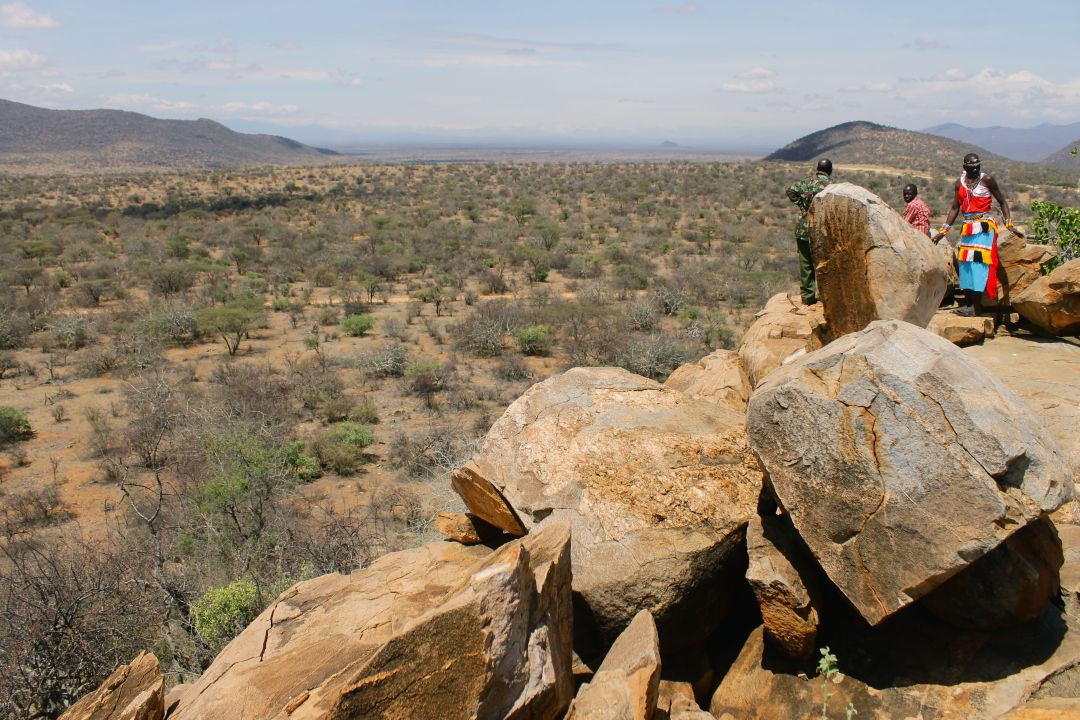
At exactly noon the very next day, bearing news that my return flight from Nairobi would be another 20 minutes late, Chady announced that he was tired of waiting. “I’m going to climb that peak,” he said, pointing at a high outcrop of sharp rocks rising from the chalky dust between river acacias. Even though I was crouched in the last spot of shade in the open-top vehicle, I jumped at the opportunity to feel and be a part of the enchanting landscape for one last time before I left. We got closer, I wondered how I could’ve missed the monolith when we left the Oryx airstrip in Samburu for Sarova Shaba Game Lodge only 24 hours ago.
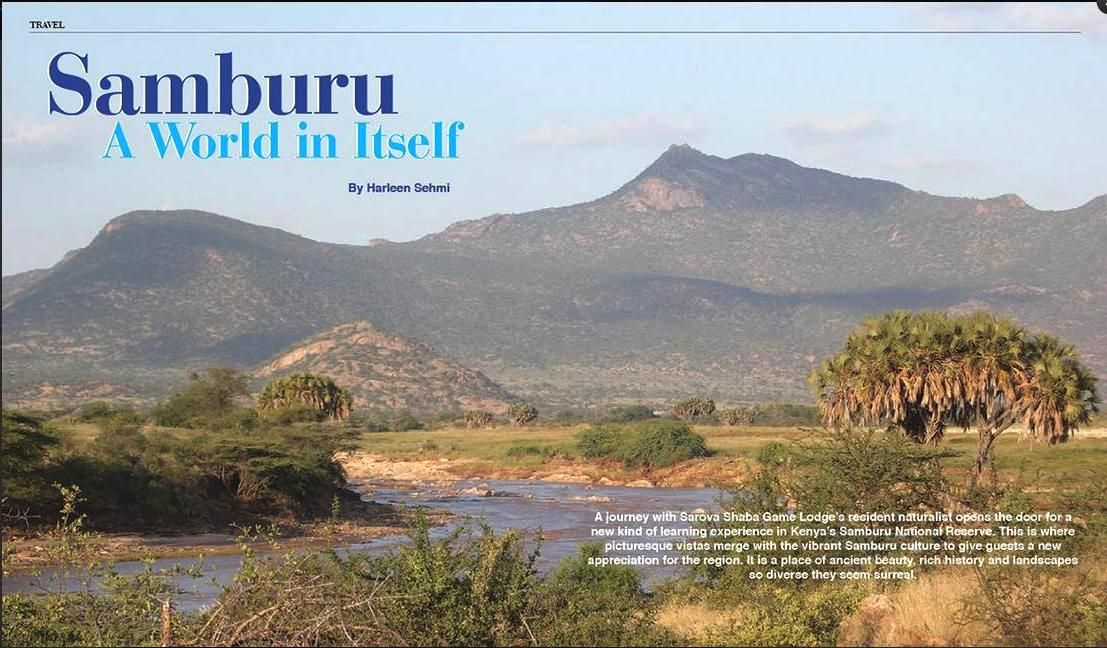
But compared to the imposing hills and mountains encompassing the sandy river acacia-strewn plains, this odd stack of jagged rocks is a rather small, but not insignificant, landmark on this magnificent semi-arid topography. We are in the Samburu National Reserve, and despite the breeze rewarding us for our short hike up, I’m already missing the serrated skyline of Shaba’s peaks – especially the craggy mountain whose gulleyed cliff had captivated me the minute it came into view once we were in the reserve.
It’s clearly visible from Sarova Shaba Game Lodge, where Chady indulged my curiosity about the magnificent landscape during the nature walk and revealed that the summit is currently a military training base for the British army, which frequently tests its ammunition against the mountain’s walls. “It’s called Lepindera in Samburu, because it’s high like a flag,” he said, using the Kiswahili equivalent, bendera, to aid my understanding. I struggled to jot down the names and various uses of the plant as he easily spewed out Latin names of the plants and trees on the botanical and historical tour of the Shaba ecosystem.
Somewhere hidden
He’s the lodge’s resident naturalist and not only does he know how the plants have been incorporated into the way of life of his Samburu people, he also deeply admires it. Chady started off our trail around the premises with the fascinating idea that all ecological relationships are planned by nature. “Everything is interdependent,” he declared, and went on to explain how the fruit of the ubiquitous doum palm only ripens in the seasons when the local communities need it most. At the core of the fruit lies a hard seed that can be crushed and mixed with milk to provide the same energy as a full meal.
The tall trees line the brown Uaso Ng’iro, the region’s seasonal river, and are prevalent where groundwater is plentiful. With the high water table, the waving fronds of the palm are not only a familiar feature of the landscape, but a crucial part of the nomadic lifestyles of the tribes in the northern parts of the country. But the large quantities of water below the dusty surface also manifest in the springs and streams that course through Shaba, and the lodge itself.
We turned away from the river and were getting closer to the source of the spring from which the pools and streams punctuating the property originate. The mighty Lepindera was to our backs as we retreated inwards. Cooler under the shade of the palms and other trees thriving in the area, I was able to peer into the gently flowing streams and see the twigs and small stones on shifting on the bed. The water is impeccably clear. Sarova Shaba Game Lodge treats this water in an in-house reverse-osmosis plant, and it is also used to irrigate the staff-run kitchen garden, which we see as we loop the grounds of the lodge.
Chady stopped at a massive umbrella acacia twisting out of a clearing fenced off by drying shrubbery, and I followed the branches as they snaked their way up and out. Apart from a few rays of warm sunlight sneaking through the ancient tree’s topmost branches, the area is dark, cool and – most importantly – secluded. When Samburu boys have undergone circumcision, they are sent away from the homestead and kept away from women. As many as 15 morans-in-the-making will collect meat and other food, and live together in such a secluded place until their supplies run out. “This is a perfect Loikar,” said Chady, translating the Samburu name to somewhere hidden. “Also, the tree is high enough to hang the meat from, no animals can reach it before us – except for a leopard, maybe,” he added casually.
Celebrating a rich history
Marriage for Samburu morans only comes after they have matured enough to “handle a woman”, according to Chady. I was curious about the protocol for finding a spouse, and as Chady described the lengths to which an eligible youngster will go to ascertain the good reputation of his or her potential spouse, I was surprisingly reminded of my own culture’s practices. “If the woman of interest lives 300 km away, you will take a companion and make the long journey. When you get there, you have to ask people around about her and her family – but you can’t blow your cover!” Once sufficient background research has been conducted, elders in the family can take the matter forward.
After supper, I attended Chady’s routine PowerPoint presentation on the intricacies of Samburu culture, which added the vivid photographic images to my idea of the people whose home and way of life I’d heard about and seen that whole afternoon. I learnt that apart from the change in beaded head gear, a woman will replace the sticks she wore in her ears as a girl with copper rings to denote her altered marital status. She will also bear the mporo marriage necklace on top of her other beaded ornaments. The mporo beads are rooted in the cultural forms and social relations of both the Samburu and Rendille pastoralists, and the symbolic necklace also relies on the bristle of a giraffe tail or dyed doum palm fibres for its functional beauty.
We also managed to catch a glimpse of the lodge’s specially designated L’kuroto area reserved for a Samburu dance performance and cultural talk for guests. Although it was being used by a conference group, I could easily imagine the space alive with the young Samburu men and women jumping in sync with their thin sticks in hand. Interestingly, Samburu music relies less on musical instruments and more on the chorus of its people. Brandishing small flame torches, the same dancers will form a colourful chain and lead guests over the streams and pools to the other side of the lodge, where a full meal for over 100 has been set under the stars. In this grassy clearing, guests can arrange for additional music while the dancers continue their performance against the backdrop of a typical Samburu hut and ancient greying doum palms.
The lodge provides guests with the modern amenities to which they are accustomed, but it also carefully weaves the history of the land and its people carefully into the overall experience. The “Born Free” legacy credited to the conservation efforts of George Adamson arises from the fact that one of his fly camps on the banks of the Uaso Ng’iro is situated on the property. In fact, the spring pool in which he bathed still drains into the river flowing outside the lodge’s electric fence, and is yet full of clear water making its way to the Lorian Swamp where the brown river drains.
And even though the staff belong to different ethnicities with histories of their own, they all come together to turn a stay at Sarova Shaba Game Lodge into a colourful and immensely educational journey across cultural borderlands. Moments before we left for the airport on my last morning in Shaba, Wilfred from the Surpelei Restaurant joined Chady to demonstrate the catch-and-release activity available within the premises. Painstakingly, they eased the stiff wire into the rod and after two tries, removed it from the pond with a large common karp thrashing at the hook. “I’m much better at tending livestock,” joked Chady, whilst Wilfred unhooked the fish and returned it to the water.
Losing Lepindera
Shaba is considered to be the gateway to Kenya’s harsh Northern Frontier and the National Reserve’s difficult conditions made the perfect setting for the competitive reality television show Survivor in 2001. The lodge has incorporated the ethos of this challenge into its team-building activities, offering mountain scaling and a trekking through a gorge at the end of which a bush dinner on the river bank awaits the team. I was desperate to try this out, but my tight schedule didn’t allow; instead we opted for a late afternoon game drive through Shaba National Reserve – giving me more than enough time to feast my eyes on my favourite Lepindera, whose rocky face took new forms as we moved closer and closer.
After coursing easily over the sandy roads with mounds of murram waiting to be spread over them, we finally arrived at the viewing point where a few reticulated giraffes munched placidly on acacia leaves. Dark clouds covered part of the sky, and I anticipated some rain but Chady quickly settled my suspicions, informing me that after the long rains that ended in the middle of May, only the higher regions of Samburu will receive rainfall for a few weeks in July.
By the time we made our way back to the lodge, the grooves in Lepindera’s face were hidden in the shadows and the mountain was a silhouette against the darkening sky - a stark reminder that a third of my time here had elapsed. As we crossed the river now shining like mercury in the last light of the sun hidden behind silver clouds, I was already working out how best to utilise the morning before my flight returned me to the cold and congested capital. “It all depends on how early you can wake up,” advised Chady.
Challenge accepted. Having witnessed the magic of Shaba by dusk, I longed to capture the topography as it woke up to a bright new day so I set my alarm for 4.30am – a rather ambitious endeavour. Eventually the humidity pushed me out of bed and onto the river-facing bench just a short walk from my room, and I watched Lepindera morph from a dark jagged mound against the lilac sky into the towering craggy flag of a mountain.
But it was far behind us when we crossed the tarmac Nanyuki-Isiolo road, and turned left into the small town of Archer’s Post beyond which the Samburu National Reserve gate lay. Replacing the iconic peak on this side of the highway are the Matthews Range and the sacred Ololokwe or Sapache, meaning the mountain with a big rounded head in Samburu. The journey from the lodge to the Oryx airstrip takes 45 minutes but we left Sarova Shaba Game Lodge early enough to cram a game drive at the adjacent reserve.
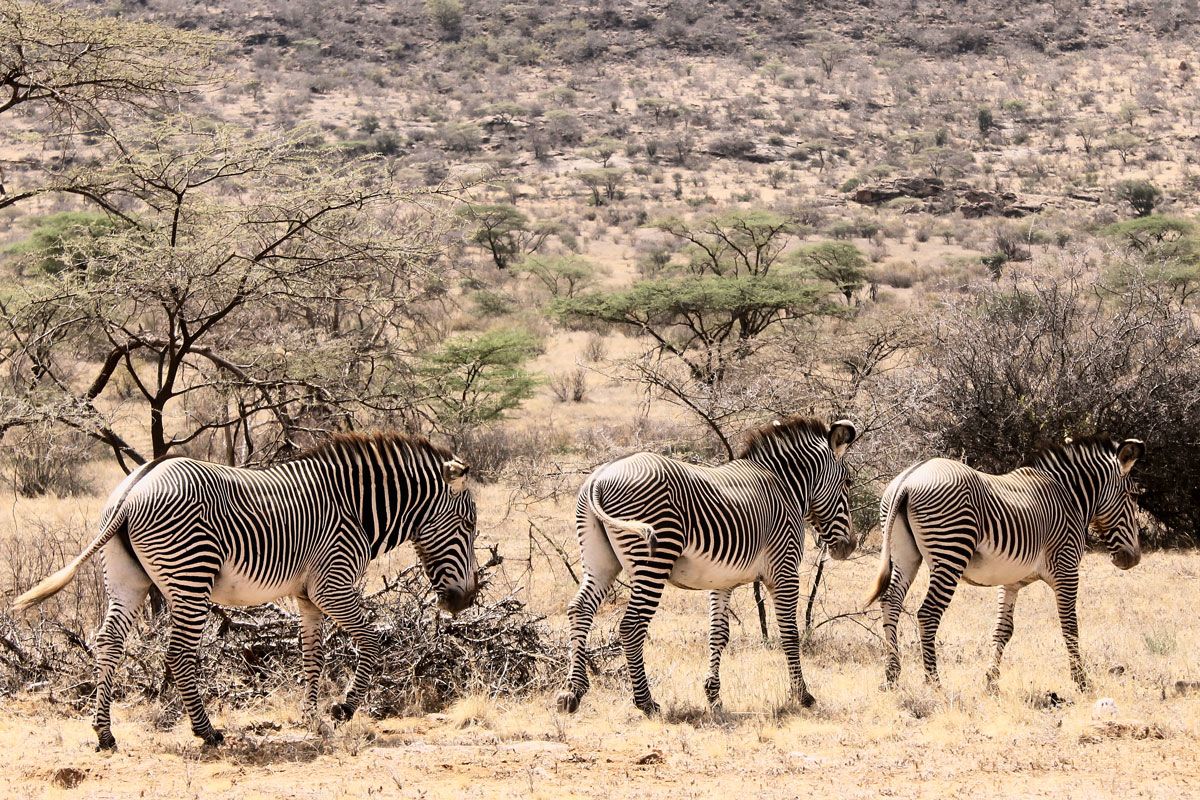
In roughly an hour, Johnson and Chady pointed out more game than we saw in Shaba the day before, including a maneless lion that chased some baboons up an acacia. Spotting a herd of elephants in the distance as we neared a wide river bank, Chady exclaimed, “Welcome to our showground!” Some male oryx had locked horns and impalas bounded between the water’s edge and the shrubs while guinea fowl scuttled between their hooves. When we got to the elephants, I was delighted that a seven-month-old calf was a member of the herd and I clicked my camera continuously until Johnson drove off so that we weren’t only a risky two metres away from them.
Pleased that each of the Samburu special five had crossed my path as I briefly traversed their territory, I still felt as if I was leaving too early. So when Chady proposed a vertical expedition for a panoramic view of the topography (and cellphone coverage) – I couldn’t refuse. On my way down, I picked three small quartz stones scattered at the foot of the precipice and rolled them around in my fist as I boarded the plane. Samburu and Shaba had kept a piece of my heart and I needed to keep a piece of the place too.